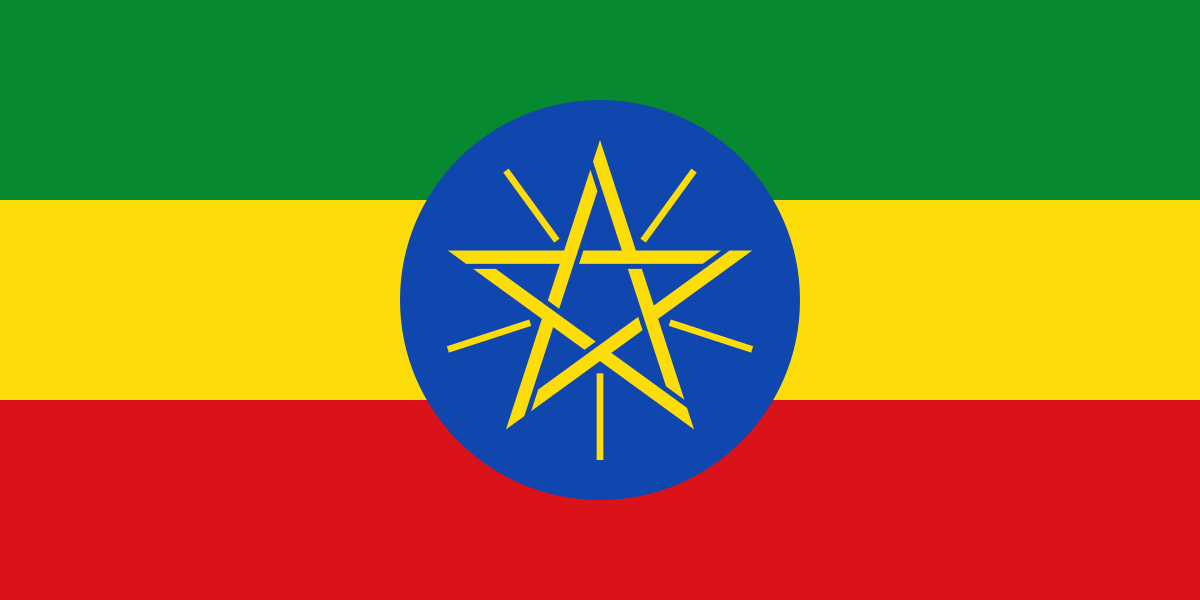
The Federal Democratic Republic of Ethiopia is an African country.
It shares borders with Eritrea to the north, Djibouti to the northeast, Somalia to the east and southeast, Kenya to the south, South Sudan to the west, and Sudan to the northwest.
As of 2023 the country’s population was 107,334,000, making it the 13 most populated country in the world and 2 most populated in Africa after Nigeria.
It covers a land area of 1,112,000 square kilometres (472,000 sq. miles).
Ethiopia is multi-ethnic with over 80 different ethnic groups. Oromo and Amhara are the country’s two largest ethnic groups.
Christianity is the most widely professed faith in the country. The country has some adherents of Islam and other faiths.
Regions
Ethiopia is administratively divided into four levels: regions, zones, woredas (districts) and kebele (wards).
The first level administrative division in Ethiopia is a region, also called kilil, or alternatively regional state.
The 1995 Constitution of Ethiopia established the regions based on ethno-linguistic territories.
The country comprises 11 regions and two city administrations under these regions, many zones, woredas and neighbourhood administration: kebeles.
Previously, this level was called a province, and though many of the old province and new region names are the same, the entities are not identical and the words region and province are not interchangeable. As of 2022 there were eleven regions.
The regions and their capitals in Ethiopia are as follows:
Addis Ababa (City) …. Addis Ababa
Afar Region … Semera
Amhara Region … Bahir Dar
Benishangul-Gumuz Region … Asosa
Dire Dawa (City) … Dire Dawa
Gambela Region … Gambela
Harari Region … Harar
Oromia Region … Addis Ababa
Sidama Region … Hawassa
Somali Region … Jijiga
South West Ethiopia Peoples’ Region … Bonga
Southern Nations, Nationalities, and Peoples’ Region … Hawassa
Tigray Region … Mek’ele
Zones
Regions are subdivided into zones. The number of zones varies, but most regions have around six to twelve zones.
The largest region Oromia has over 20 zones, and the two smallest regions have none.
There are some cities which are set up as “special zones”, such as Bahir Dar Special Zone in the Amhara Region.
The earlier equivalent to a zone was called an awrajja, and many zones today are named the same as their earlier awrajja, but the terms zone and awrajja are not interchangeable.
Woredas
Zones are divided into woredas (districts). In Ethiopia, the woredas comprise three main organs: a council, an executive and a judicial.
The Woreda Council is the highest government organ of the district, which is made up of directly elected representatives from each kebele in the woredas.
The representative of the people in each kebele is accountable to their electorate.
Kebele
Woredas are divided into kebele, municipalities. Each kebele comprises around 20 smaller villages.
Kebele is the smallest administrative division. This is sometimes also called tabia or tabiya. They are at the neighbourhood level and are the primary contact for most citizens living in Ethiopia. Their administrative unit consists of an elected council, a cabinet (executive committee), a social court and the development and security staff. Kebeles are accountable to their woreda councils and are typically responsible for providing basic education, primary health care, agriculture, water, and rural roads.
List of insurance companies in Ethiopia The insurance companies in Ethiopia are: Africa Insurance Company S.C Awash Insurance Company S.C Global Insurance Company S.C. Lion Insurance…
Date of establishment of banks in Ethiopia Banks in Ethiopia and their dates of establishment Awash International Bank Established Date: 1994 E.C. Commercial Bank of Ethiopia Established Date: 1963…
Insurance companies in Adamawa The insurance companies in Adamawa State are: 1 Kapital Insurance Company Ltd.30 Atiku Abubakar way, Sabru House 2 Lion of…
Banks in Ethiopia and number of their branches Ethiopia banks and their branches Awash International Bank Number of Branches: 180 Commercial Bank of Ethiopia Number of Branches: 644 Development Bank…
Top Banks in Ethiopia by number of branches Leading Ethiopia banks according to number of branches ① Commercial Bank of Ethiopia Number of Branches: 644 ② Hibret Bank Number…
EDO SECONDARY SCHOOLS. LGA, NAME OF SCHOOL, ADDRESS, DATE APPROVED LGANAME OF SCHOOLADDRESS DATE APPROVEDLGANAME OF SCHOOLADDRESS DATE APPROVEDAkoko EdoAlafin CollegeAtte, Akoko Edo2008Akoko EdoAnglican Science CollegeIgarra2002Akoko EdoApex CollegeJames Ayogun Road2003Akoko EdoBuntina Secondary…
Phone numbers of banks in Ethiopia Banks in Ethiopia and their phone numbers Awash International Bank Phone+251 116 62 78 28 Commercial Bank of Ethiopia Phone+251…
NDIC, Nigeria Deposit Insurance Corporation story The NDIC (Nigeria Deposit Insurance Corporation) is an independent agency of the Federal Government of Nigeria. The purpose of the deposit insurance…
List of Lagos industrial estates with location, size (in hectares) & year of establishment Lagos industrial estates’ location, size (in hectares) & year of establishment LocationSize (hectares)Year of establishmentApapa1001957Ikeja1801959Ijora1601965Oshodi/Isolo1201968Ogba (Agege)1501961Agidingbi (C.B.D. Ikeja)971969Ikorodu15821981Badiya151958Ilasamaja601971Abesan/Ipaja1001981Akowonjo501976Matori (Mushin)1201958Ilupeju1101962Iganmu801965Amuwo Odofin2001969Oregun1001981Gbagada501958Surulere201976Oyadiran…