FG Gives HR Personnel 12 Months to Obtain Professional Certification: See the Circular Attached
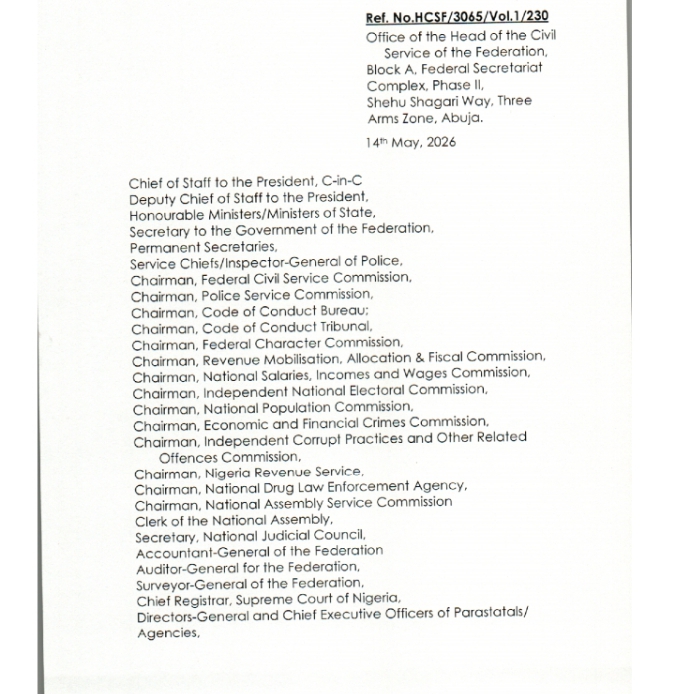
The Federal Government has introduced a new policy requiring human resource personnel in the Federal Civil Service to obtain recognised professional certifications within a 12-month transition period. The directive, issued through the Office of the Head of the Civil Service of the Federation (OHCSF), is part of a broader reform agenda aimed at strengthening professionalism, accountability, and competence within Nigeria’s public sector workforce.
According to the circular signed by the Head of the Civil Service of the Federation, Didi Esther Walson-Jack, the policy establishes clear certification standards for officers occupying HR-related positions across Ministries, Departments, and Agencies (MDAs). The reform also outlines deployment conditions and transitional arrangements for administrative officers currently serving in HR roles.
The government explained that the move is connected to ongoing efforts to professionalise human resource management in the civil service and align Nigeria’s public administration with international standards. The initiative builds on earlier circulars released in 2023 and 2024 concerning the restructuring and modernisation of HR practice in the Federal Civil Service.
Under the new policy, only certifications obtained from approved professional bodies will be recognised by the federal government. These include the Chartered Institute of Personnel Management of Nigeria, the Chartered Institute of Personnel and Development, the Society for Human Resource Management, the Human Resource Certification Institute, and the Chartered Professionals in Human Resources. The OHCSF also reserved the right to approve additional certification bodies when necessary.
The circular broadly defined HR functions within government institutions to include workforce planning, recruitment, onboarding, employee records management, training and capacity development, staff welfare, industrial relations, disciplinary administration, compensation management, and exit procedures. Officers handling such responsibilities are expected to comply with the certification requirement before the expiration of the grace period.
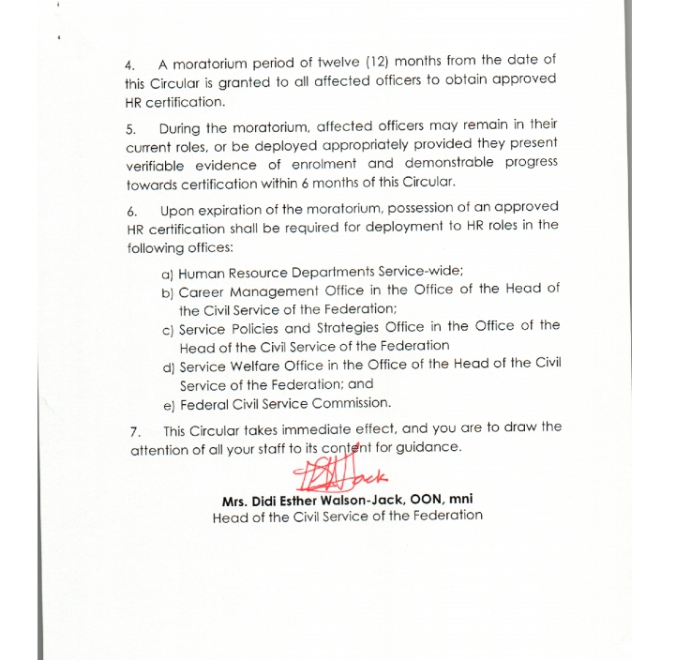
Government authorities granted affected officers a one-year moratorium beginning from the effective date of the circular. During this transition period, employees may continue serving in their current HR positions if they can provide evidence that they have enrolled for an approved certification programme and are making measurable progress toward completion within six months.
After the moratorium expires, only officers with approved HR certifications will be eligible for deployment into HR departments and related strategic offices within the civil service. These include the Career Management Office, the Service Policies and Strategies Office, the Service Welfare Office under the OHCSF, and the Federal Civil Service Commission.
The policy has been widely interpreted as a significant shift in the structure of public sector human resource administration in Nigeria. Officials believe the reform will improve efficiency, promote merit-based deployment, and ensure that HR functions are handled by trained professionals with globally recognised competencies.
The federal government has consistently argued that modern governance requires specialised HR management capable of handling workforce planning, talent development, and institutional performance. Recent civil service reform programmes have focused heavily on workforce audits, digital personnel systems, and competency-based management frameworks designed to improve service delivery across MDAs.
The Chartered Institute of Personnel Management of Nigeria welcomed the new directive, describing it as a landmark policy that reinforces professional standards in Nigeria’s public sector. The institute stated that the reform aligns Nigeria’s civil service with international HR practices and strengthens ethical compliance within workforce management.
Ahmed Ladan Gobir, President and Chairman of the Governing Council of the institute, emphasised that the organisation remains the only body with statutory authority to regulate HR practice within Nigeria under existing law. He noted that although some international certifications have been recognised, HR practitioners operating in Nigeria are still expected to comply with the regulatory framework established by the institute.
Observers within the public administration sector believe the policy could significantly reshape career progression within the civil service. By making certification mandatory for HR deployment, the government is effectively transforming human resource management from a general administrative function into a specialised professional discipline.
Analysts also note that the reform could encourage more federal employees to pursue advanced HR training and internationally recognised certifications, potentially improving workforce management practices across government institutions. Supporters argue that professionally trained HR personnel are better equipped to manage employee performance, succession planning, industrial relations, and organisational transformation in an increasingly complex governance environment.
Head of the Civil Service of the Federation, Mrs Didi Esther Walson-Jack
The policy forms part of broader federal civil service reforms under the Federal Civil Service Strategy and Implementation Plan, which seeks to build a more efficient, data-driven, and performance-oriented public service. Authorities say improving human resource management is essential to achieving institutional accountability and delivering better public services nationwide.
More
World Heritage Sites in Holy See UNESCO World Heritage Sites in Holy See are: Historic Centre of Rome, the Properties of the Holy See in that…