NRS and JRB Announce Nationwide Implementation of Taxpayer Identification System
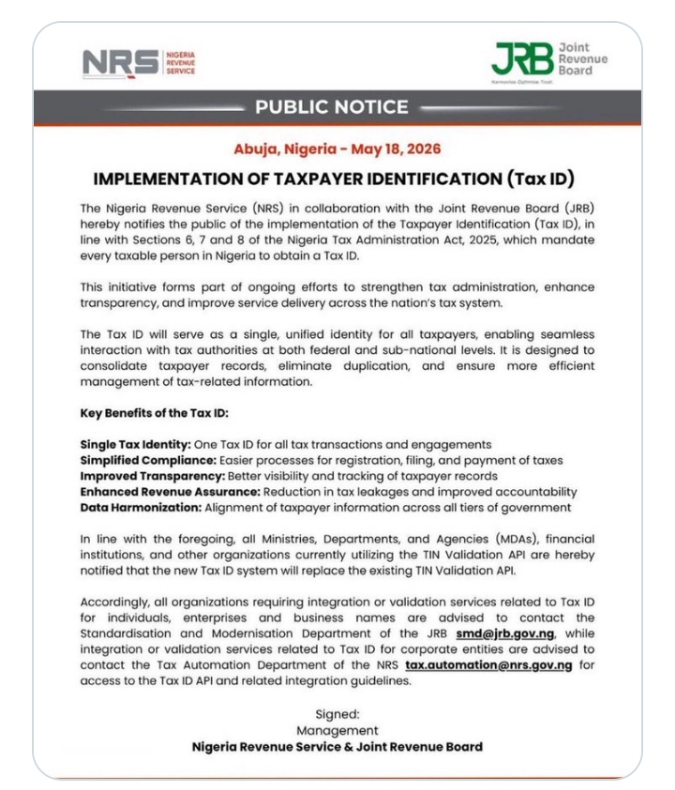
The Nigeria Revenue Service (NRS), in partnership with the Joint Revenue Board (JRB), has officially announced the implementation of a new Taxpayer Identification system known as the Tax ID. The announcement was made through a public notice issued in Abuja on May 18, 2026.
The initiative is being introduced in accordance with Sections 6, 7, and 8 of the Nigeria Tax Administration Act, 2025, which require every taxable individual and organization in Nigeria to obtain a Tax ID.
According to the NRS and JRB, the new system represents a major step toward modernizing Nigeria’s tax administration framework, improving transparency, and enhancing service delivery across federal and sub-national tax authorities.
What the New Tax ID Means
The newly introduced Tax ID will function as a single, unified identity for taxpayers in Nigeria. Instead of using multiple identifiers across different tax systems and government agencies, taxpayers will now have one centralized identification number for all tax-related activities.
The authorities explained that the system is designed to streamline taxpayer interactions with government agencies while improving the management and accuracy of tax records nationwide.
By consolidating taxpayer information into a unified platform, the government aims to eliminate duplication, improve accountability, and strengthen revenue collection processes.
Key Benefits of the Tax ID System
Single Tax Identity
Under the new framework, taxpayers will use one Tax ID for all tax transactions and engagements. This creates a more organized and efficient identification structure across various tax authorities and government agencies.
Simplified Tax Compliance
The NRS stated that the Tax ID system will simplify several tax processes, including taxpayer registration, tax filing, and payment procedures. This is expected to reduce administrative burdens on individuals and businesses.
Improved Transparency
The centralized nature of the system will provide better visibility into taxpayer records and activities. Authorities believe this will strengthen transparency and make tax administration more efficient.
Enhanced Revenue Assurance
The government also expects the initiative to reduce tax leakages and improve accountability within the tax system. By maintaining harmonized taxpayer data, revenue authorities can better monitor compliance and reduce inconsistencies.
Data Harmonization Across Government Levels
One of the major objectives of the Tax ID initiative is the alignment of taxpayer information across all tiers of government. This harmonization is intended to improve coordination between federal, state, and local tax authorities.
Existing TIN Validation API to Be Replaced
As part of the transition to the new system, the NRS and JRB announced that the existing TIN Validation API currently used by Ministries, Departments, Agencies (MDAs), financial institutions, and other organizations will be replaced by the new Tax ID system.
Organizations currently relying on the old validation infrastructure have been advised to begin preparations for migration to the updated platform.
Integration Guidelines for Organizations
The public notice also outlined new integration procedures for organizations requiring access to Tax ID verification and validation services.
Organizations seeking integration or validation services for individuals, enterprises, and business names have been directed to contact the Standardisation and Modernisation Department of the JRB through:
Meanwhile, organizations requiring integration or validation services for corporate entities are advised to contact the Tax Automation Department of the NRS through:
These departments will provide access to the new Tax ID API as well as related technical integration guidelines.
A Major Shift in Nigeria’s Tax Administration
The implementation of the Tax ID marks a significant development in Nigeria’s ongoing efforts to modernize public revenue management. By creating a unified taxpayer identity system, the government seeks to improve efficiency, strengthen compliance monitoring, and establish a more transparent tax ecosystem.
The initiative is also expected to support broader digital transformation goals within Nigeria’s public sector, particularly in areas involving data management, financial accountability, and inter-agency collaboration.
The public notice was jointly signed by the management of the Nigeria Revenue Service and the Joint Revenue Board.
NIN, National Identification Number of Nigeria The National Identification Number (NIN) consists of 11 non- intelligible numbers randomly chosen and assigned to an individual after the…
Botswana health system Botswana has a five tier health system comprising of health post, clinic, primary hospital, district hospital and referral hospitals. Consultation…