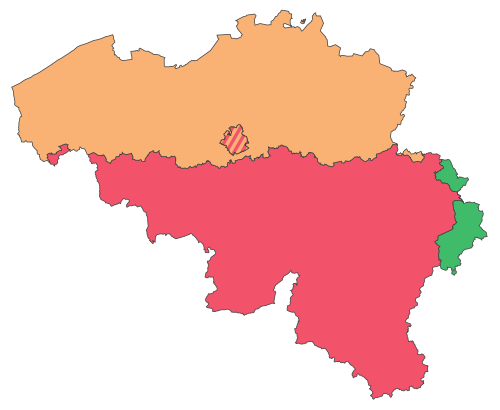
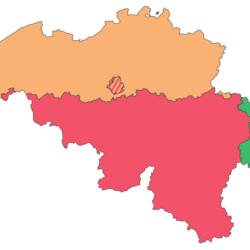
Belgium’s institutional structure is one of the most sophisticated in Europe. Shaped by linguistic diversity, historical compromise, and successive waves of federalisation, today’s Belgium is composed of three Communities, three Regions, and four constitutionally established language areas.
This article provides a detailed, structured, and highly informative exploration suitable for readers seeking depth—covering how Belgium’s divisions work, why they exist, and how they interact politically and administratively.
Belgium’s Federal Structure
Belgium is a federal state built around two main concepts:
1. Communities — based on language and culture
Flemish Community (Dutch-speaking)
French Community (French-speaking)
German-speaking Community
2. Regions — based on economics and territory
Flemish Region (Flanders)
Walloon Region (Wallonia)
Brussels-Capital Region
3. Language Areas — constitutional geographic zones
Dutch language area
French language area
German language area
Bilingual Brussels-Capital area
Each layer fully covers the country, meaning they overlap but serve different purposes.
1. Understanding the Language Areas
Established by the 1963 Second Gilson Act and anchored in the Constitution since 1970, the four areas determine:
the official language(s) of public administration
the scope of linguistic rights
the territorial limits of Community institutions
🔹 Dutch Language Area
Covers Flanders except Brussels-adjacent municipalities with limited facilities for French speakers.
🔹 French Language Area
Covers Wallonia except the German-speaking area.
🔹 German Language Area
A small territory of nine municipalities in eastern Liège province, bordering Germany.
🔹 Bilingual Brussels-Capital Area
French–Dutch bilingual territory consisting of 19 municipalities.
2. The Three Communities
Communities exercise powers linked to people—particularly language and culture.
Community
Capital
Population
Competencies
Flemish Community
Brussels
~6.9 million
Culture, education, a large share of healthcare & social matters
French Community
Brussels
~4.5 million
Culture, education, certain health/social matters
German-speaking Community
Eupen
~80,000
Culture, education, regional powers delegated by Wallonia
Special Feature: The Flemish Merger
Since 1980, Flanders has operated a single Parliament and Government for both the Flemish Region and the Flemish Community.
Brussels-based Flemish MPs cannot vote on exclusively regional matters.
3. The Three Regions
Regions manage competencies linked to territory and economy, such as:
spatial planning
environment
transport
economy
agriculture
Flemish Region (Flanders)
Area: 13,626 km²
Population: ~6.8 million
Provinces (5): Antwerp, Limburg, Flemish Brabant, East Flanders, West Flanders
Language: Dutch (limited French facilities in certain municipalities)
Flanders abolished its own regional institutions and merged them with Community ones.
Walloon Region (Wallonia)
Area: 16,901 km²
Population: ~3.7 million
Provinces (5): Hainaut, Namur, Liège, Luxembourg, Walloon Brabant
Language: French (German in the east)
Wallonia and the French Community remain separate institutions, though ministers often serve in both.
Brussels-Capital Region
Area: 162 km²
Population: ~1.25 million
Municipalities: 19
Languages: French & Dutch (bilingual)
Brussels is the capital of:
Belgium (federal)
Flanders (de facto seat)
The French Community
The Brussels-Capital Region itself
4. Municipalities and Subdivisions
Belgium has:
581 municipalities
Sub-municipalities (deelgemeenten)
Provinces (except Brussels)
Judicial and electoral arrondissements
Police districts and zones
Belgium’s municipal structure is complex due to historical mergers and linguistic arrangements.
5. Municipalities with Language Facilities
Belgium has 27 municipalities where residents may request administrative services in a neighbouring language.
Types of facilities municipalities:
🔹 Around Brussels (6)
For French speakers in Flemish municipalities (e.g., Sint-Genesius-Rode).
🔹 At Flemish–Walloon border (several)
Accommodating linguistic minorities.
🔹 Around the German-speaking area
Two Walloon municipalities offer German-language facilities.
6. How Competencies Are Divided
Belgium functions on three governmental levels:
Federal State
justice
defence
social security
interior affairs
public debt
Regions
economy
housing
environment
agriculture
public works
employment policy
Communities
language use
education
culture
healthcare (human-focused)
assistance to individuals
Brussels
Special because:
both Flemish and French Community institutions operate in the region
bilingual public administration is required
7. Why Belgium Developed This System
Belgium’s federalisation was driven by:
✔ Linguistic tensions
Dutch-speakers sought equality, leading to territorial and cultural autonomy.
✔ Economic divergence
Flanders and Wallonia evolved economically at different speeds.
✔ Compromise politics
Each reform (1970–1980–1988–1993…) added new powers to regions and communities.
✔ Protection of minorities
Especially in Brussels and the German-speaking area.
8. The German-speaking Community: A Unique Entity
A small but fully institutionalised Community with:
its own Parliament & Government
authority over culture and education
additional powers delegated by Wallonia, such as certain local government matters
This makes it a sophisticated micro-federal unit within Belgium.
Belgium’s complex federal architecture reflects its cultural richness and its commitment to balancing linguistic diversity with political order. The coexistence of Communities, Regions, and language areas illustrates a unique model of decentralised governance in Europe.
World Heritage Sites in Belgium UNESCO World Heritage Sites in Belgium are: Flemish Béguinages La Grand-Place, Brussels The Four Lifts on the Canal du Centre…
Azerbaijani Language: History, Grammar, and Global Presence Azerbaijani language, its history, dialects, phonology, grammar, and global distribution. Learn key vocabulary, pronunciation rules, and linguistic features. Azerbaijani Azerbaijani,…