Belgium Communities, Regions, and Language Areas: Structure & Context
Territorial-institutional structure of Belgium under Belgian Constitution
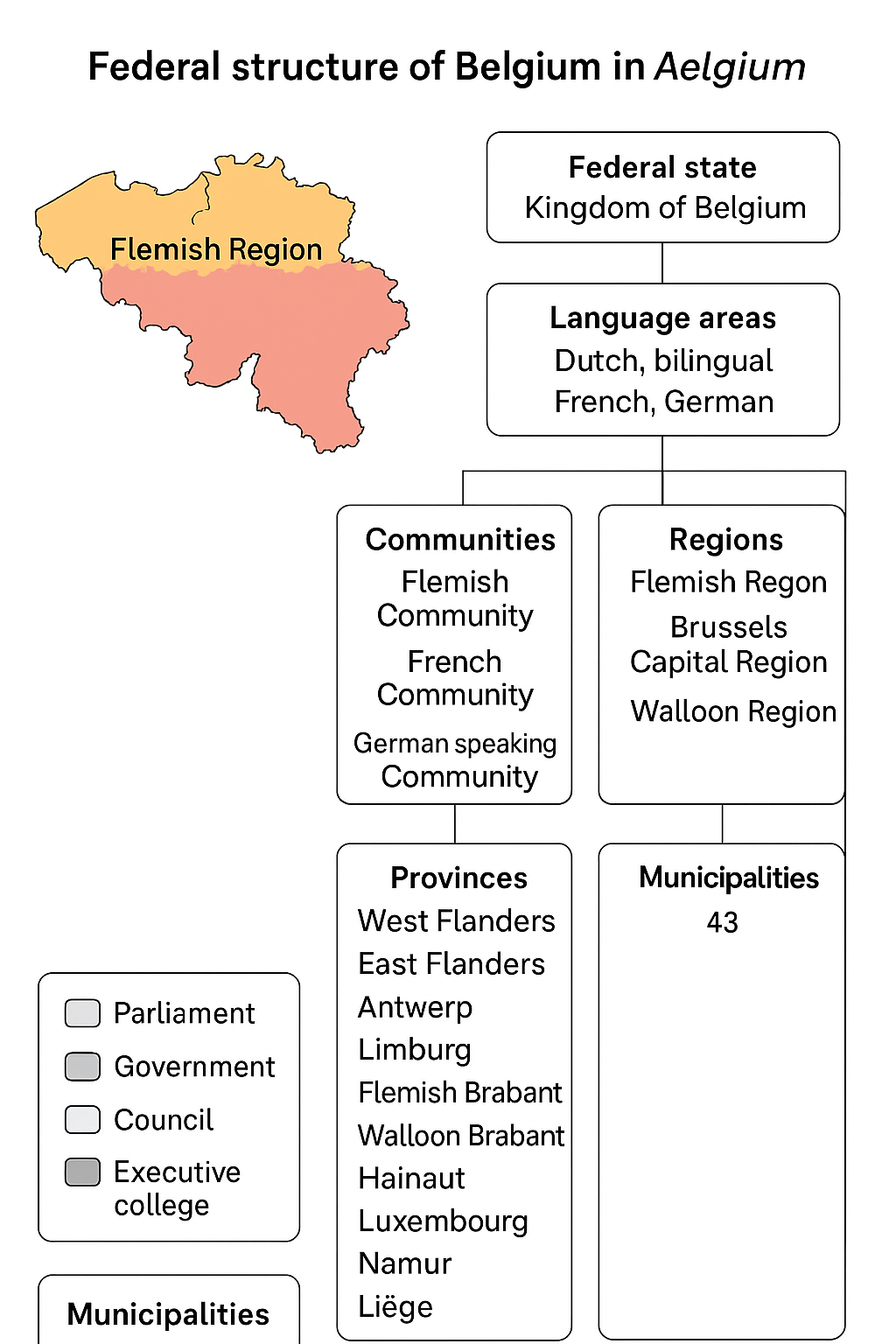
According to the Constitution, Belgium is a federal State composed of Communities and Regions.
There are three Communities: the Flemish Community, the French Community, and the German-speaking Community.
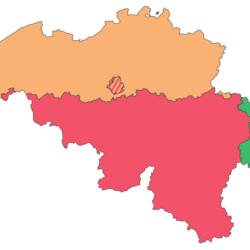
There are three Regions: the Flemish Region, the Walloon Region, and the Brussels-Capital Region.
The Constitution also defines four linguistic (language) regions / language areas: the Dutch-speaking region, the French-speaking region, the bilingual (Brussels-Capital) region, and the German-speaking region. Every municipality belongs to exactly one such linguistic region.
Thus, Belgium’s federal architecture rests on multiple overlapping layers — territorial (Regions), cultural/linguistic (Communities and language areas), and national (federal).
🏛 Levels of Government and Their Institutions
The federal (state) level — the Kingdom of Belgium — remains responsible for “residual” powers: those not devolved to Regions or Communities (e.g., defence, justice, foreign affairs).
Each Community and each Region has its own parliament (council) and government (executive).
One peculiarity: the powers of the Flemish Region are exercised by the institutions of the Flemish Community — so in practice there is a single parliament and government for both the Flemish Region and Flemish Community.
Thus, Belgium effectively has five separate “governments/parliaments” in addition to the federal government — one for each Community (3) plus for the two Regions (Brussels and Wallonia).
Below the regional/community tier, there are local tiers:
Provinces (10 in number) — but only in the Flemish and Walloon Regions. The Brussels-Capital Region does not have provinces.
Municipalities (communes / gemeenten / Gemeinden) — the basic local government units.
In some contexts there are arrondissements (administrative districts) between provinces and municipalities — these are purely administrative and do not have their own independent institutions under the Constitution.
Belgium has 10 provinces: 5 in the Flemish Region (Antwerp, East Flanders, West Flanders, Limburg, Flemish Brabant) and 5 in the Walloon Region (Hainaut, Liège, Namur, Luxembourg, Walloon Brabant). The Brussels Region has none.
Municipalities: most recent reliable sources give 565 municipalities distributed among the Regions as:
285 in the Flemish Region
261 in the Walloon Region
19 in the Brussels-Capital Region
Between provinces (or Brussels) and municipalities there are 43 arrondissements (administrative districts) — but these have no self-governing institutions and serve only for administrative/judicial purposes.
(Note: you previously listed 565 municipalities and 43 arrondissements; that matches well the updated consensus.)
⚖ Competences and Distribution of Powers
Because of the federal structure and overlapping jurisdictions, competences are divided and shared across levels:
Regions handle territorial and economic/regional matters: environment, public works, transport, housing, urban planning, energy, regional economy, public works, etc.
Communities manage personal and cultural matters tied to language and identity: education, cultural affairs, language policy, social services in certain areas (especially where language matters).
Provinces and Municipalities remain relevant for “local-level” tasks: local infrastructure (roads, watercourses), local planning, civil registry, local policing, municipal administration, local welfare, etc.
In many domains there may be overlap or shared responsibilities (for example: economic matters, certain aspects of social policy, environmental regulation) — which underlines the complexity (and flexibility) of the federal system.
🧮 Why This Structure — Context & Purpose
The federal structure, with Communities, Regions, and language areas, emerged through a series of constitutional reforms between the 1970s and 1990s. Its goal was to accommodate Belgium’s linguistic, cultural, and regional diversity, particularly the deep divisions between Dutch-speaking (Flemish) and French-speaking (Walloon) communities — and a small German-speaking community as well.
This structure allows for decentralized governance, giving substantial autonomy to Communities and Regions over “sensitive” areas like language, education, culture, and regional economy.
At the same time, the federal level remains responsible for uniting elements — national defence, justice, foreign affairs — preserving national cohesion.
✅ Clarifications and Common Misunderstandings
It is not correct to think of Belgium as a simple “state → provinces → municipalities” hierarchy. Instead, Communities and Regions sit at the same federal tier as distinct but overlapping entities.
The fact that the Flemish Region and Flemish Community share the same institutions sometimes causes confusion: legally they are distinct concepts, but institutionally they coincide.
Municipalities in the Brussels-Capital Region do not belong to any province — the Region itself substitutes for provincial level in Brussels.
The linguistic regions / language areas are not administrative units with governments — they determine language regulations but have no legislative or executive bodies of their own.
Belgium’s Multi-Layered Federal Architecture
Tier / Level
Entities / Units
Institutional Bodies
Primary Competence / Purpose
Federal (State)
The Kingdom of Belgium
Federal Parliament & Government
National matters (defence, justice, foreign affairs, overarching federal laws)
Communities (3)
Flemish, French, German-speaking Communities
Each has its own Parliament and Government
Cultural, linguistic, educational, social matters tied to language/identity
Regions (3)
Flemish, Walloon, Brussels-Capital
Each has Parliament & Government (Flemish shares with Flemish Community)
Territorial/regional matters: economy, transport, environment, planning, regional development
Provinces (10)
5 in Flanders + 5 in Wallonia
Provincial Council + Deputation (executive)
Intermediate local tasks; supports municipalities, regional planning, infrastructure, public services
Municipalities (565)
Towns and cities across the whole country
Municipal Council + College (Mayor & Aldermen)
Local governance: civil registry, local roads, zoning, welfare, policing, municipal administration
Arrondissements (43)
Administrative subdivisions between provinces & municipalities
— (no independent institutions)
Judicial/administrative districts — coordination, statistical or judicial purposes
More
Belgium Communities, Regions, and Language Areas Belgium’s institutional structure is one of the most sophisticated in Europe. Shaped by linguistic diversity, historical compromise, and successive waves…
World Heritage Sites in Belgium UNESCO World Heritage Sites in Belgium are: Flemish Béguinages La Grand-Place, Brussels The Four Lifts on the Canal du Centre…