Language in Bosnia and Herzegovina is closely tied to history, identity, and politics. While the country is linguistically unified in everyday communication, its legal and constitutional framework reflects the complexity of its multicultural society.
Official Language Status
Bosnia and Herzegovina’s constitution does not explicitly name an official language. However, the Dayton Peace Agreement, which ended the war in the 1990s, was drafted in Bosnian, Croatian, Serbian, and English. Linguistic scholars widely interpret this as a practical recognition of three official languages at the state level.
In 2000, the Constitutional Court of Bosnia and Herzegovina confirmed that Bosnian, Croatian, and Serbian must have equal status throughout the country. This ruling required both political entities—the Federation of Bosnia and Herzegovina and Republika Srpska—to amend their constitutions. Previously, each entity had favored only certain languages, but following the court decision, all three became official in both entities.
Mutual Intelligibility and Identity
Bosnian, Croatian, and Serbian are fully mutually intelligible. Linguistically, they are standardized varieties of what is commonly known as Serbo-Croatian, although this term is not officially used within the country today.
Despite their similarities, language choice has become a powerful marker of ethnic identity. Scholars note that the formal distinction between the three languages serves more as a symbolic expression of national belonging than a reflection of linguistic necessity. In everyday life, speakers understand one another with little difficulty.
Minority Languages and Legal Protection
Bosnia and Herzegovina is a signatory to the European Charter for Regional or Minority Languages, under which it recognizes a wide range of minority languages. These include:
Albanian
Montenegrin
Czech
Italian
Hungarian
Macedonian
German
Polish
Romani
Romanian
Rusyn
Slovak
Slovene
Turkish
Ukrainian
Jewish languages (Yiddish and Ladino)
This recognition highlights the country’s long-standing multicultural character and its commitment to protecting linguistic diversity.
The German Linguistic Legacy
The German-speaking population in Bosnia and Herzegovina is largely descended from Danube Swabians, who settled in the region during the Habsburg period. Following the two World Wars, expulsions and forced assimilation drastically reduced the number of ethnic Germans, leaving only a small linguistic and cultural presence today.
Mother Tongue Statistics
According to the 2013 census, citizens identified their first language as follows:
Bosnian – 52.86%
Serbian – 30.76%
Croatian – 14.6%
Other languages – 1.57%
No response – 0.21%
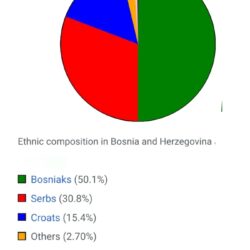
These figures closely mirror the country’s ethnic composition and underline the close connection between language and identity.
Although Bosnia and Herzegovina functions with three officially recognized languages, everyday communication remains seamless due to their shared linguistic foundation. The country’s language policies reflect not division, but the historical and symbolic importance of identity in a diverse society. Understanding language in Bosnia and Herzegovina means understanding both its unity and its complexity.
Cuisine of Bosnia and Herzegovina The cuisine of Bosnia and Herzegovina is a rich reflection of the country’s history, geography, and cultural diversity. Shaped by…
Education in Bosnia and Herzegovina Education in Bosnia and Herzegovina has a rich and layered history shaped by religious traditions, imperial rule, socialism, and modern…
Religion in Bosnia and Herzegovina Religion plays a central role in the history, identity, and social structure of Bosnia and Herzegovina. The country is widely…
Bosnia and Herzegovina Ethnic Composition Bosnia and Herzegovina is one of the most ethnically diverse countries in Southeast Europe. Its social fabric has been shaped…
Bolivia 37 Official Languages and Others Official Languages of Bolivia (37) (Recognized by the 2009 Constitution) Spanish (Castilian) Aymara Quechua Araona Baure Bésiro (Chiquitano) Canichana Cavineño…
Borno People and Languages With a rich but diverse historical and cultural heritage, Borno State is pluralistic in ethnic composition. About thirty languages are…