Languages of Bulgaria: Diversity, History, and Modern Use
Languages of Bulgaria including official, minority, and foreign languages, census data, and cultural impact
Bulgaria is a country rich in history, culture, and identity—and language plays a key role in shaping that identity. The Languages of Bulgaria reflect centuries of migration, empire, tradition, and modern globalization. From the official Bulgarian language to minority tongues and widely spoken foreign languages, Bulgaria presents a fascinating linguistic landscape that continues to evolve today.
Have a look at how languages are used in Bulgaria, their historical roots, current statistics, and why multilingualism matters in Bulgarian society.
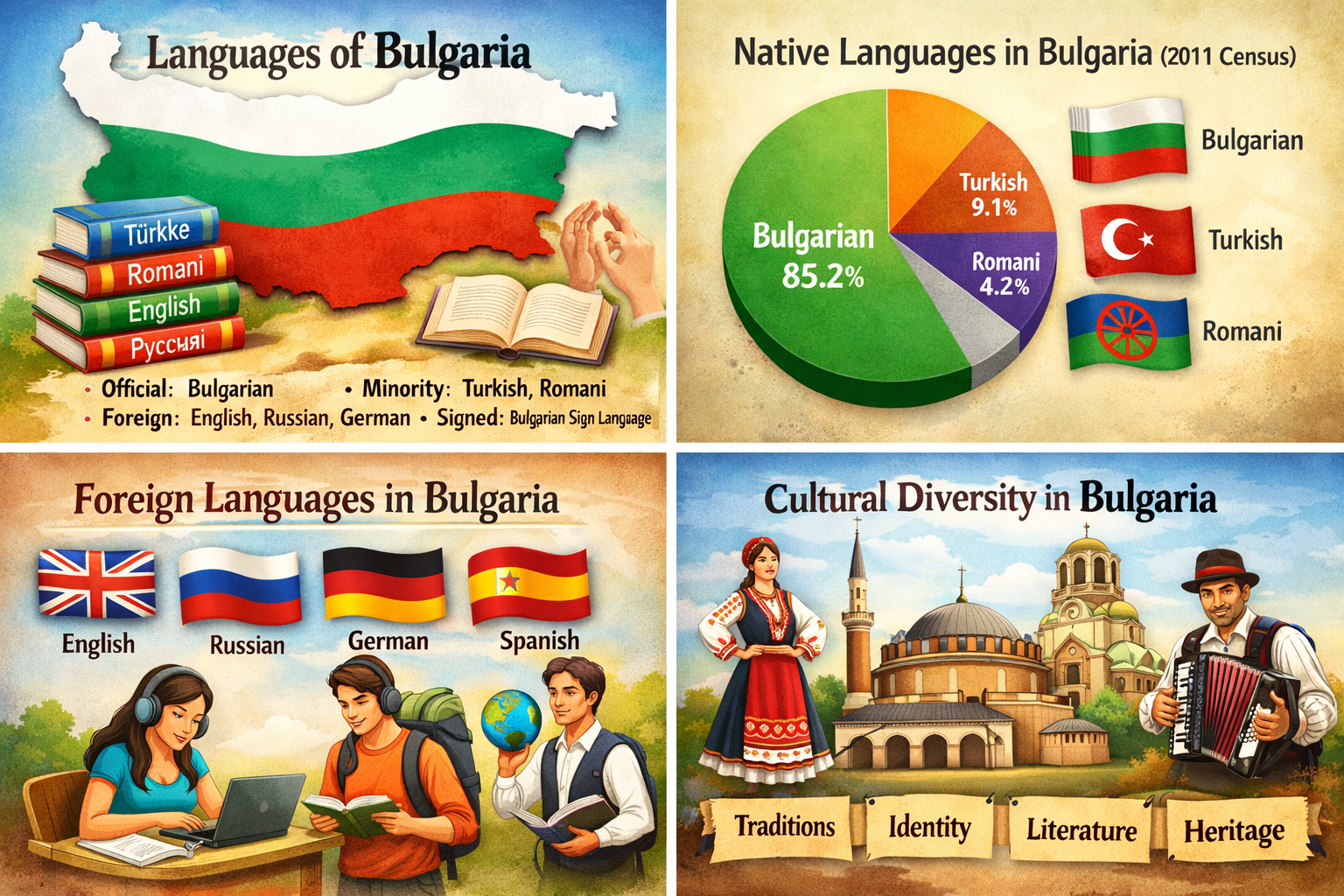
The Languages of Bulgaria can be grouped into four main categories:
Official language
Minority languages
Foreign languages
Sign language
Each category plays a distinct role in communication, education, governance, and cultural preservation.
Official Language of Bulgaria
Bulgarian Language
Bulgarian is the only official language of the Republic of Bulgaria and is spoken natively by the vast majority of the population.
Key features of Bulgarian:
Member of the South Slavic language group
Closely related to Macedonian
Written using the Cyrillic alphabet
Used in government, education, media, and law
Bulgarian is unique among Slavic languages because it has largely lost grammatical cases, making it structurally different from Russian or Serbian. Its use of definite articles attached to nouns is another defining trait.
Bulgarian Sign Language
Bulgarian Sign Language is officially recognized and used by the deaf and hard-of-hearing community. It has:
Its own grammar and structure
Approximately 37,000 users
Growing institutional support in education and public services
This makes it an important part of the modern Languages of Bulgaria framework.
Minority Languages in Bulgaria
Bulgaria is home to several ethnic communities, each contributing to linguistic diversity.
Turkish Language
Turkish is the largest minority language in Bulgaria.
Spoken mainly by ethnic Turks
Concentrated in northeastern and southern regions
Historically linked to Ottoman rule
Still actively used in homes, cultural life, and media
Turkish remains a vital part of the linguistic identity of many Bulgarian citizens.
Romani Language
Romani is spoken by Bulgaria’s Roma population and exists in multiple varieties.
Main forms: Balkan Romani and Vlax Romani
Oral tradition is dominant
Strong cultural significance
Romani communities contribute greatly to Bulgaria’s cultural diversity, even though the language faces challenges related to standardization and education.
These languages are often preserved within families and cultural organizations rather than formal institutions.
Languages of Bulgaria According to the 2011 Census
The 2011 national census provides valuable insight into native language use.
Language
Percentage of Respondents
Bulgarian
85.2%
Turkish
9.1%
Romani
4.2%
Russian
0.24%
Armenian
0.08%
Romanian
0.08%
Other
<1%
These figures confirm Bulgarian’s dominance while highlighting meaningful minority representation.
Foreign Languages Spoken in Bulgaria
Foreign language knowledge is increasingly important in Bulgaria due to globalization, education, and EU membership.
Most Common Foreign Languages
English – the most widely known foreign language
Russian – more common among older generations
German – popular for education and employment
Spanish – growing interest among younger people
English is considered the most useful foreign language for future generations, especially in business, travel, and technology.
Education and Language Learning in Bulgaria
Language education begins early in Bulgaria.
Bulgarian is the main language of instruction
Foreign languages are introduced in primary school
English dominates secondary and higher education
Minority languages may be studied privately or culturally
This system supports both national unity and international communication.
Cultural Importance of the Languages of Bulgaria
Language in Bulgaria is deeply tied to:
National identity
Folk traditions
Literature and music
Religious practices
Protecting linguistic diversity helps preserve Bulgaria’s multicultural heritage.
Challenges Facing Linguistic Diversity
Despite diversity, some challenges remain:
Decline in minority language use among youth
Limited formal education in minority languages
Urbanization and migration reducing intergenerational transfer
Addressing these challenges is key to maintaining the full spectrum of the Languages of Bulgaria.
Future of Languages in Bulgaria
The future looks both dynamic and hopeful:
English use continues to grow
Digital tools support language learning
Cultural initiatives promote minority languages
EU policies encourage multilingualism
Bulgaria’s linguistic future balances tradition with global integration.
1. What is the official language of Bulgaria?
Bulgarian is the only official language used in government, education, and law.
2. What minority languages are spoken in Bulgaria?
Turkish and Romani are the largest, followed by Armenian, Russian, Greek, Romanian, and others.
3. Is English widely spoken in Bulgaria?
Yes, English is the most commonly known foreign language, especially among younger people.
4. Does Bulgaria use the Cyrillic alphabet?
Yes, Bulgarian is written using Cyrillic, which originated in the region.
5. Is Bulgarian Sign Language recognized?
Yes, it is officially recognized and used by tens of thousands of people.
6. Why are languages important to Bulgarian culture?
They preserve history, identity, and cultural traditions across generations.
The Languages of Bulgaria tell a powerful story of history, identity, and modern change. While Bulgarian unites the nation, minority and foreign languages add richness and depth to society. As education, technology, and cultural awareness grow, Bulgaria continues to strengthen its multilingual character while honoring its roots.
List of Bulgaria Ethnic Groups by Province Bulgaria’s ethnic composition across its 28 provinces and Sofia City. While ethnic Bulgarians remain the overwhelming majority nationwide, the regional…
List of Bulgaria Municipalities List of the municipalities of Bulgaria, grouped by province (oblast). Total: 265 municipalities Blagoevgrad Province (14) Bansko Belitsa Blagoevgrad Gotse…
List of Bulgaria Provinces Bulgaria’s administrative structure reflects its long history, unitary form of government, and strong central authority. Designed to balance local governance…
World Heritage Sites in Bulgaria UNESCO World Heritage Sites in Bulgaria are: Boyana Church Madara Rider Rock-Hewn Churches of Ivanovo Thracian Tomb of Kazanlak Ancient…