Distribution of population by age groups in Sindh, Pakistan
Age group
Total – Total
Total – Male
Total – Female
Total – Transgender
Urban – Total
Urban – Male
Urban – Female
Urban – Transgender
Rural – Total
Rural – Male
Rural – Female
Rural – Transgender
Total Population (‘000)
55,638.4
28,986.7
26,647.5
4.2
30,014.5
15,748.8
14,262.2
3.6
25,623.9
13,237.9
12,385.3
0.6
Less than 15 years (‘000)
23,246.0
12,064.6
11,181.2
0.2
11,280.1
5,867.1
5,412.9
0.1
11,965.9
6,197.5
5,768.3
0.1
15 to 64 years (‘000)
30,687.4
16,020.6
14,662.9
3.9
17,735.8
9,342.9
8,389.4
3.4
12,951.7
6,677.7
6,273.5
0.5
65 and above (‘000)
1,705.0
901.5
803.4
0.1
998.7
538.7
459.8
0.1
706.3
362.8
343.5
0
Dependency ratio (%)
81.3
80.9
81.7
7.3
69.2
68.6
70.0
5.3
97.8
98.2
97.4
20.23
Distribution of population by age groups, Sindh, Pakistan, Census 2023
Sindh’s Population by Age Group
Sindh has a young population, with a large working-age group and a very large number of children. Of the province’s 55.64 million people, about 41.8% are under 15 and 55.2% are aged 15 to 64. Only about 3.1% are 65 or older.
This age structure is typical of a population that is still growing quickly. It has a wide base of children and a thin top of older people. It also affects demand for schools, health services, jobs and housing.
Children Under 15
Sindh has about 23.25 million children under 15, or 41.8% of the population. Boys number about 12.06 million and girls about 11.18 million.
The share of children differs a lot between urban and rural areas. In urban areas, children are about 37.6% of the population (11.28 million). In rural areas, they are about 46.7% (11.97 million). Rural Sindh is therefore noticeably younger than its cities.
Working-Age Population (15 to 64 Years)
About 30.69 million people in Sindh are of working age, which is 55.2% of the total. Of these, about 16.02 million are male and 14.66 million are female.
Urban areas hold about 17.74 million of them, or roughly 57.8% of the province’s working-age population. Working-age people are 59.1% of the urban population but only 50.5% of the rural population. Cities have more people in the productive age bracket relative to children and the elderly.
Elderly Population (65 Years and Above)
About 1.71 million people in Sindh are aged 65 or older, around 3.1% of the population. Men make up about 0.90 million of this group and women about 0.80 million.
The elderly share is about 3.3% in urban areas and 2.8% in rural areas. Both are small, but the group will grow as life expectancy improves.
Dependency Ratio
The dependency ratio compares the number of children (under 15) and elderly people (65 and above) with the working-age population. Sindh’s overall ratio is 81.3%, meaning roughly 81 dependents for every 100 working-age people. Most of this comes from children rather than the elderly.
Urban: 69.2%
Rural: 97.8%
Male: 80.9%
Female: 81.7%
Rural Sindh has nearly as many dependents as working-age people, so rural households carry a heavier economic burden. Urban areas are better placed because they have proportionally more people of working age.
Distribution by Sex
Males number about 28.99 million (52.1%) and females about 26.65 million (47.9%). That works out to about 109 men for every 100 women. The census also recorded about 4,200 transgender persons, of whom about 3,600 live in urban areas and about 600 in rural areas.
Urban and Rural Distribution
Urban Sindh has about 30.01 million people (54%) and rural Sindh about 25.62 million (46%). This makes Sindh one of Pakistan’s more urbanized provinces, and its cities are home to a majority of its people.
Key Facts
Data source: Pakistan Bureau of Statistics, Socio Economic Indicators of Sindh at District Level
Census year: 2023
Coverage: Sindh province, Pakistan
Unit of measurement: Population figures are in thousands (‘000), and the dependency ratio is a percentage
Age groups: Under 15, 15 to 64, and 65 and above
Disaggregation: Total, urban and rural, each split by male, female and transgender
Total population: 55,638.4 thousand (about 55.6 million)
Percentages in this post: These were calculated from the census figures and rounded
Source: Pakistan Bureau of Statistics, Socio Economic Indicators of Sindh at District Level.
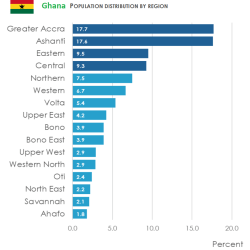
Ghana’s population distribution by region Ghana’s population distribution by region Four regions (Greater Accra, 17.7%, Ashanti, 17.6%, Eastern, 9.5% and Central, 9.3%) contain more than…
FEEDING FOR TILAPIA ACCORDING TO AGE Tilapia farming continues to grow worldwide due to its fast growth rate, adaptability, and strong market demand. However, one critical…
Sindh administrative setup and settlements by district Administrative setup and settlements by district in Sindh, Pakistan LevelProvince / Division / DistrictTehsilQanungo HalqaMauzaMetropolitan / Municipal CorporationDistrict Municipal CorporationMunicipal…