The name Ukraine first appears in a chronicle entry for 1187, and for centuries it meant a frontier before it meant a country.
The first sighting: 1187
The oldest known use of the word appears in the Kievan Chronicle, entered under the year 1187 and preserved in the Hypatian Codex, copied around 1425. The passage describes the death of Volodimer Glebovich, prince of Pereyaslavl, and says that the ukraina mourned him greatly.
Scholars translate the word differently. Lisa Heinrich renders it as “frontier,” while Paul Magocsi leaves it untranslated as ukraïna. In context it meant the lands of the Principality of Pereyaslavl, which lay between the Kievan Rus’ heartland on the Middle Dnieper and the steppe to the southeast, home to the Polovtsi.
The chronicle uses the word again in 1189, for the Galician frontier, which suggests it was a general term for border territory rather than the name of one place.
What the word is built from
Scholars still dispute the exact meaning of ukraina, but they agree that it comes from krai, a Slavic root tracing back to a Proto-Indo-European word for “to cut.” Its main sense is “edge,” and related words in modern Slavic languages mean everything from “country” and “region” to “shore” and “rim.”
That double meaning is the heart of the puzzle. Krai can mean the boundary of an area or the area the boundary encloses, and either reading yields a sensible place name. Denmark, a combination of “Danish” and “boundary,” is a comparable case.
From borderland to place on the map
Through the late Middle Ages the term described fortified borderlands of many Rus’ principalities, including Halych-Volhynia, Pskov, Polatsk and Ryazan, without pointing to any single region. Even the Muscovites used it for their own steppe frontier.
After 1569, when the southwestern Rus’ lands passed to the Polish Crown, the stretch from eastern Podillia to Zaporizhia became informally known as Ukraina because it bordered the Tatar world to the south. A 1580 royal decree by Stefan Batory already spoke of Kyivan, Volhynian and Podolian Ukraine.
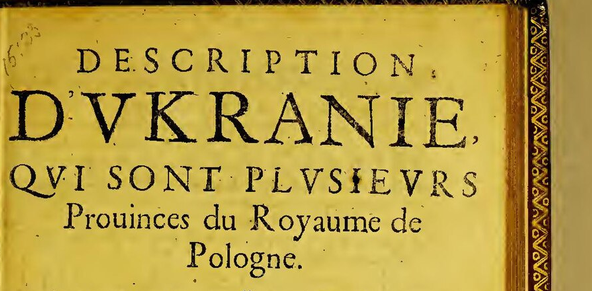
Mapmakers then carried the name across Europe. The 1613 Radziwiłł map was the first to show “Ukraine” and “Cossacks.” Guillaume Le Vasseur de Beauplan, a French engineer who built fortifications in the region in the 1630s, popularised it in his 1648 map of the “Wild Fields, in common speech Ukraine” and in his Description of Ukraine. That book was translated into Latin, Dutch, Spanish and English and reprinted for more than a century. The first English use of the word “Ukrainians” appears in a 1672 translation of A Discourse of the Cossacks.
The Cossacks gave the name a different meaning. In diplomacy with Muscovy, officials of the Cossack Hetmanate, from Bohdan Khmelnytsky onward, used “Ukraine” for the territory their state controlled. Yurii Khmelnytsky’s 1660 negotiating instructions defined it by the Treaty of Zboriv of 1649, which made it a political term rather than a geographic one. The 1672 Treaty of Buchach even called the Right Bank Hetmanate the “Ukrainian State.”
Little Russia versus Ukraine
From the 18th century, the Russian Empire referred to these lands as Little Russia. In the 1830s, Mykola Kostomarov and his Brotherhood of Saints Cyril and Methodius in Kyiv began using the name Ukrainians. Volodymyr Antonovych, the Khlopomany and later the Ukrainophiles of Halychyna, including Ivan Franko, took it up.
By the turn of the 20th century, “Ukraine” had become a self-sufficient name that pushed aside regional identities. It finally defeated Little Russia in the 1920s, during the Bolshevik policy of Korenization and Ukrainization.
Borderland or country? A scholarly debate
Most etymological dictionaries, including Max Vasmer’s, and historians such as Orest Subtelny, Paul Magocsi, Omeljan Pritsak and Mykhailo Hrushevskyi, read the word as “borderland.” The article’s source notes that this reading is increasingly challenged by revisionists motivated by assertion of identity.
Ukrainian philologists often prefer “region, principality, country,” or “the land around” a given centre. Linguist Hryhoriy Pivtorak argues that ukraina (territory) differs from okraina (borderland), and that the borderland sense was a creation of tsarist Russia. He points out that the Zaporozhian Cossacks had used the word for their own territory since the 16th century. Russian scholars contest this view.
Why it is “Ukraine,” not “the Ukraine”
Use of the article was standard before independence in 1991 but has declined since. The Associated Press dropped it on 3 December 1991. Critics argued that it suggested a region, like “the Midwest,” rather than a sovereign state. In 2012 the Ukrainian embassy in London called it politically and grammatically incorrect, and style guides such as those of The Guardian and The Times now omit it.
A parallel debate concerns prepositions. In 1993 the Ukrainian government asked that Russian v (“in”) be used instead of na (“on”), since na can imply a boundary or non-sovereign territory. Both forms appear in older Ukrainian literature, even within a single Shevchenko poem, but v Ukraini is the official and more frequent form today. Polish, Czech and Slovak still use na, while the South Slavic languages use v.
The country’s name, as stated in its declaration of independence and constitution, is simply Ukraine.
World Heritage Sites in Ukraine UNESCO World Heritage Sites in Ukraine are: Kyiv: Saint-Sophia Cathedral and Related Monastic Buildings, Kyiv-Pechersk Lavra L’viv – the Ensemble…
Does Botswana have an international airport Botswana has 4 international airports, there are: Sir Seretse Khama International Airport Maun International Airport Kasane International Airport PG Matante…
Does Benin Republic have airport Benin Republic have one international airport. It is officially named Cardinal Bernardin Gantin International Airport. Unofficially the airport is known…
What IPPIS does Integrated Payroll and Personnel Information System (IPPIS) is Nigeria’s federal government payroll administration department meant to improve the effectiveness and…
Does Police Academy require JAMB? Procedures for Applying to Nigeria Police Academy (POLAC) Applicants must, in addition, apply through the Joint Admissions and Matriculation Board…