Brazil Age Pyramid: A Look at Population Structure and Demographic Change
Brazil age pyramid with detailed analysis of age groups, gender distribution, and what Brazil’s population structure reveals about the future.
The Brazil age pyramid is one of the most effective tools for understanding how the country’s population is structured today—and where it is headed in the future. By examining population distribution across age groups and genders, the age pyramid reveals patterns of growth, aging, workforce dynamics, and social change.
Brazil has undergone major demographic shifts over the last decades. Once known for its youthful population, the country is now moving steadily toward an aging society. This article explores the Brazil age pyramid using official population data, explains what the numbers mean, and highlights the social and economic implications behind them.
What Is an Age Pyramid and Why It Matters
An age pyramid is a graphical representation of a population divided by age groups and gender. Typically, females are shown on one side and males on the other, forming a pyramid-like shape.
The Brazil age pyramid helps policymakers, researchers, and citizens understand:
Birth and fertility trends
Life expectancy differences between men and women
The size of the working-age population
Pressure on healthcare, pensions, and education systems
By studying the pyramid, it becomes easier to predict future challenges and opportunities for the country.
Brazil Age Pyramid: Population by Age and Gender
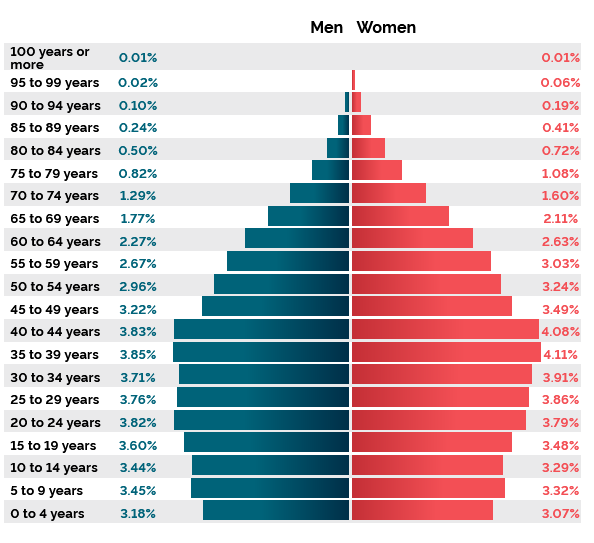
Below is the population distribution for Brazil, showing both female and male populations across age groups.
Age group
Female
Male
100 years or more
27,244
10,570
95 to 99 years
114,859
50,319
90 to 94 years
385,388
194,341
85 to 89 years
835,554
493,649
80 to 84 years
1,465,178
1,009,852
75 to 79 years
2,189,593
1,657,786
70 to 74 years
3,243,186
2,615,350
65 to 69 years
4,288,180
3,588,052
60 to 64 years
5,338,555
4,605,834
55 to 59 years
6,149,601
5,419,505
50 to 54 years
6,584,190
6,014,391
45 to 49 anos
7,091,003
6,549,109
40 to 44 years
8,291,111
7,781,059
35 to 39 years
8,345,458
7,827,333
30 to 34 years
7,935,832
7,537,285
25 to 29 years
7,842,265
7,627,458
20 to 24 years
7,699,157
7,767,306
15 to 19 years
7,058,427
7,317,515
10 to 14 years
6,682,215
6,992,746
5 to 9 years
6,738,158
7,011,282
0 to 4 years
6,243,171
6,461,689
Key Insights from the Brazil Age Pyramid
One of the most noticeable features of the Brazil age pyramid is its changing shape. Instead of a wide base and narrow top, Brazil now shows a more rectangular structure, indicating declining birth rates and longer life expectancy.
1. Declining Birth Rates
Younger age groups (0–4 and 5–9 years) are smaller than those aged 30–39 and 40–44. This suggests fewer births in recent years, a trend linked to urbanization, increased education, and family planning.
2. Strong Working-Age Population
The largest population groups are between ages 30 and 44. This represents Brazil’s economic backbone, supporting productivity, consumption, and tax revenue.
3. Rapid Population Aging
Older age groups are growing steadily. The population aged 60 and above is expanding fast, signaling higher demand for healthcare services, pensions, and elderly care.
Gender Differences in the Brazil Age Pyramid
A clear pattern emerges when comparing male and female populations. Women significantly outnumber men in older age groups, especially after age 70. This reflects higher life expectancy among women, a trend seen globally.
In younger age groups, however, males slightly outnumber females. This balance shifts gradually with age due to differences in mortality rates.
Social and Economic Implications
The structure of the Brazil age pyramid has far-reaching consequences:
Healthcare: Increased demand for chronic disease management and elder care
Pensions: Pressure on social security systems
Labor Market: Potential workforce shortages in the future
Education: Lower demand for primary education, higher demand for adult retraining
Planning ahead is essential to ensure Brazil remains economically and socially stable as its population continues to age.
How Brazil’s Age Pyramid Has Changed Over Time
Decades ago, Brazil had a classic pyramid shape with a wide base. High fertility rates and lower life expectancy defined the population. Today, improved healthcare, education, and access to contraception have reshaped the pyramid into a more balanced form.
This transition places Brazil in a critical demographic moment known as the “demographic window,” where economic growth can accelerate if supported by the right policies.
1. What does the Brazil age pyramid show?
It shows how Brazil’s population is distributed by age and gender.
2. Is Brazil’s population aging?
Yes, older age groups are growing faster than younger ones.
3. Why are there more women than men at older ages?
Women generally have higher life expectancy.
4. Are birth rates declining in Brazil?
Yes, recent age groups are smaller than those from previous decades.
5. How does the age pyramid affect the economy?
It influences labor supply, healthcare demand, and pension systems.
6. What challenges does Brazil face due to aging?
Healthcare costs, pension sustainability, and workforce replacement.
The Brazil age pyramid tells a powerful story of transformation. Brazil is no longer a young nation but one in transition toward an aging society. Understanding this demographic structure is essential for planning sustainable policies in health, education, employment, and social protection. As the pyramid continues to evolve, the choices made today will shape Brazil’s future for generations to come.
FEEDING FOR TILAPIA ACCORDING TO AGE Tilapia farming continues to grow worldwide due to its fast growth rate, adaptability, and strong market demand. However, one critical…
How to change information on your National ID Card Process of modification (Adults) Applicants walks into the enrolment Centre with a supporting document (including application letter). Applicant will be…