Singapore is a multi-religious society where Buddhists, Christians, Muslims, Taoists, Hindus and a growing group with no religion live side by side. This article looks at the 2025 breakdown, how it compares with 2020 and 2010, and what the numbers show.
Religious Composition at a Glance (2025)
Religion
Share of residents (2025)
Buddhism
30.9%
No religion
23.9%
Christianity
17.1%
Islam
15.0%
Taoism
7.3%
Hinduism
5.4%
Other religions
0.4%
Total
100%
Buddhism is still the largest single affiliation at just under a third of residents. No religion is now the second-largest category, ahead of Christianity and Islam. Buddhism and Taoism together come to 38.2%. If Buddhism, Taoism and Hinduism are grouped as “Eastern” faiths, that group comes to 43.6%, but those groupings are my own, not an official category.
As far as I can tell, the 2025 figures come from the Department of Statistics’ General Household Survey 2025. Like the census, it covers the resident population (citizens and permanent residents) aged 15 and over.
How Religion Has Shifted: 2010 to 2025
Here is how the main religions have moved over 15 years:
Religion
2010
2020
2025
Change, 2020 to 2025
Buddhism
33.3%
31.1%
30.9%
-0.2 pts
No religion
17.0%
20.0%
23.9%
+3.9 pts
Christianity
18.3%
18.9%
17.1%
-1.8 pts
Islam
14.7%
15.6%
15.0%
-0.6 pts
Taoism
10.9%
8.8%
7.3%
-1.5 pts
Hinduism
5.1%
5.0%
5.4%
+0.4 pts
Other
0.7%
0.6%
0.4%
-0.2 pts
The 2010 Buddhism and Taoism figures are worked out from the reported 2010-to-2020 changes. In the 2020 census, Buddhism fell by 2.2 percentage points to 31.1%, and Taoism fell by 2.1 points to 8.8%. The same report noted that Islam rose by 0.9 points to 15.6%, and Christianity rose by 0.6 points to 18.9%.
The main trends:
“No religion” has grown fastest. It went from 17.0% in 2010 to 20.0% in 2020 and 23.9% in 2025. In 2020, a higher proportion of residents reported no religious affiliation across all age groups.
Taoism is declining. It has dropped from 10.9% to 7.3% in 15 years. In 1980 Taoism was the second-largest religion, at 30.0% in 1980.
Christianity rose between 2010 and 2020, then fell back to 17.1% in 2025.
Hinduism is the only major religion to gain in 2025, rising slightly to 5.4%.
Religion and Ethnicity
Religion in Singapore is closely tied to ethnicity (see our companion article on Singapore’s ethnic groups).
Chinese Singaporeans are the most religiously varied group. In 2020, 40.4% of ethnic Chinese declared themselves Buddhist. Other figures for the same group show roughly 25.7% with no religion, 21.6% Christian and 11.6% Taoist.
Malays are almost entirely Muslim. In 2020, 98.8% of Malays were Muslim, and only 0.4% reported no religion.
Indians are the most evenly mixed of the three major groups. In 2020, 57.3% of Indians were Hindu and 23.4% were Muslim. Another 12.6% were Christian, according to the same breakdown.
Ethnic group
Main religion (2020)
Share
Chinese
Buddhism
~40%
Malay
Islam
98.8%
Indian
Hinduism
57.3%
Absolute Numbers: The 2020 Census
The census gave actual headcounts as well as percentages. In 2020, Islam had 539,251 adherents, Taoism 303,960 and Hinduism 172,963. The 2020 census was a large survey: about 150,000 households focused mainly on the resident population of citizens and permanent residents.
Blurred Lines and Shared Spaces
Religion in Singapore is often practised in blended or overlapping ways:
Some Singaporeans, mostly Chinese, consider themselves affiliated with more than one faith, as Confucianism and Taoism can coincide with other religions such as Buddhism.
Some Chinese places of worship have merged with other religions. A well-known example is the Loyang Tua Pek Kong Temple in the east, where Taoism, Hinduism and Buddhism are co-located.
Many Buddhist traditions are present, including Tibetan, Thai and Chinese Mahayana Buddhism, brought by migration over the years.
These overlaps are one reason the census categories are an imperfect picture. Taoism, for example, is reported together with Chinese traditional beliefs.
Buddhism (30.9%) is still the largest religion, but its share is slowly shrinking.
No religion (23.9%) is now the second-largest category and the fastest-growing.
Christianity (17.1%) and Islam (15.0%) are the third and fourth largest, and both dipped between 2020 and 2025.
Taoism (7.3%) has fallen sharply over the long term.
Hinduism (5.4%) is small but edged up in 2025.
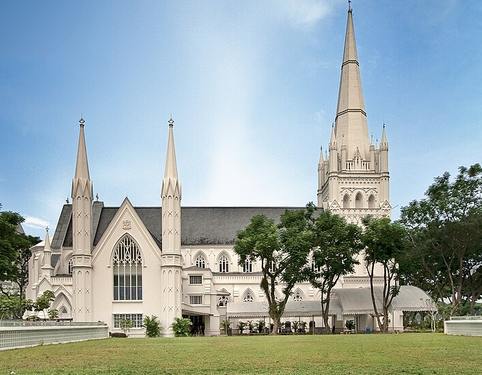
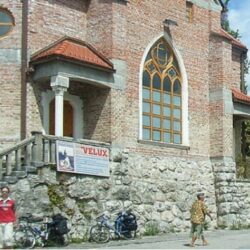
St. Andrew’s Cathedral, Singapore.
Religion follows ethnicity closely: Malays are almost entirely Muslim, Indians are mostly Hindu, and Chinese Singaporeans are spread across Buddhism, no religion, Christianity and Taoism.
Sources: Singapore Department of Statistics (Census of Population 2020 and General Household Survey 2025), Wikipedia’s Religion in Singapore, and Salt&Light’s coverage of the 2020 census.
Religion in Brazil by Region Religion in Brazil is a defining element of the country’s cultural identity and social structure. As the largest nation in…
Religion in Bosnia and Herzegovina Religion plays a central role in the history, identity, and social structure of Bosnia and Herzegovina. The country is widely…
HOW TINUBU APPOINTS HEADS OF AGENCIES BY RELIGION President Tinubu’s approach to appointing heads of agencies in Nigeria has sparked conversations around religious and ethnic diversity. Tinubu has…
Religion in Central African Republic The main religion in Central African Republic is Christianity and majority of the Christians in the country are Roman Catholics.…
Aksum religion In the 4th century AD, under King Ezana, Christianity was declared the empire’s official religion. The introduction of Christianity resulted…
Cape Verde population by religion Majority of Cape Verdeans are Christians. Roman Catholics make up the single largest religious community, close to 80% as of…
Cape Verde religion The vast majority of Cape Verdeans are Christians. This reflects centuries of Portuguese rule. Roman Catholics make up the single…
Burundi population by religion In Burundi Christians constitute 80–90% of the population, going by estimates, with Roman Catholics representing the largest group at 60–65%.…
What is the main religion in Burundi The main religion in Burundi is Christianity. Christians constitute 80–90% of Burundi population, going by estimates, with Roman Catholics representing…