Singapore’s Climate: Always Warm, Always Wet, Never Dull
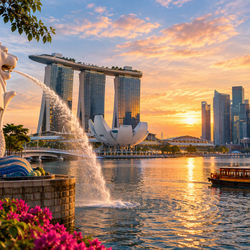
If you’re packing for Singapore, you can skip the winter coat and check the umbrella instead. This tropical island city-state, sitting just over one degree north of the equator, has one of the most predictable climates on Earth: hot, humid and rainy all year. The seasons here are marked by monsoon winds, not by temperature swings.
The figures below are climate normals for 1991 to 2020 from Singapore’s National Environment Agency, with record extremes drawn from 1929 to 1941 and 1948 to the present.
A year of near-constant warmth
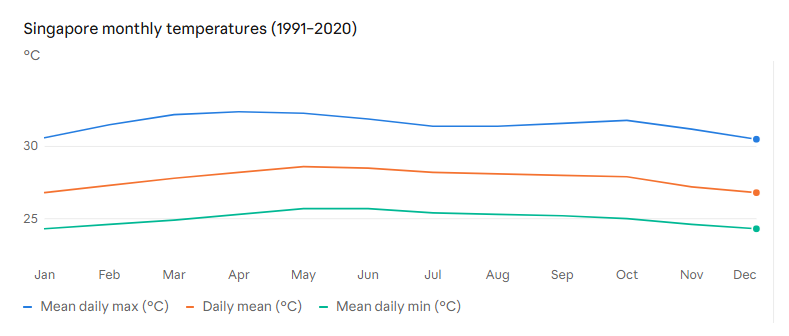
The average temperature in Singapore moves by less than two degrees across the entire year. The coolest months, December and January, average 26.8 °C (80.2 °F). The warmest, May, averages 28.6 °C (83.5 °F).
Daytime highs typically reach 30.5 to 32.4 °C (87 to 90 °F), and nights rarely drop below 24 °C (75 °F). The gap between a typical day’s high and low is only about 6.6 °C. The hottest month by daytime highs is April, at 32.4 °C (90.3 °F).
The extremes are modest too. The record high is 36.0 °C (96.8 °F), set in March, and the record low is 19.4 °C (66.9 °F), set in January. Even the coldest night on record would feel mild in many parts of the world.
Rain in every month
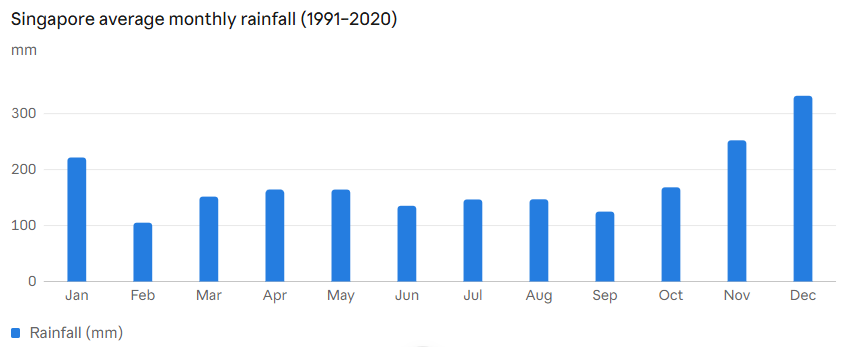
Singapore receives about 2,113 mm (83.2 in) of rain a year, spread over roughly 171 rainy days. That is far more than London, which gets around 600 mm.
The wettest month is December, with 331.9 mm (13.07 in), about 16% of the annual total. November to January together deliver roughly 38% of the year’s rain. The driest month is February, at 105.1 mm (4.14 in) over 9 rainy days.
Even the driest months are far from dry, and there’s no true dry season. If you’re visiting, expect a shower at some point whatever the month.
Humid, but sunny
Relative humidity sits between 80% and 86% all year, peaking in December (85.5%) and bottoming out in August and September (80.7%). Dew points stay around 23 to 24.5 °C (74 to 76 °F), which is why the air feels thick even on cooler days.
Despite the rain, Singapore is reasonably sunny, with about 2,074 hours of sunshine a year, or around 5.7 hours a day. February is the sunniest month (198.6 hours) and December the dullest (133.1 hours).
Understanding the seasons
Locals describe the year in terms of monsoons rather than summer and winter. The timing below is approximate and varies from year to year.
Northeast Monsoon (December to early March): The wettest and slightly cooler part of the year. December and January bring heavy rain, while February often offers a drier, sunnier break.
Inter-monsoon (April to May): Winds are light and variable. This is the hottest, most humid stretch, with frequent afternoon thunderstorms.
Southwest Monsoon (June to September): Somewhat drier, with brief showers. Hazy skies can occur when regional fires affect air quality.
Inter-monsoon (October to November): Thunderstorms become frequent and rainfall climbs steeply into November.
When to visit
There’s no bad time to visit for temperature, but timing still matters:
Best odds of dry weather: February, and the June to September period.
Sunniest: February and March.
Wettest: November to January, so pack a light rain jacket or umbrella.
Hottest and stickiest: April and May.
Measure
Value
Annual mean temperature
27.8 °C (82.0 °F)
Record high / low
36.0 °C (96.8 °F) / 19.4 °C (66.9 °F)
Annual rainfall
2,113.2 mm (83.2 in)
Rainy days per year
171
Average relative humidity
82.2%
Annual sunshine
2,074 hours
Sources: National Environment Agency (Singapore); NOAA (sunshine data, 1991-2020); Weather.Directory.
More
Climate of Singapore Singapore climate normals, extremes.1948-present Singapore has a tropical rainforest climate. Temperatures barely change through the year, humidity is high, and…
Forbidden Places You May Never Visit Some locations around the world are so mysterious, dangerous, or protected that they are entirely off-limits to visitors. From natural…
Afghanistan Climate and Recent Trends Afghanistan’s climate is highly diverse and strongly influenced by its complex topography. The country encompasses high mountain ranges (such as…
Egypt Climate by Month and Region Egypt, a land of ancient wonders and sun-soaked landscapes, is characterized by a predominantly arid desert climate. Its weather patterns…
Botswana Climate and Seasons Botswana’s climate is semi-arid though it is hot and dry for much of the year. The country experiences all the…
Cotonou climate As far as the climate is concerned, Cotonou is typically tropical. The city experiences two rainy seasons each year, the…
Climate of Benin Republic Benin has two (02) types of climate: In the south, an equatorial climate with high humidity. Alternating dry seasons (November…
Climate of Ogun State The climate of Ogun State follows a tropical pattern with the raining season starting about March and ending in November,…
Climate of Nasarawa State The State has a climate typical of the tropical zone because of its location and is quite pleasant. It has…
Ekiti state climate and vegetation Ekiti has plenty of sunshine to share practically all year round. When the rains to pour, Ekiti State becomes a…
Akwa Ibom climate Akwa Ibom has a tropical climate marked by two distinct seasons: the dry season (November – March) and the rainy…
Climate of Niger State Niger State experiences distinct dry and wet seasons with annual rainfall varying from 1,100mm in the northern part to 1,600mm…
Obudu Mountain Resort climate Obudu Mountain Resort has temperate climate. The climate is typical of the temperate regions of the world. The resort has…