The National Flag of Barbados: Meaning, Design, and Etiquette
The national flag of Barbados stands as one of the most powerful and instantly recognizable symbols of the country’s independence, identity, and heritage. Its design, colours, and display protocols reflect the island’s history, natural environment, and respect for national emblems. In this post, we explore the origin, symbolism, and rules governing the flag — offering a comprehensive guide for those seeking to understand or display it appropriately.
Design and Symbolism
🏳️ Appearance and Origins
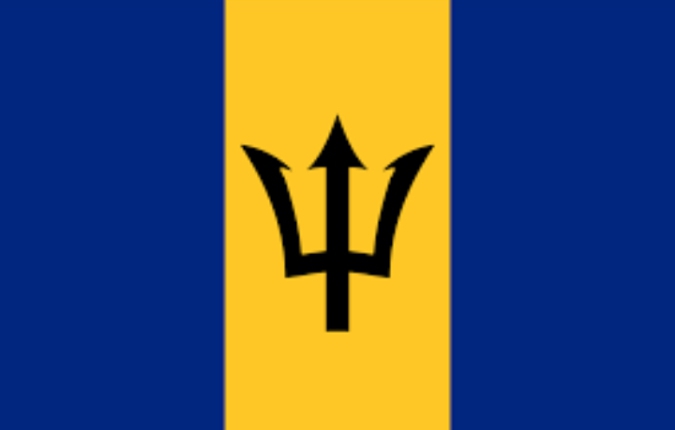
The flag consists of a vertical triband: two outer stripes of ultramarine (blue) and a central stripe of gold (yellow), with a black broken trident head centered on the gold band.
The design was submitted by Grantley W. Prescod, who won a nationwide competition from over a thousand entries.
The flag was officially adopted on 30 November 1966, the day of Barbados’s independence.
🎨 Colour Meanings and the Trident
The ultramarine blue stripes symbolize the sea and sky surrounding Barbados. The gold stripe represents the golden sand of its beaches.
The broken trident head carries deep symbolic weight: the trident comes from classical imagery of the sea god Neptune (reflecting marine associations), and its broken shaft signifies Barbados’s break from colonial rule and emergence as an independent nation.
The three prongs of the trident are often interpreted as standing for the three pillars of democracy: government “of the people, by the people, for the people.”
Protocols and Etiquette for Display
To preserve the flag’s dignity and respect the symbol of sovereignty, careful protocols govern how—and when—the flag may be displayed. These are codified in the national regulations.
📏 Proportions and Condition
The flag must follow the proportion 3:2 (width to height) for both land and sea usage.
The flag should always be in regulation condition — not faded, bleached, torn, or soiled. If damaged, it must be repaired before hoisting.
🏛️ How and Where to Fly the Flag
When placed on land, a white-painted flag-mast should be used, erected upright in a central or conspicuous location. On buildings, the mast may be upright on the roof or fixed at an angle at the front or balcony.
The national flag must take precedence over all other flags: it should not be flown below any other flag, and if displayed with other national flags, each must be on separate staffs of equal height, with no other flag above Barbados’s.
In group displays (e.g., multiple flags), the Barbados flag should occupy the centre and highest point.
When flown alongside others, the Barbados flag should be the first raised and the last lowered.
🕕 When to Display
On public buildings (e.g., government offices, official buildings) in the capital’s central square and elsewhere, the flag is flown daily from 6:00 a.m. to 6:00 p.m.
It may also be flown at other government buildings, schools (when in session), and places of business.
Outside these formal settings, a private citizen may fly the flag from an upright staff at the front of their home or business on a day of special significance (as designated by the relevant government authority).
As a general rule, it should not be flown after 6:00 p.m. unless indoors. On ceremonial occasions, it may be flown after sunset — preferably floodlit.
🎖️ Parades, Ceremonies, and Mourning
During parades or formal flag ceremonies involving other flags, the Barbados flag is to be carried on the marching right (or in front at the centre of the line). While hoisting or lowering, all persons present should stand at attention and face the flag.
The flag may be flown at half-staff as a mark of mourning. The correct procedure calls for raising the flag first to the peak, then lowering it to half-staff; before final lowering, it must again be raised to the peak. The decision to fly the flag at half-staff rests with the national government (Cabinet).
🚫 Prohibited Uses
The flag must be treated with respect and must never be used in ways that degrade or commercialise it:
It should not be dipped to any person or object (except in maritime use).
The broken-trident should never be inverted — except when used as a distress signal at sea.
The flag should not be used on floats, motor vehicles, boats (unless from a proper staff/mast), as drapery, advertising, clothing, furniture, or as a receptacle.
It must not be allowed to touch the ground, water, floor, vehicles, or other surfaces.
Historical Context: From Colony to Independent Emblem
Prior to independence, Barbados used colonial flags, combining British symbols (like the Union Jack) with colonial emblems.
With the move toward sovereignty, the government launched a public contest for a new national flag — an effort that culminated in the selection of Grantley Prescod’s design.
On 30 November 1966, the day Barbados gained independence, the colonial flag was lowered and the new national flag hoisted — marking the symbolic birth of a free and self-governing nation.
Importance and Meaning Today
The flag continues to serve as more than a piece of fabric.
It encapsulates the island’s natural beauty — sea, sky, and beach — reminding citizens and visitors of Barbados’s unique physical environment.
It symbolizes freedom — the broken trident as a resolute declaration of independence and rejection of colonial rule.
It affirms national identity and unity — a shared emblem under which all Barbadians, regardless of background, stand together.
Through its strict etiquette and display protocols, it fosters respect for national symbols, ensuring the flag remains dignified.
The National Flag of Barbados
The national flag of Barbados is a carefully crafted symbol, rich in meaning and steeped in historical significance. From its distinctive design — the blue and gold stripes alongside the broken trident — to the rigorous protocols governing its display, the flag embodies Barbados’s heritage, natural environment, and sovereign identity.
Properly understanding and honouring the flag’s symbolism and etiquette allows citizens and admirers alike to appreciate the gravitas of what it represents — a proud nation built on independence, unity, and respect.
Akwa Ibom Flag and its meaning The flag of Akwa Ibom State has 3 colours: Orange, white and green. The white colour is in the form…
Osun State flag and its meaning The seven cowries represent the seven grandsons of Olofin Oduduwa. Their military valour, diplomatic dexterity and trade mastery created wealth…
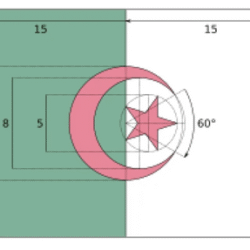
Flag of Algeria and its meaning The flag of Algeria is a national symbol of the country. Significance of the colors on the flag The flag…
Angola flag meaning The National Flag of Angola has two colors arranged in two horizontal stripes. The upper stripe is red-red and the…
Meaning of Benin flag The meaning of the colors is explained in the New Dawn, the national anthem of Benin. Green is a reminder…
Meaning of Angola flag The National Flag has two colors arranged in two horizontal stripes. The upper stripe is red-red and the lower one…
Algerian National Flag Algerian National Flag: Meanings, Dimensions The national flag of Algeria is a powerful symbol of the country’s identity, history, and…