The Belgium federal state structure is one of the most distinctive and intricate governmental systems in the world. Within the first ten percent of this article, it’s important to highlight that this system emerged from deep historical, cultural, and linguistic developments that shaped Belgium for centuries. Today, Belgium stands as a powerful example of how political compromise, cultural identity, and administrative decentralization can coexist under one federal model.
The foundation of this structure came from centuries of linguistic tension, particularly between Dutch-speaking Flemings and French-speaking Walloons. Over time, the country moved from a centralized monarchy to a highly decentralized federal state, balancing autonomy with unity. In this article, we break down its origins, its layers, and why it remains one of the most complex but successful federal models in Europe.
Historical Foundations of Belgium’s Linguistic Division
Belgium didn’t become federal overnight. The roots trace back to the Burgundian and Habsburg courts, where French was the language of prestige. By the 19th century, speaking French became a requirement for participating in government or high society. Dutch speakers, mainly in Flanders, were treated as second-class citizens.
This inequality sparked Flemish movements in the late 19th and early 20th centuries. These movements challenged the dominance of French and fought for the recognition of Dutch as an equal language. Progress came slowly, especially in education, where Flemings eventually gained linguistic rights. After World War II, linguistic tensions intensified, pushing Belgium toward structural reforms that aimed to protect the interests of all communities.
How Belgium Transitioned Into a Federal State
Belgium’s path to federalism unfolded step-by-step through constitutional reforms. Beginning in the 1960s, the government defined four major language areas:
Dutch-speaking
French-speaking
German-speaking
Bilingual (Brussels)
This crucial step acknowledged the country’s linguistic borders and set the stage for institutional autonomy. Constitutional revisions in 1970, 1980, 1988, and 1993 gradually shifted Belgium from a unitary state to a full federal state. Unlike many federations, Belgium based its system not just on regions but on cultural-linguistic communities.
By 1993, Belgium officially became a federal state with three major levels of power:
Federal Government
Language Communities
Territorial Regions
This unique dual-structure—one based on language, the other on land—makes Belgium the only country with overlapping federal entities sharing jurisdiction.
The Federal Government: Powers, Responsibilities, and National Role
The federal level maintains authority over matters that affect all Belgians equally. This includes:
Defense
Justice
Social security
Monetary policy
Public debt
Federal police
Nuclear energy
Large national companies like the Belgian Railways and the Belgian Post Group operate under federal oversight. The federal government is also responsible for Belgium’s commitments to NATO and the European Union, playing a major role in diplomacy and national security.
Despite decentralization, nearly 50% of the national fiscal budget (excluding debt) falls under federal control. Surprisingly, only 12% of civil servants work at the federal level, highlighting the distribution of power across other government layers.
Language Communities: Culture, Education, and Personal Services
Belgium’s three language communities—the Flemish, French, and German-speaking—manage powers tied to people rather than geography. Their authority includes:
Education
Culture
Audiovisual media
Personal health services
Youth protection
Assistance for families
Social welfare
The Flemish Community, interestingly, merged its community and regional institutions into a single government and parliament. This means Flanders manages nearly everything except federal and certain municipal matters under a unified system.
The German-speaking Community, though small, possesses broad cultural and educational autonomy and continues to gain additional powers through cooperation agreements.
The Regions: Economy, Land, and Infrastructure
Belgium’s three regions—the Flemish Region, the Walloon Region, and the Brussels-Capital Region—have authority over territory-based matters. These include:
Economy and employment
Agriculture and water policy
Environment
Public works
Energy
Transport
Town and country planning
Nature conservation
Housing
Foreign trade
Regions also supervise provinces, municipalities, and intercommunal organizations.
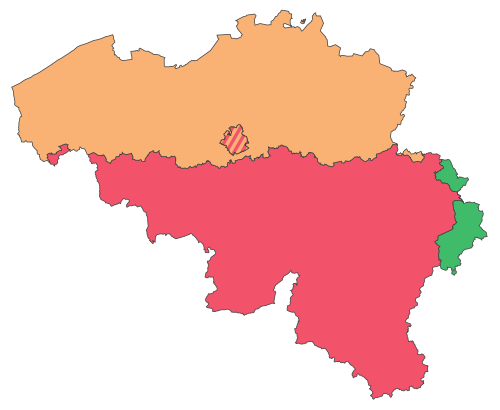
Brussels, although geographically within Flanders, is officially bilingual and home to institutions belonging to both the Flemish and French Communities. This overlapping jurisdiction is one of Belgium’s most unique federal features.
Why Overlapping Boundaries Matter
Because communities and regions overlap, Belgium’s federal system handles cross-authority disputes through the Constitutional Court, ensuring no single entity oversteps its power.
Two major peculiarities define the structure:
Brussels belongs to both the Flemish and French Communities.
The German-speaking Community lies entirely within the Walloon Region.
This design isn’t accidental—it was built as a compromise model, allowing different linguistic groups to coexist while preserving their cultural identities.
Shared and Mixed Responsibilities
Not everything is perfectly divided. In many fields, the federal government, regions, and communities share responsibilities. A clear example is education:
Communities manage teaching content, culture, and administration.
The federal government sets compulsory education rules and minimum qualification requirements.
All levels can participate in international relations and scientific cooperation within their areas of authority. Belgium is also known for granting its regions and communities expansive treaty-making powers, making them some of the most internationally autonomous federated units in the world.
FAQs About the Belgium Federal State Structure
Q1: Why is Belgium considered one of the most complex federal states in the world? Because it combines territorial regions with cultural-linguistic communities, creating overlapping jurisdictions that don’t exist in any other country.
Q2: What triggered Belgium’s transition to federalism? Rising linguistic tensions and demands for cultural autonomy, especially from the Flemish community, pushed the country toward decentralization.
Q3: How many governments does Belgium have? Up to six, including: the federal government, three community governments, and three regional governments (though Flanders merged its community and region into one).
Q4: What powers do communities hold? Communities manage culture, education, language use, and personal services like social welfare and health assistance.
Q5: Who governs Brussels? Brussels has its own regional government but falls under both the Flemish and French Community authorities for cultural and educational matters.
Q6: How does Belgium handle conflicts between its different governments? The Constitutional Court resolves jurisdictional disputes to maintain balance and prevent institutional conflict.
A Model of Compromise and Cultural Respect
The Belgium federal state structure is a testament to compromise, identity, and coexistence. Belgium transformed centuries of linguistic tension into a decentralized system that empowers communities and regions while maintaining national unity. Although complex, the structure allows diverse cultures to live together peacefully and maintain their unique heritage.
Belgium stands as a global example of how delicate political balance can protect cultural rights without sacrificing federal stability.
World Heritage Sites in Belgium UNESCO World Heritage Sites in Belgium are: Flemish Béguinages La Grand-Place, Brussels The Four Lifts on the Canal du Centre…
Belgium Communities, Regions, and Language Areas Belgium’s institutional structure is one of the most sophisticated in Europe. Shaped by linguistic diversity, historical compromise, and successive waves…
UNDERSTANDING GLOBAL MARKETING RESEARCH Global marketing is the technique of promoting, selling and distributing a product/service worldwide. It is a field of study in…
Structure of Ekiti State Judiciary The Ekiti State Judiciary, is the third arm of government (after Executive and Legislature). It is made up broadly of…
Lagos State government structure The Government of Lagos State is made up of three statutory organs: The Executive The Legislature The Judiciary An Executive…
Nigeria police salary structure The Nigerian Police salary structure implemented in year 2023 describes the amount paid as salary to employees of the Nigerian…
NIGERIA POLICE FORCE STRUCTURE The structure of the Nigeria Police Force is provided for in section 214 (2)(a) and 215(2) of the 1999 Constitution.…
Kogi Political Structure Kogi State consists of three senatorial districts, namely: Kogi Western Senatorial District Kogi Central Senatorial District Kogi Eastern Senatorial District…