Why Singapore Runs on “Early” Time: Inside UTC+8, Equatorial Sun, and Shifting Clocks
If you look at a map of the world, Singapore sits around 103.8° East longitude—a spot that geographically aligns closer to UTC+7. Yet every single day of the year, Singapore runs on Singapore Time (SGT)—also called Singapore Standard Time (SST)—at UTC+8, with no Daylight Saving Time (DST).
That deliberate one-hour “offset” shapes everything from when the sun rises and sets to how effortlessly Singapore connects with regional financial hubs.
Equatorial Daylight: Why Sunsets Barely Budge
Because Singapore lies just over one degree north of the equator, its daylight rhythm looks very different from temperate countries. Instead of dramatic winter darkness or 16-hour summer days, Singapore gets roughly 12 hours of daylight year-round, and twilight fades quickly—often in under half an hour.
Running on UTC+8 shifts solar noon slightly later into the afternoon (around 12:50 PM to 1:18 PM depending on the month), giving residents brighter evenings after work without needing seasonal clock changes.
Month
Typical Sunrise – Sunset (SGT)
What It Feels Like
February
07:14 – 19:19
Later mornings and evening light stretching past 7:15 PM
July
07:04 – 19:16
Early-seven-ish dawn with long, warm dusk past 7:15 PM
November
06:47 – 18:50
Earlier sunrise and dusk wrapping up just before 7:00 PM
A Century of Clock Shifts: How Singapore Landed on UTC+8
Singapore’s current clock wasn’t set by geography alone—it’s the product of regional coordination, wartime history, and commerce:
Early solar & regional offsets: Before June 1905, Singapore followed local mean time near GMT+06:55, before shifting to GMT+07:00 and later experimenting with 20- and 30-minute adjustments in the 1930s and 1941.
World War II: During the Japanese occupation (1942–1945), clocks were moved to Tokyo time (GMT+09:00) before reverting to GMT+07:30 after the war.
The 1982 jump to UTC+8: On December 31, 1981 at 11:30 PM, Singapore moved its clocks forward by 30 minutes to enter January 1, 1982 on UTC+8. The move aligned peninsular Singapore and Malaysia with East Malaysia and major Asian business centers like Hong Kong, Beijing, Taipei, and Perth.
Why UTC+8 Matters Today
For travelers, remote workers, and global teams, SGT (Asia/Singapore in the IANA time zone database) is refreshingly predictable:
Zero DST math: Singapore never springs forward or falls back. Any shift in the time difference between Singapore and cities like London, New York, or Los Angeles comes from those cities changing their clocks.
Built-in regional sync: Sharing UTC+8 with major hubs across East and Southeast Asia simplifies trading hours, flights, and cross-border operations.
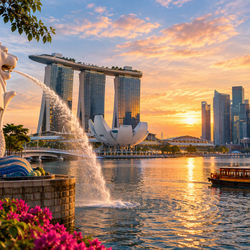
Equatorial sunset over Marina Bay. Source: aramidko / Getty Images
Consistent evenings: Even in months like November when sunset dips below 7:00 PM, the offset keeps evening hours usable without seasonal whiplash.
List of states in Nigeria with dates of creation and names of presidents at the time of creation List of Nigeria’s 36 states and the Federal Capital Territory AbiaAdamawaAkwa IbomAnambraBauchiBayelsaBenueBornoCross RiverDeltaEbonyiEdoEkitiEnuguFederal Capital Territory, AbujaGombeImoJigawaKadunaKanoKatsinaKebbiKogiKwaraLagosNasarawaNigerOgunOndoOsunOyoPlateauRiversSokotoTarabaYobeZamfara List of 5 states…
History of Equatorial Guinea Before the advent of Christianity, the inhabitants of Guinea were hunters and lived on fruit and foodstuff gathering, traces of…