Barbados, a vibrant island nation in the eastern Caribbean, possesses a rich and dynamic demographic profile shaped by centuries of cultural exchange, migration, and sociopolitical development. Its population characteristics—spanning ethnicity, language, and religion—form a distinctive national identity that influences every aspect of Barbadian life. This educational overview explores these key demographic dimensions in detail.
Population Growth and Composition
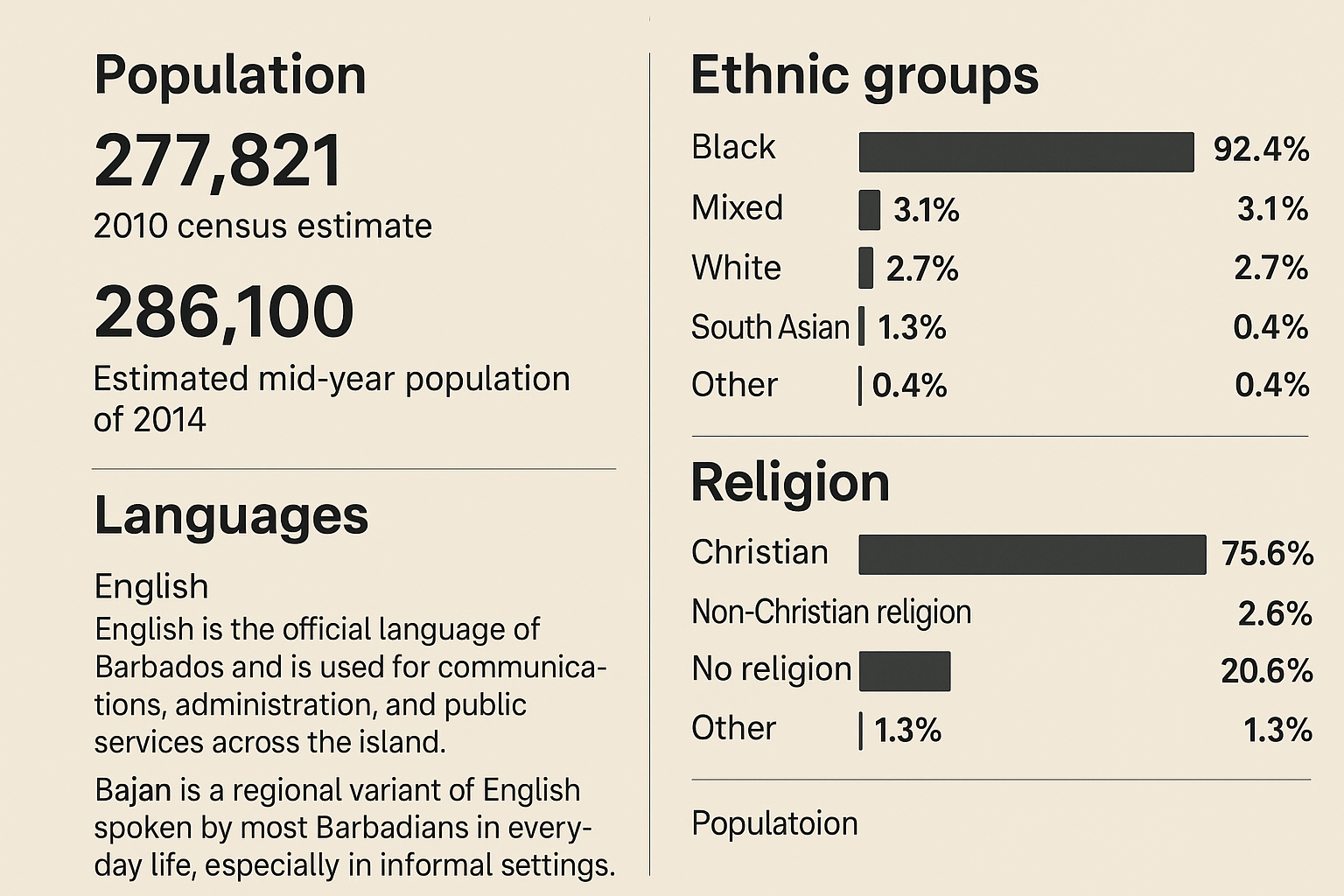
Barbados recorded an estimated 277,821 inhabitants in the 2010 census, though the official tabulated figure, 226,193, reflected a notable 18% undercount. Continued demographic monitoring shows a steady upward trend, with an estimated mid-2014 population of 286,100 under the medium-fertility scenario of global population projections.
Several factors influence population change in Barbados:
Gradual natural increase driven by moderate fertility levels
High life expectancy, among the highest in the Caribbean
Migration flows, including both returning nationals and foreign workers
This results in a relatively stable population profile that supports the island’s social framework and labor market.
Ethnic Composition
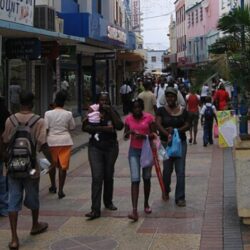
Barbados is widely recognized for its cultural richness, much of which stems from its ethnic diversity. According to census data:
92.4% of the population identifies as Black
3.1% identifies as Mixed
2.7% identifies as White
1.3% is of South Asian origin
The remaining 0.4% includes East Asian and Middle Eastern communities
This composition reflects centuries of historical movements, including African ancestry connected to the plantation era, European settler influences, and later Asian and Middle Eastern migration. Today, these communities contribute to Barbados’s culinary traditions, religious institutions, and artistic expressions.
Languages of Barbados
English serves as the official language of Barbados, used throughout government, education, and media. While strongly influenced by British English, Barbadian English incorporates distinctive local pronunciations and vocabulary.
Alongside the official language is Bajan, the island’s widely spoken creole-influenced vernacular. Used primarily in informal settings, Bajan varies in its degree of creolization and, in its most localized form, may be difficult for non-Barbadian English speakers to understand.
Key features of the linguistic landscape include:
Diglossia, with Standard English and Bajan coexisting
Influence from neighbouring Caribbean dialects
Preservation of oral traditions, storytelling, and music shaped by Bajan speech
The coexistence of these linguistic forms enriches Barbados’s cultural identity and communication patterns.
Religious Landscape
Barbados exhibits a predominantly Christian religious profile:
75.6% Christian
2.6% non-Christian religions
20.6% identify with no religion
Within Christianity, several denominations play significant roles:
Anglicanism (23.9%) – long-established and historically influential
Pentecostal (19.5%) – rapidly expanding with vibrant worship practices
Seventh-day Adventist (5.9%), Methodist (4.2%), and Roman Catholic (3.8%) communities also form important segments
Smaller Christian groups include Wesleyans, Nazarenes, Jehovah’s Witnesses, Baptists, and others.
Non-Christian faiths contribute to the island’s pluralism:
Muslims (0.7%), largely of Gujarati Indian heritage
Rastafarians (1.0%), growing since the 1970s
Hindus (0.5%), Jews (0.05%), Baha’is, and Buddhists
This blend reveals a society anchored in religious tradition yet increasingly receptive to diverse belief systems.
The demographics of Barbados tell a compelling story of multicultural evolution, linguistic richness, and religious diversity. These characteristics not only define the island’s social fabric but also shape its educational systems, artistic heritage, and national identity. Understanding these dynamics offers valuable insight into how Barbados continues to balance tradition and modernity as it progresses through the twenty-first century.
Major ethnic groups, languages in Edu The major ethnic groups, languages in Edu are: Nupe, Yoruba and Hausa. Edu, a Local Government Area in Kwara State…
Baruteen ethnic groups, languages The major ethnic groups, languages in Baruteen are Batonu, Hausa, Fulani, Yoruba and Bokobaru. Baruteen Local Government Area was created from…
Plateau people, tribes, ethnic groups, languages Plateau state has over forty ethno-linguistic groups. Some of the indigenous tribes in the state are:BeromAfizereAmoAnagutaAtenBogghomBujiChallaChipFierGashishGoemaiIrigweJarawaJukunKofyar (comprising Doemak Kwalla and…
Ethnic Communities of Barbados Barbados is widely recognised for its rich cultural tapestry, shaped by centuries of migration, colonial influence, and global exchange. While…
Demographics of Ogun State The population of Ogun State during the 1991 Census was 2,333,726. With its growth rate of 2.83 per cent per…
LIST OF TOP 10 RELIGIONS With the exception of Christianity, the rest are self styled salvation that goes no where ChristianityPrincipal person: Jesus Christ United…