Religion in Benin: Distribution, History, and Social Influence
Religion in Benin represents one of the most diverse and historically layered belief systems in West Africa. The country’s religious landscape is shaped by indigenous African traditions, centuries of trans-Saharan and coastal trade, Islamic scholarship, European missionary activity, and modern Christian movements. Today, Benin is widely regarded as a model of religious coexistence, where multiple faiths operate freely and often intersect within families, communities, and cultural practices.
Overview of Religious Composition in Benin
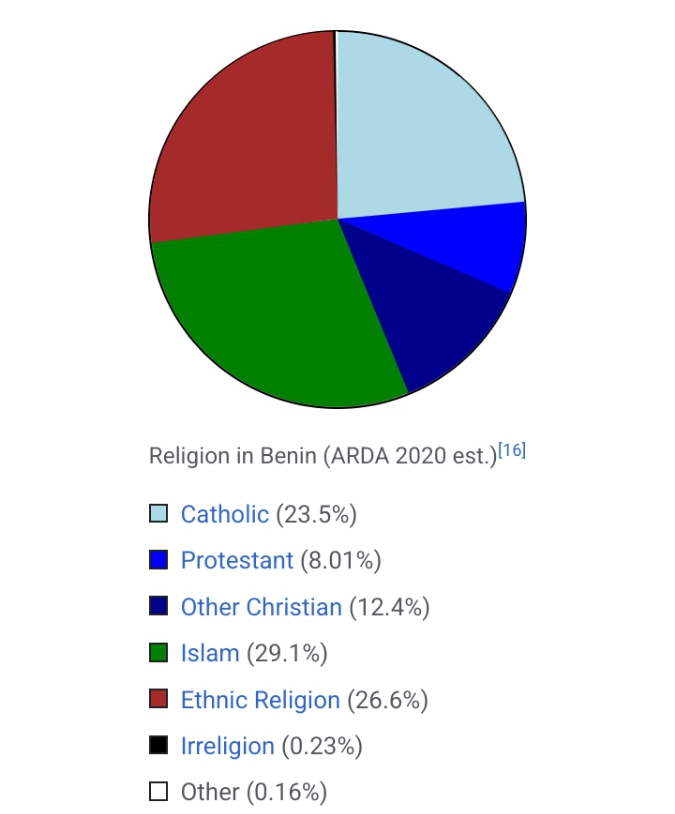
According to the Association of Religion Data Archives (ARDA) 2020 estimates, Benin’s population is distributed across several major religious traditions:
Catholic Christianity: 23.5%
Protestant Christianity: 8.01%
Other Christian denominations: 12.4%
Islam: 29.1%
Ethnic and traditional religions: 26.6%
Irreligion: 0.23%
Other religions: 0.16%
These figures highlight two defining characteristics of Benin’s religious identity: the strong presence of Islam and Christianity alongside the enduring vitality of African traditional religions, particularly Vodoun.
Earlier estimates from Pew Forum and national surveys show some variation but confirm the same overall pattern. In 2013, Islam accounted for approximately 27.7% of the population, Roman Catholicism 25.5%, Protestantism 13.5%, Vodoun 11.6%, and other traditional religions 2.6%. Pew Forum estimated that in 2010, Christians collectively made up over 53% of the population, with Catholics at 30% and Protestants at 23.2%.
Christianity in Benin
Christianity is one of the dominant religious forces in Benin, with Roman Catholicism being the single largest denomination. Catholic influence dates back to the Portuguese presence along the Bight of Benin in the 15th and 16th centuries, intensifying during French colonial rule in the late 19th and early 20th centuries. Catholic institutions played a central role in education, healthcare, and administration, contributing to their long-term social influence.
Protestant Christianity in Benin includes a wide range of denominations, such as Methodists, Baptists, Evangelicals, and African-initiated churches. One of the most distinctive movements is the Celestial Church of Christ, founded in 1947 in present-day Benin. The church has since expanded across West Africa and into Europe and the Americas, blending Christian theology with African spiritual symbolism.
Other Christian groups include Pentecostal and Charismatic churches, which have grown rapidly since the 1980s, particularly in urban areas. These churches often emphasize healing, prophecy, and prosperity teachings, attracting younger populations and urban professionals.
Islam in Benin
Islam is practiced by roughly one-third of Benin’s population, making it the largest single religious affiliation in some estimates. Islamic influence entered the region through trans-Saharan trade routes and the expansion of Sahelian empires such as the Songhai Empire. Muslim communities are particularly concentrated in northern Benin among ethnic groups such as the Bariba, Dendi, and Fulani, though Islam is also present in southern cities due to internal migration and trade.
Most Muslims in Benin follow Sunni Islam, primarily of the Maliki school of jurisprudence. Islamic life is structured around mosques, Quranic schools, and religious associations that play an important role in community cohesion, moral education, and conflict mediation. Islamic festivals such as Eid al-Fitr and Eid al-Adha are nationally recognized and widely observed.
African Traditional Religions and Vodoun
Benin is internationally recognized as the historical heartland of Vodoun, one of the most influential African traditional religions. Vodoun is not merely a belief system but a comprehensive worldview encompassing cosmology, ethics, medicine, music, dance, and social organization. It involves the veneration of a supreme creator, lesser deities known as vodun, ancestral spirits, and natural forces.
Approximately one-quarter of Benin’s population adheres primarily to ethnic or traditional religions, with Vodoun being the most prominent. The religion remains especially strong among the Fon, Ewe, and related groups in southern Benin. January 10 is officially celebrated as National Vodoun Day, a public holiday that reflects state recognition of traditional religion as a core component of national heritage.
Notably, many Beninese practice religious syncretism, combining elements of Vodoun with Christianity or Islam. It is common for individuals who identify as Christian or Muslim to participate in traditional rituals, consult traditional priests, or observe ancestral customs.
Religious Freedom and Coexistence
Benin’s constitution guarantees freedom of religion, and the country consistently ranks as one of the most religiously tolerant societies in Africa. Interfaith marriages are common, and it is not unusual for members of the same family to practice different religions. Religious conflicts are rare, and faith-based organizations often collaborate on social initiatives such as education, healthcare, and poverty alleviation.
The government maintains a secular stance while recognizing major religious holidays from Christianity, Islam, and traditional religions. This inclusive approach has contributed significantly to social stability and national cohesion.
Social and Cultural Impact of Religion
Religion in Benin extends far beyond personal belief. It influences naming practices, festivals, political discourse, moral values, and artistic expression. Music, dance, sculpture, and oral traditions are deeply infused with religious symbolism, particularly from Vodoun. Religious leaders, whether priests, pastors, or imams, often serve as community authorities and mediators.
In modern Benin, religion also intersects with globalization. Diaspora communities have carried Beninese religious traditions abroad, while global Christian and Islamic movements continue to shape local expressions of faith.
Religion in Benin is characterized by diversity, historical depth, and remarkable coexistence. Islam, Christianity, and African traditional religions all play significant and enduring roles in shaping the country’s identity. Rather than replacing one another, these belief systems have interacted, adapted, and coexisted for centuries, producing a unique religious environment that continues to define Benin’s social and cultural life.
History of Benin Republic Benin Republic was occupied previously by many kingdoms, namely: Danhomé (Abomey), Xogbonou (Porto-Novo), Allada, Nikki, Kouandé, Kandi among others. Flag…
Benin Republic history The present day Benin was occupied by several kingdoms. The most prominent were called Danhomé (Abomey), Xogbonou (Porto-Novo), Allada, Nikki,…
Religion in Bosnia and Herzegovina Religion plays a central role in the history, identity, and social structure of Bosnia and Herzegovina. The country is widely…
Religion in Brazil by Region Religion in Brazil is a defining element of the country’s cultural identity and social structure. As the largest nation in…
HOW TINUBU APPOINTS HEADS OF AGENCIES BY RELIGION President Tinubu’s approach to appointing heads of agencies in Nigeria has sparked conversations around religious and ethnic diversity. Tinubu has…
Religion in Central African Republic The main religion in Central African Republic is Christianity and majority of the Christians in the country are Roman Catholics.…
Aksum religion In the 4th century AD, under King Ezana, Christianity was declared the empire’s official religion. The introduction of Christianity resulted…
Cape Verde population by religion Majority of Cape Verdeans are Christians. Roman Catholics make up the single largest religious community, close to 80% as of…
Cape Verde religion The vast majority of Cape Verdeans are Christians. This reflects centuries of Portuguese rule. Roman Catholics make up the single…
Burundi population by religion In Burundi Christians constitute 80–90% of the population, going by estimates, with Roman Catholics representing the largest group at 60–65%.…
What is the main religion in Burundi The main religion in Burundi is Christianity. Christians constitute 80–90% of Burundi population, going by estimates, with Roman Catholics representing…
Burundi religion Christians constitute 80–90% of Burundi population, going by estimates, with Roman Catholics representing the largest group at 60–65%. Protestant and…
RELIGION IN ONDO STATE By religion, Ondo State people are mostly Christians (present day) while a sizable number of Muslims can be found in Ikare,…
List of Benin’s 12 Departments and 77 Communes Benin Republic is divided into 12 departments (French: départements), which together are subdivided into 77 communes, forming the primary units…