Uzbek Language: Number of Speakers, Locations, Dialects, Syntax, Vocabulary
The Uzbek language is one of the most widely spoken Turkic languages in Central Asia and plays a vital role in the cultural and national identity of Uzbekistan. Spoken by tens of millions of people across several countries, Uzbek is known for its rich history, agglutinative grammar, and evolving writing systems. This blog article offers a clear, engaging, and well-structured overview of the Uzbek language, making it ideal for students, linguists, and curious readers alike.
Geographical Distribution of the Uzbek Language
The Uzbek language is primarily spoken in Uzbekistan, where it is the dominant and official language. Approximately 75% of the population of Uzbekistan uses Uzbek as their main language of communication. Beyond national borders, Uzbek has a significant presence throughout Central Asia and neighboring regions.
Countries Where Uzbek Is Spoken
Uzbekistan – 20,000,000 speakers
Afghanistan – 1,500,000 speakers
Tajikistan – 1,300,000 speakers
Kyrgyzstan – 600,000 speakers
Kazakhstan – 350,000 speakers
Turkmenistan – 350,000 speakers
China (Xinjiang Province) – 15,000 speakers
In total, there are approximately 24 million native speakers of the Uzbek language worldwide.
Official Status and Importance
The Uzbek language holds the status of official language of Uzbekistan, where it is used in government, education, media, and public life. Since independence from the Soviet Union, Uzbekistan has actively promoted Uzbek as a symbol of national identity and cultural revival.
Dialects and Varieties of Uzbek
The standard form of the Uzbek language is based on the Tashkent dialect, spoken in the capital city. However, Uzbek is far from uniform and includes several regional varieties:
Western Uzbek (influenced by Oghuz and Kipchak Turkic languages)
Ferghana Valley dialects
Northern Uzbek dialects
Afghan Uzbek
These dialects differ in pronunciation, vocabulary, and vowel harmony, yet remain mutually intelligible.
Phonology: Sounds of the Uzbek Language
Vowels
Uzbek has nine vowel sounds, though pronunciation varies widely across dialects. Vowel harmony exists but is generally weak and inconsistent, especially in modern standard Uzbek.
Consonants
The language uses 24 consonant sounds, many of which are typical of Turkic languages.
Script and Writing System
The Uzbek language has undergone several script changes over the last century:
Arabic script (used until 1927)
Cyrillic script (used during the Soviet period)
Latin-based alphabet (officially adopted in 1993)
Modern Uzbek Alphabet
The current Latin-based Uzbek alphabet consists of 29 letters. However, it uses only six vowel letters (a, e, i, o, u, o‘), which do not always distinguish between front and back vowels. Because of this, linguists often rely on special transliteration systems for accurate phonetic representation.
Morphology: How Uzbek Words Are Formed
The Uzbek language is agglutinative, meaning words are formed by adding multiple suffixes to a root.
Nominal Morphology
Nouns can take suffixes in a fixed order:
Number
Possession
Case
Key Features
No grammatical gender
Plural marker:-lar
Six possessive suffixes, one for each person and number
Case System in Uzbek
Uzbek has seven grammatical cases:
Case
Suffix
Function
Nominative
—
Subject
Accusative
-ni
Direct object
Genitive
-ning
Possession
Dative
-ga
Direction / indirect object
Locative
-da
Location / time
Ablative
-dan
Origin
Equitative
-day / -cha
Comparison
The equitative case is unique and not common to all Turkic languages.
Pronouns in the Uzbek Language
Uzbek uses several types of pronouns:
Personal
Demonstrative
Interrogative
Reflexive
Indefinite
Demonstrative System
Uzbek has a four-way demonstrative distinction:
bu – this
shu – that (near)
osha – that (far)
u – that (out of sight)
Verbal System and Tenses
Uzbek verbs are rich and expressive, often formed with auxiliary verbs.
Tense and Aspect
Uzbek includes:
Present (simple, progressive, momentary)
Past (simple, imperfective, perfect, indirective)
Future (definite and aorist)
The indirective past is especially interesting, as it expresses events inferred from evidence.
Mood and Voice
Moods
Indicative
Optative
Imperative
Conditional
Deontic-permissive
Voices
Active
Middle
Passive
Reciprocal
Causative
These voices are formed through specific suffixes attached to the verb stem.
Syntax and Sentence Structure
The Uzbek language follows a Subject–Object–Verb (SOV) word order, typical of Turkic languages. However, topical elements can be moved to the front for emphasis.
Key Syntax Rules
Modifiers precede nouns
No obligatory plural agreement
Postpositions are used instead of prepositions
Relative clauses rely on participles
Vocabulary and Loanwords
Uzbek vocabulary reflects its history:
Persian and Arabic loans via Chaghatay
Russian influence from the Soviet era
Despite these influences, Uzbek maintains a strong Turkic core.
Basic Uzbek Vocabulary
English
Uzbek
one
bir
two
ikki
father
ota
mother
ona
head
bosh
eye
ko‘z
hand
qo‘l
heart
yurak
tongue
til
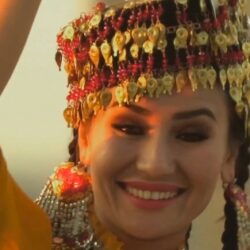
Uzbek people
Frequently Asked Questions (FAQs)
1. Is the Uzbek language difficult to learn?
Uzbek grammar is logical and regular, making it easier than many languages once the suffix system is understood.
2. Is Uzbek similar to Turkish?
Yes, both are Turkic languages, but Uzbek has more Persian and Russian influence.
3. What script is Uzbek written in today?
Officially, Uzbek uses a Latin-based alphabet.
4. How many people speak the Uzbek language?
Around 24 million people speak Uzbek as their first language.
5. Does Uzbek have grammatical gender?
No, the Uzbek language does not use grammatical gender.
6. Where can I learn more about Turkic languages?
You can explore linguistic maps and resources at sites like Languages Gulper for comparative studies.
SPEAKERS OF HOUSE OF ASSEMBLY, BAYELSA STATE BAYELSA STATE SPEAKERS OF THE HOUSE OF ASSEMBLY FIRST ASSSEMBLY (1999-2003) Rt. Hon. Heineken Lokpobiri (Ekeremor II) June 1999-May 2001…