Bosnia and Herzegovina is one of the most ethnically diverse countries in Southeast Europe. Its social fabric has been shaped by centuries of shared history, migration, religion, and political change. Today, the country is officially recognized as the homeland of three constituent peoples, alongside several smaller minority communities.
Ethnic Composition
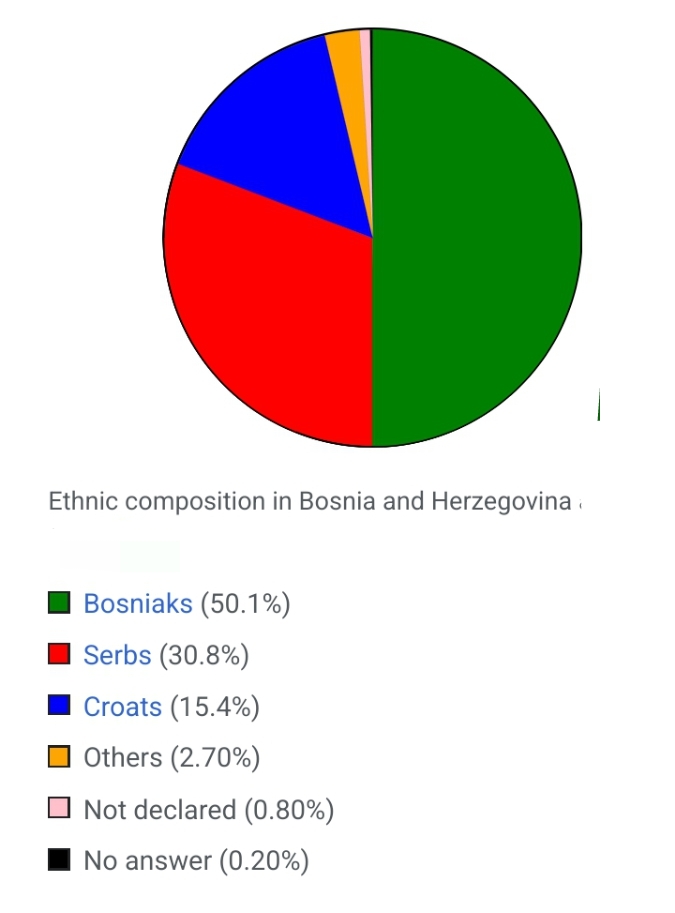
According to the 2013 population census, Bosnia and Herzegovina has a clear but complex ethnic structure. The population is primarily made up of three major ethnic groups, with smaller percentages belonging to other communities or choosing not to declare an ethnic identity.
Ethnic composition (2013):
Bosniaks – 50.1%
Serbs – 30.8%
Croats – 15.4%
Others – 2.7%
Not declared – 0.8%
No answer – 0.2%
This distribution varies significantly by region and municipality, creating a mosaic of ethnic majorities across the country.
The Three Constituent Peoples
Bosniaks
Bosniaks form the largest ethnic group in Bosnia and Herzegovina. They are predominantly Muslim and are most concentrated in central Bosnia and parts of the Federation of Bosnia and Herzegovina. Bosniak culture has been strongly influenced by Ottoman history, contributing to the country’s architecture, cuisine, and traditions.
Serbs
Bosnian Serbs are mainly Orthodox Christians and are the majority population in Republika Srpska, one of the country’s two political entities. Serbian cultural and religious heritage plays an important role in eastern and northern parts of the country.
Croats
Croats in Bosnia and Herzegovina are largely Catholic and are primarily concentrated in western Herzegovina and parts of central Bosnia. They share close cultural and historical ties with neighboring Croatia.
Minority Communities
In addition to the three main ethnic groups, Bosnia and Herzegovina is home to several smaller but historically significant communities, including:
Roma
Jewish communities, particularly Sephardic Jews with roots dating back to the 15th century
Other ethnic and national minorities
These groups contribute to the country’s cultural diversity, languages, and traditions.
Census Controversy and Political Debate
The 2013 census results have not been universally accepted. Officials and political leaders from Republika Srpska disputed the figures, mainly over the inclusion of people considered non-permanent residents. This disagreement reflects broader political tensions within the country.
Despite these objections, Eurostat, the statistical office of the European Union, reviewed the methodology and confirmed in 2016 that the census was conducted in accordance with international standards.
Why Ethnic Diversity Matters
Ethnic identity plays a significant role in Bosnia and Herzegovina’s political system, education, and governance. Understanding the country’s ethnic composition is essential to understanding its constitutional structure, post-war recovery, and ongoing political dialogue.
Bosnia and Herzegovina’s ethnic makeup is both a defining feature and a continuing challenge. While diversity enriches the country’s cultural life, it also requires careful political balance and mutual respect. As the nation continues to evolve, acknowledging and respecting this diversity remains key to long-term stability and cooperation.
Cuisine of Bosnia and Herzegovina The cuisine of Bosnia and Herzegovina is a rich reflection of the country’s history, geography, and cultural diversity. Shaped by…
Education in Bosnia and Herzegovina Education in Bosnia and Herzegovina has a rich and layered history shaped by religious traditions, imperial rule, socialism, and modern…
Religion in Bosnia and Herzegovina Religion plays a central role in the history, identity, and social structure of Bosnia and Herzegovina. The country is widely…
Languages of Bosnia and Herzegovina Language in Bosnia and Herzegovina is closely tied to history, identity, and politics. While the country is linguistically unified in…
KOGI ETHNIC COMPOSITION Kogi State is highly heterogeneous and Its central location coupled with the diverse states and ethnic groups surrounding it. The…
Benue ethnic composition Benue State comprises several ethnic groups namely: Tiv, Idoma, Igede, Etulo, Abakwa, Nyifon, Undir, Ugee, Jukun, Afia, Utonkon, Izzi, Uzza…
List of ethnic and racial groups in Brazil 1. Official Racial Groups in Brazil Brazil officially recognizes five self-identified racial categories: Pardo (Mixed-race) – 45.3% People of mixed…