China’s First 10,000-Tonne Rotating Bridge Elegantly Spans a Maglev Line
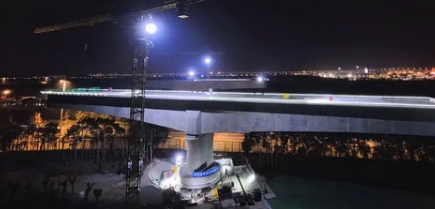
On the quiet night of January 8 in Pudong, Shanghai, an extraordinary engineering performance unfolded—one that many have since called a silent “air ballet.” China successfully rotated a 10,000-tonne bridge structure into position over an operational high-speed maglev line, marking a historic first in the country’s infrastructure development.
A Precision Feat Completed in Just One Hour
At the heart of this achievement is the Chuansha Super Major Bridge, a key component of Phase II of the Shanghai–Suzhou–Nantong Railway. Its massive continuous beam—equivalent in weight to more than 1,600 adult elephants—was rotated 60 degrees clockwise with millimeter-level precision.
What makes this even more remarkable is the timeframe: The entire rotation took only one hour, finishing precisely at 11:30 p.m., when maglev traffic disruption could be minimized.
Four intelligent hydraulic jacks, guided by real-time dynamic control systems, executed the maneuver smoothly and silently—without interrupting maglev operations below.
Innovative Construction to Avoid Any Disruption
Rotating a bridge over an active high-speed maglev line is no ordinary task. The project faced two major challenges:
Zero tolerance for interference with maglev operations
Extremely high precision requirements
To overcome these, engineers adopted a novel strategy: “Build first, rotate later.”
The bridge was initially constructed using symmetrical cantilever casting parallel to the maglev line. Once completed, it was then rotated into its final position. This approach dramatically reduced construction risks and traffic disruption.
Custom-built 100,000-kilonewton spherical hinges ensured stability during rotation, achieving:
Axis deviation under 5 millimeters
Closure error within 2 millimeters
Such accuracy is rare even in global large-span bridge construction.
A New Benchmark for China’s Infrastructure
This project was built by China Construction Eighth Engineering Bureau and managed by the Shanghai State Railway Construction Management Company. Its success closes a long-standing technical gap in rotating bridge construction over operational high-speed maglev lines.
More importantly, it sets a replicable standard—offering valuable technical and management experience for future projects across China and beyond.
Boosting Connectivity in the Yangtze River Delta
Once completed, Phase II of the Shanghai–Suzhou–Nantong Railway will stretch 111.8 kilometers with a design speed of 200 km/h. The line is expected to:
Strengthen Shanghai’s role as a national transport hub
Improve regional mobility
Accelerate economic integration across the Yangtze River Delta
Engineering That Moves—Literally
While there were no fireworks or crowds, the rotation of the Chuansha Super Major Bridge stands as a quiet but powerful symbol of China’s advancing engineering capabilities. Precision, innovation, and coordination came together to move not just a bridge—but the future of smart infrastructure forward.
Ajaokuta Bridge Stretching an impressive 2,890 meters, the Ajaokuta Bridge is one of Nigeria’s most significant infrastructure achievements. This bridge not only…
BURUKU BRIDGE: TIZA MEETS SETRACO Benue State Commissioner for Works, Housing and Urban Development, Hon. Tiza Isaac Imojime Orya earlier today held a closed door…
Ashamena bridge collapsed after heavy rains The Ugondo community in Mbayaka District, Buruku Local Government, is facing difficulty due to the collapse of a bridge connecting…
Second bridge over the Wouri The project for the construction of the second bridge over the Wouri amounts to about CFAF 119 billion divided as…
Kwabeng-Abomosu-Asuom Road and Bridge The GH¢46.72 million bridge over River Birim at Abomosu in the Eastern Region, constructed by Messrs First Sky Limited has…
How Loko – Oweto Bridge was made LOKO – OWETO BRIDGE IS LOCATED ACROSS RIVER BENUE, IN BENUE AND NASARAWA STATES IN NIGERIA The Loko – Oweto…