List of Indigenous Igbo Communities in Nigerian States Outside the South East
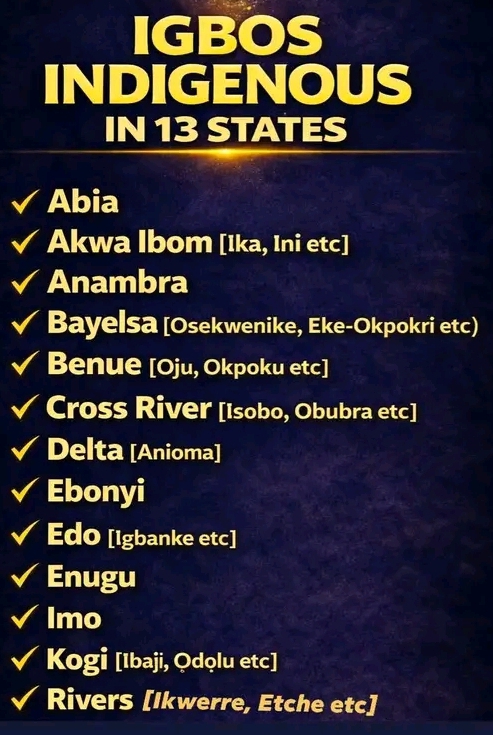
Nigeria’s Igbo-speaking populations extend far beyond the contemporary political boundaries of the five South-Eastern states. Historical migrations, pre-colonial settlement patterns, colonial boundary-making, and post-colonial state creation all contributed to the presence of indigenous Igbo communities in several other Nigerian states.
This list documents Igbo-speaking or Igbo-origin communities that are indigenous to states outside the South East, based on linguistic, historical, and cultural continuity. It does not refer to migrant or settler populations.
Note: Some identities listed here are contested or hybrid, shaped by long-term interaction with neighboring ethnic groups. Classification as “Igbo” is therefore based on language, origin traditions, and historical self-identification, not political labels.
1. Rivers State (Indigenous Igbo and Igboid Communities)
Rivers State contains several indigenous groups historically linked to the Igbo cultural and linguistic continuum.
Egbema
Etche
Omuma
Ndoni
Ikwerre
Ekpeye
Obigbo (Ogba–Egbema–Ndoni axis)
Opobo
Ogba
Many of these groups today assert distinct ethnic identities, yet linguistically and historically belong to the Igboid language cluster.
2. Edo State
Igbanke / Igbo Akiri
Located in Orhionmwon Local Government Area
Historically linked to Ika and Anioma Igbo
Notable Historical and Cultural Notes
Archbishop Benson Idahosa and his wife were of Igbanke origin
The mother of former military governor Samuel Osaigbovo Ogbemudia was Igbanke
Many Igbanke people bear hybrid Edo–Igbo names due to centuries of interaction
Examples: Nduka Irabor, Jim Ovia, Omorogie Nwawanne
3. Delta State (Anioma / Western Igbo Region)
Delta State contains the largest concentration of Igbo-speaking communities outside the South East, collectively referred to as Anioma.
Ika
Ndokwa
Ukwuani
Aniocha
Oshimili
These groups are unambiguously Igbo in language, culture, and origin, despite long-standing political marginalization.
4. Bayelsa State
Ukwuani-origin Igbo communities in Sagbama LGA, including:
Osekwenike
Abuetor
Eke Okpokri
These villages are:
Of Ukwuani stock
Part of the Anioma Igbo cultural sphere
Indigenous to Bayelsa State, not migrant settlements
5. Cross River State
Igbo communities in Abi LGA (Isobo area)
Includes Isobo (Igbo-speaking sections)
Former Cross River State Governor Liyel Imoke is often cited in discussions of Igbo ancestry from this axis
Cross River contains several Lower Cross / Igboid transition communities, many of which were historically Igbo before later reclassification.
6. Akwa Ibom State
Ikot Udo Ika
Located in Ika Local Government Area
An Igbo-speaking community surrounded by Ibibio-speaking populations
This community represents an Igbo–Ibibio boundary settlement, reflecting pre-colonial migration and intergroup contact.
7. Benue State
Indigenous Igbo Communities in Benue State
Igbo presence in Benue predates Christianity and colonial rule. Many of these communities would today fall within Ebonyi State but were administratively reassigned during colonial boundary adjustments.
Major Igbo Groups and Communities
Ezza-speaking communities, including:
Umuezeokoha
Umuezeoka
Oriuzor
Umuoghara
Amaekka
Amaezekwe
Found in:
Ado
Oju
Obi
Okpokwu LGAs
Demographic Notes
Umuezeokoha alone reportedly contains over 300 villages
Total Igbo-speaking villages in Benue exceed 600
Major markets in Igbo-speaking Benue include:
Inikiri Ichari
Iddah
Iduokpe
There are also Igbo-speaking Idoma communities, reflecting centuries of cultural blending.
8. Kogi State
Indigenous Igbo Communities in Kogi State
Found mainly in:
Ibaji LGA
Igalamela/Odolu LGA
Communities include:
Eke Avurugo
Nwajala
Umuoye
Ubulie-Umuez
Ozara
Other related settlements
These communities are linguistically Igbo and historically connected to the Lower Niger Igbo corridor.
This list demonstrates that Igbo indigeneity in Nigeria is not confined to the South East. Colonial borders, state creation, and political narratives often obscure deeper historical realities.
Understanding these communities requires:
Linguistic evidence
Oral traditions
Archaeological and historical context
Respect for present-day self-identification
The Igbo world has always been geographically wider, culturally fluid, and historically interconnected.