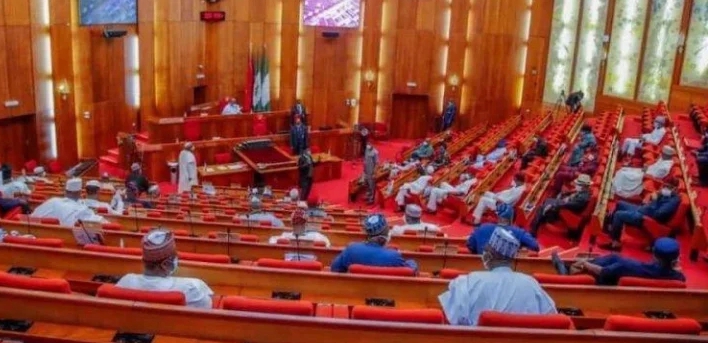
Nigeria moved a significant step closer to restructuring its security architecture on Wednesday as the Senate passed the long-debated Constitution Alteration Bill seeking to establish state police across the country.
The development marks a major milestone in decades of discussions over decentralising Nigeria’s policing system to better address the nation’s growing security challenges, including terrorism, banditry, kidnapping, communal conflicts, and other forms of criminal activity.
Senate Approves Constitutional Amendment
The bill secured approval after a detailed clause-by-clause review by lawmakers and received the support of more than two-thirds of senators through a manual voting process conducted during plenary.
Senate President Godswill Akpabio officially announced the passage of the legislation after senators overwhelmingly voted in favour of the proposal.
The upper chamber reached its decision following the presentation of a report by the Senate Committee on the Review of the Constitution, chaired by Deputy Senate President Barau Jibrin. Lawmakers first considered the bill’s provisions at the Committee of the Whole before adopting them and proceeding to a final vote.
Leading the debate, Senate Leader Opeyemi Bamidele urged lawmakers to support what many described as a critical constitutional reform designed to strengthen internal security and improve responses to local threats across Nigeria.
What the State Police Bill Proposes
The legislation introduces a state policing framework that would operate alongside the existing federal police structure. If fully implemented, it would end the Federal Government’s exclusive control over policing and establish state-controlled police services across the federation.
One of the bill’s most notable provisions grants state governors the authority to appoint Commissioners of Police for their respective states, subject to confirmation by the state Houses of Assembly.
Under Clause 17 of the proposed constitutional amendment, while the Federal Police Service will continue to be led by the Inspector-General of Police, each State Police Service will be headed by a Commissioner of Police appointed by the governor and confirmed by the state’s legislature.
The bill also defines the operational relationship between governors and state police leadership.
According to Section 17(6), governors may issue lawful written directives of a general policy nature to Commissioners of Police on matters concerning public safety and public order within their states.
Safeguards Against Abuse
Recognising concerns that state police could be misused for political purposes, lawmakers included several provisions aimed at protecting civil liberties and preventing abuse of power.
A key safeguard is contained in Section 17(7), which prohibits state police authorities from targeting individuals or groups simply for expressing criticism of government policies.
The provision states that a state Commissioner of Police cannot arrest, detain, investigate, or deploy force against any person, political party, or organisation solely because they have criticised the government, except where actions are carried out in accordance with the law.
Supporters of the clause believe it will help prevent state police structures from being used against political opponents, activists, journalists, or dissenting voices while ensuring adherence to due process and constitutional protections.
Manual Voting Adopted for Historic Decision
The Senate’s approval of the State Police Bill came shortly after lawmakers abandoned plans to use an electronic voting system for constitutional amendment proposals.
Concerns emerged over technical issues affecting some voting devices, raising fears that certain senators could be excluded from participating in the process. To avoid any controversy and ensure the integrity of the exercise, lawmakers agreed to adopt manual voting.
The decision followed a motion moved by Senate Leader Opeyemi Bamidele, who argued that every senator should have an equal opportunity to participate in what many considered a historic constitutional vote.
Senate President Akpabio supported the proposal, noting that an open voting process would enhance transparency and allow Nigerians to clearly see how their representatives voted on critical national issues.
Following the adoption of the motion, senators were called individually to publicly declare their votes during consideration of the constitutional amendment bills.
Top Government Officials Witness Proceedings
Several senior government officials attended the Senate session and witnessed the passage of the bill.
Among those present were Kaduna State Governor Uba Sani, Ogun State Governor Dapo Abiodun, Ondo State Governor Lucky Aiyedatiwa, and the Chief of Staff to President Bola Tinubu, Femi Gbajabiamila.
Their presence underscored the significance of the legislation and the growing national interest surrounding the proposed security reform.
A Turning Point in Nigeria’s Security Debate
The successful passage of the State Police Bill is widely regarded as one of the most significant constitutional reforms undertaken by the 10th National Assembly.
For years, advocates of state policing have argued that Nigeria’s centrally controlled police system is overstretched and unable to effectively respond to security threats across the country’s diverse regions and communities. They believe state police would provide faster responses, improved intelligence gathering, and greater accountability at the local level.
Critics, however, remain concerned that state governors could misuse police powers to intimidate political opponents, influence elections, and suppress dissent.
The inclusion of constitutional safeguards is intended to address some of these concerns, although debates over the practical implementation of state policing are expected to continue.
What Happens Next?
While the Senate’s approval represents a major legislative breakthrough, the constitutional amendment process is not yet complete.
The proposal must still secure the necessary approvals from state Houses of Assembly and satisfy other constitutional requirements before it can become law.
Nevertheless, the Senate’s action has brought Nigeria closer than ever to establishing state-controlled police services that would operate alongside the federal police system.
If eventually adopted, the reform could fundamentally reshape the country’s security framework and redefine how law enforcement is managed across the federation.
Senate from Osun State, 2014 Members of House of Senate, Osun State, 2014 Senator Mudashiru Hussein Senator Jide Omoworare Senator Olusola Adeyeye Osun State Osun…
JUST IN, SENATE CONFIRM MINISTERS NOMINEES The Nigerian Senate has recently confirmed the latest ministerial nominees proposed by President Bola Tinubu. The appointments include seven key…
NIGERIAN SENATE One of the two chambers of the Nigeria’s National Assembly that make up the Bicameral Legislature is the Senate. It…
State Police in Nigeria Nigeria is closer to establishing state police forces after major progress in the constitutional amendment process. The issue, which has…
List of Countries with State Police Countries that have police forces controlled by subnational governments (states, provinces, regions, cantons, Länder, etc.) rather than a single national…