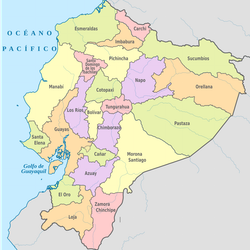
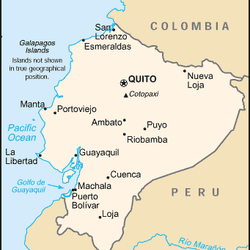
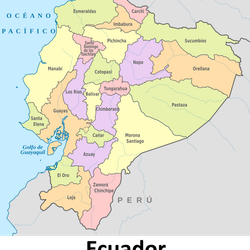
Provinces are ordered from largest to smallest total area, and cantons within each province are ranked from largest to smallest. Province totals are the sum of their cantons’ areas.
Pastaza Province (29,647 km²)
Pastaza — 19,944
Arajuno — 8,859
Mera — 531
Santa Clara — 313
Morona Santiago Province (24,004 km²)
Taisha — 6,135
Morona — 4,368
Gualaquiza — 2,160
Limón Indanza — 1,831
Palora — 1,451
Pablo Sexto — 1,389
Santiago de Méndez — 1,368
Sucúa — 1,196
Tiwintza — 1,181
Logroño — 1,179
San Juan Bosco — 1,090
Huamboya — 656
Sevilla Don Bosco — no area figure available (canton created in 2024)
Orellana Province (21,730 km²)
Aguarico — 11,294
Francisco de Orellana — 7,083
Loreto — 2,151
Joya de los Sachas — 1,202
Manabí Province (19,519 km²)
Chone — 3,062
Pedernales — 1,969
El Carmen — 1,741
Jipijapa — 1,476
Flavio Alfaro — 1,347
Paján — 1,100
Pichincha — 1,075
Santa Ana — 1,019
Portoviejo — 957
San Vicente — 737
Montecristi — 705
Sucre — 693
Jama — 568
Veinticuatro de Mayo — 546
Bolívar — 524
Puerto López — 429
Tosagua — 381
Manta — 290
Rocafuerte — 279
Junín — 267
Olmedo — 257
Jaramijó — 97
Sucumbíos Province (18,097 km²)
Cuyabeno — 3,865
Putumayo — 3,551
Lago Agrio — 3,151
Shushufindi — 2,506
Gonzalo Pizarro — 2,245
Sucumbíos — 1,517
Cascales — 1,262
Guayas Province (15,899 km²)
Guayaquil — 4,491
Naranjal — 1,702
Balzar — 1,176
Pedro Carbo — 941
Colimes — 757
El Empalme — 649
El Triunfo — 560
Yaguachi — 531
Daule — 511
Isidro Ayora — 492
Balao — 439
Milagro — 399
Salitre — 393
Santa Lucía — 365
Samborondón — 344
Durán — 342
Simón Bolívar — 290
Playas (General Villamil Playas) — 270
Coronel Marcelino Maridueña — 254
Naranjito — 231
Alfredo Baquerizo Moreno (Jujan) — 228
Palestina — 186
General Antonio Elizalde — 141
Nobol — 135
Lomas de Sargentillo — 72
Esmeraldas Province (15,835 km²)
Eloy Alfaro — 4,480
Quinindé — 3,621
San Lorenzo — 3,099
Río Verde — 1,513
Esmeraldas — 1,346
Muisne — 1,266
Atacames — 510
Napo Province (12,542 km²)
Tena — 3,908
El Chaco — 3,485
Archidona — 3,057
Quijos — 1,591
Carlos Julio Arosemena Tola — 501
Loja Province (11,065 km²)
Loja — 1,891
Zapotillo — 1,212
Paltas — 1,156
Saraguro — 1,085
Calvas — 851
Gonzanamá — 682
Catamayo — 652
Puyango — 637
Macará — 573
Celica — 522
Espíndola — 516
Sozoranga — 422
Chaguarpamba — 313
Quilanga — 237
Pindal — 202
Olmedo — 114
Zamora-Chinchipe Province (10,564 km²)
Palanda — 2,042
Nangaritza — 2,021
Zamora — 1,901
Yacuambi — 1,253
Chinchipe — 1,102
Yantzaza — 1,014
El Pangui — 632
Paquisha — 339
Centinela del Cóndor — 260
Pichincha Province (9,453 km²)
Quito — 4,201
Mejía — 1,411
Cayambe — 1,201
San Miguel de Los Bancos — 855
Puerto Quito — 696
Pedro Vicente Maldonado — 619
Pedro Moncayo — 335
Rumiñahui — 135
Galápagos Province (8,233 km²)
Isabela — 5,528
Santa Cruz — 1,855
San Cristóbal — 850
Azuay Province (8,173 km²)
Cuenca — 3,195
Santa Isabel — 827
Sígsig — 677
Pucará — 639
Nabón — 632
Gualaceo — 346
Girón — 343
Sevilla de Oro — 315
Oña — 290
Paute — 268
Camilo Ponce Enríquez — 214
San Fernando — 143
El Pan — 139
Chordeleg — 104
Guachapala — 41
Los Ríos Province (7,238 km²)
Babahoyo — 1,071
Valencia — 970
Vinces — 711
Buena Fe — 581
Palenque — 569
Mocache — 566
Baba — 515
Ventanas — 513
Urdaneta — 385
Quevedo — 379
Montalvo — 355
Pueblo Viejo — 334
Quinsaloma — 289
Cotopaxi Province (6,189 km²)
Latacunga — 1,496
Sigchos — 1,358
Pujilí — 1,329
Pangua — 720
La Maná — 661
Salcedo — 469
Saquisilí — 156
Chimborazo Province (6,116 km²)
Alausí — 1,289
Guamote — 1,194
Riobamba — 999
Colta — 820
Guano — 465
Pallatanga — 380
Penipe — 371
Chunchi — 273
Chambo — 166
Cumandá — 159
El Oro Province (5,870 km²)
Santa Rosa — 896
Arenillas — 787
Zaruma — 652
Piñas — 614
El Guabo — 580
Pasaje — 456
Machala — 372
Chilla — 332
Las Lajas — 299
Portovelo — 284
Atahualpa — 282
Marcabelí — 148
Huaquillas — 99
Balsas — 69
Imbabura Province (4,791 km²)
Cotacachi — 1,865
Ibarra — 1,139
San Miguel de Urcuquí — 736
Otavalo — 531
Pimampiro — 440
Antonio Ante — 80
Bolívar Province (3,957 km²)
Guaranda — 1,860
Chillanes — 670
San Miguel — 586
Chimbo — 270
Echeandía — 245
Caluma — 176
Las Naves — 150
Carchi Province (3,784 km²)
Tulcán — 1,815
Mira — 584
Espejo — 568
Montúfar — 381
Bolívar — 360
San Pedro de Huaca — 76
Santo Domingo de los Tsáchilas Province (3,779 km²)
Santo Domingo de los Colorados — 3,455
La Concordia — 324
Santa Elena Province (3,688 km²)
Santa Elena — 3,595
Salinas — 68
La Libertad — 25
Cañar Province (3,647 km²)
Cañar — 1,954
Azogues — 954
La Troncal — 367
Biblián — 182
Déleg — 74
El Tambo — 63
Suscal — 53
Tungurahua Province (3,386 km²)
Baños — 1,068
Ambato — 1,022
Píllaro — 470
Patate — 293
Pelileo — 200
Quero — 169
Mocha — 85
Tisaleo — 60
Cevallos — 19
Ecuador’s 222 Cantons by Land Area: From Vast Amazon Territories to Tiny Highland Towns
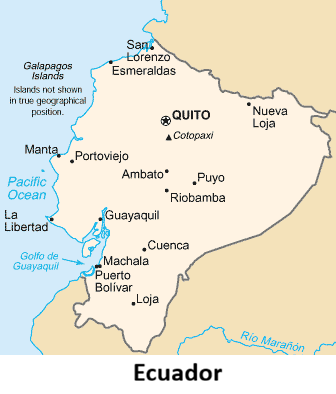
Ecuador is one of South America’s smaller countries, yet the land area of its cantons varies enormously. Across the 221 cantons with a recorded area, the figures add up to about 257,206 square kilometers. The largest canton covers nearly 20,000 square kilometers, and the smallest covers just 19. Mapping Ecuador’s cantons by size reveals a country split between a vast, thinly settled Amazon and a compact, densely subdivided Andes and coast.
Pastaza: in a class of its own
The largest canton in Ecuador is Pastaza, in the province of the same name. It covers 19,944 square kilometers, with Puyo as its seat. It is roughly one and three-quarters times the size of the next largest canton, Aguarico in Orellana Province, at 11,294 square kilometers. A single canton accounts for nearly 8 percent of the area of the 221 measured cantons. It is larger than the entire area of Manabí Province and of every province below it in size, 21 provinces in all.
The remaining places in the top five all lie in the Amazon as well: Arajuno in Pastaza (8,859 km²), Francisco de Orellana in Orellana (7,083 km²) and Taisha in Morona Santiago (6,135 km²). Together with Pastaza and Aguarico, these five cantons cover more than 53,000 square kilometers, about a fifth of the total.
The Amazon provinces dominate
At the provincial level, the pattern is just as clear. Pastaza Province is the largest in Ecuador at 29,647 square kilometers, followed by Morona Santiago (24,004 km²) and Orellana (21,730 km²). Manabí is the first province outside the Amazon on the list, ranking fourth with 19,519 square kilometers. Sucumbíos (18,097 km²) and Napo (12,542 km²) also rank in the top ten, and Zamora-Chinchipe (10,564 km²) is just behind.
Combined, the six Amazon provinces cover about 116,600 square kilometers, roughly 45 percent of the area of all cantons measured. The Amazon is large in area, and its cantons tend to be large too. Eight of the ten largest cantons in the country are in the Amazon region.
Outside the Amazon: Isabela, Guayaquil and Eloy Alfaro
The largest canton outside the Amazon is Isabela, in the Galápagos Islands. It covers 5,528 square kilometers, the sixth largest canton in Ecuador, and takes in the largest island of the archipelago. The Galápagos Province as a whole spans 8,233 square kilometers across three cantons: Isabela, Santa Cruz (1,855 km²) and San Cristóbal (850 km²).
On the mainland, Guayaquil is the largest canton outside the Amazon at 4,491 square kilometers. It narrowly edges out Eloy Alfaro in Esmeraldas Province (4,480 km²), and Quito sits only a little behind at 4,201 square kilometers. Both of the country’s largest cities, then, are also among its largest cantons by land. Cuenca, the third largest city in terms of canton population, also ranks high in area, at 3,195 square kilometers.
Esmeraldas, on the northern coast, has some of the largest cantons outside the Amazon. Eloy Alfaro, Quinindé (3,621 km²) and San Lorenzo (3,099 km²) all rank in the top thirty. Chone in Manabí (3,062 km²) is the largest canton in its province, and Santa Elena canton (3,595 km²) makes up nearly the entire area of Santa Elena Province.
The smallest cantons
At the other end of the scale are cantons that fit within a few dozen square kilometers. Cevallos in Tungurahua Province is the smallest in Ecuador at just 19 square kilometers. La Libertad in Santa Elena Province follows at 25 square kilometers, then Guachapala in Azuay (41 km²), Suscal in Cañar (53 km²) and Tisaleo in Tungurahua (60 km²). Pastaza canton is more than 1,000 times the size of Cevallos.
Many of these small cantons are in the highlands. Tungurahua Province has the smallest of the lot in Cevallos, along with Tisaleo (60 km²) and Mocha (85 km²). Cañar Province has Suscal, El Tambo (63 km²) and Déleg (74 km²). On the coast, Salinas (68 km²) in Santa Elena and Balsas (69 km²) in El Oro are also small.
Land area is not population
Size on the map often says little about the number of people. La Libertad covers only 25 square kilometers yet counted 112,247 residents in the 2022 census. Cevallos has 10,433 people in 19 square kilometers. In contrast, Aguarico, the second largest canton in the country, had just 6,872 residents in 2022, and Pastaza, the largest, had 82,754.
The newest canton
The 222nd canton, Sevilla Don Bosco in Morona Santiago Province, was created in 2024 and has no published area figure. Morona Santiago is the second largest province in Ecuador, with 24,004 square kilometers across the other twelve cantons.
A country of two scales
The geography of Ecuador’s cantons shows two distinct administrative scales. In the Amazon, a handful of cantons covers thousands of square kilometers each. In the highlands and on the coast, dozens of cantons are packed into much smaller areas, some no larger than a few dozen square kilometers. Between the two lies a long middle tier of cantons covering several hundred to a few thousand square kilometers.
More
Capital Towns of Ecuador’s Cantons Provinces and cantons are listed alphabetically. Each entry gives the canton followed by its seat (capital town). Azuay Province Camilo…
Cantons of Ecuador by Population Provinces are ordered from most to least populated, and cantons within each province are ranked from most to least populated.…
Algeria population density (km2) The density of Algeria population is 1 person per 14 km2. The density according to the provinces is as follows:…
World Heritage Sites in Ecuador UNESCO World Heritage Sites in Ecuador are: City of Quito Galápagos Islands Sangay National Park Historic Centre of Santa Ana…
Indonesia’s Provinces: From Largest to Smallest by Land Area ProvinceArea (Km2)Indonesia1,890,179.78Kalimantan Tengah153,430.36Kalimantan Barat147,018.06Kalimantan Timur126,951.76Papua Selatan117,858.97Riau89,900.78Sumatera Selatan86,771.92Papua81,383.32Sumatera Utara72,437.76Kalimantan Utara69,900.89Sulawesi Tengah61,496.98Papua Tengah61,079.59Papua Barat60,308.59Aceh56,835.02Papua Pegunungan52,508.66Jambi49,023.04Jawa Timur48,055.88Nusa Tenggara Timur46,378.11Maluku46,133.83Sulawesi Selatan45,323.98Sumatera Barat42,107.67Papua Barat Daya139,103.06Kalimantan…
Tehsils of Balochistan, Pakistan, by Land Area, From Largest to Smallest TehsilLand Areain km²Nok Kundi Tehsil16,092Awaran Tehsil13,075Mashkel Tehsil11,663Turbat Tehsil9,742Zhob Tehsil9,322Taftan Tehsil9,318Gichk Tehsil8,387Dalbandin Tehsil7,791Yakmach7,572Washuk Tehsil7,494Aranji Tehsil7,456Jhal Jhao Tehsil6,381Tohumulk Tehsil6,347Khuzdar Tehsil6,112Besima Tehsil6,014Karkh Tehsil5,352Pasni…
Romania Largest Counties by Land Area The largest counties in Romania by size of land area (per square kilometres) are: Timiş 8,697 km sq Suceava 8,553…
Land area size of countries The land area, in square kilometers, of all countries of the world Land area is the total space within the…
World’s Smallest Countries by Land Area While land area often reflects a country’s physical scope and influence, many of the world’s smallest nations pack significant historical,…
Top 10 Largest Countries by Land Area Land area is one of the fundamental ways to measure a country’s physical size and scope. This list explores the…
Land Area of Countries The land area of a country has always been a key element in defining its geographic, economic, and political significance.…
Chad land area Chad is located between 7° and 24° north latitude and 13° and 24° east longitude. It is the link between…