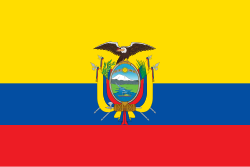
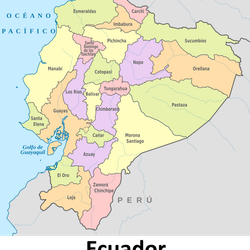
Most countries are named for peoples, rivers, rulers, or ancient kingdoms. Ecuador is named for an imaginary line. In Spanish, ecuador literally means “equator,” and the country’s official name, República del Ecuador, translates as “Republic of the Equator.”
A name shortened from a title
In everyday use, the country is simply “Ecuador,” a truncation of its full official name. Where the name came from is a story of colonial administration and the collapse of a short-lived South American union.
From Royal Audience to department
Before independence, the territory belonged to the Royal Audience of Quito, a Spanish colonial administrative and judicial body with Quito as its seat. After the independence wars, the region became part of Gran Colombia, the republic that Simón Bolívar helped create and that united much of northern South America, including present-day Colombia, Venezuela, Ecuador, and Panama.
In 1824, Gran Colombia reorganized its territory into departments. Part of the former Royal Audience of Quito became the Ecuador Department, a name that pointed to its position on the equatorial line. Quito remained its capital.
Why “Equator”?
The choice reflected geography, and the area’s fame as a place tied to the equator was not new. In the 18th century, a French scientific expedition, the Geodesic Mission, travelled to the Quito region to measure the shape of the Earth near the equatorial line. Its work helped make the territory known internationally as a land of the equator, so naming a department after that line was a natural step.
From department to nation
Gran Colombia did not last. In 1830, Ecuador separated and became an independent state, keeping the name of the department it had been. The name of an administrative division became the name of a country, and it has stayed that way ever since.
A capital near the line
Quito, the capital of both the department and the republic, is famously linked to the equator. Strictly speaking, the city sits slightly south of the line, roughly 25 kilometers, while the equator passes just north of it. The famous monument and site known as Mitad del Mundo (“Middle of the World”) marks the line nearby, and the country’s name makes the connection between nation and geography unmistakable.
A fitting identity
Few countries carry a name so closely tied to a physical feature of the planet. For Ecuador, the equator is not just a line on a map but a defining part of its history and identity, from the department of 1824 to the republic of today.
More
How Indonesia Got Its Name The word “Indonesia” began as a scholarly label for a region before it became the name of a nation. Here…
How Ghana got its name How Ghana got its names: Wagadugu, Gold Coast, Ghana The Republic of Ghana is named after the medieval Ghana Empire…
How Nigeria got its name Who Named Nigeria & In What Year? The name “Nigeria” was given to the country by a British journalist and…
How Port Harcourt got its name Port Harcourt named after Lewis Vernon Harcourt.Mr Harcourt was the British Secretary of State for the Colonies. In August 1913,…
How Ebonyi state got its name Ebonyi State got its name from a River, the Aboine River also called Abonyi River. The name Abonyi was Anglicized…
How Flora Shaw gave Nigeria its name The name “Nigeria” was given to the country by a British journalist and Times editor named Mrs. Flora Shaw on January 8,…
World Heritage Sites in Ecuador UNESCO World Heritage Sites in Ecuador are: City of Quito Galápagos Islands Sangay National Park Historic Centre of Santa Ana…
PENDA GOT COMMENDATIONS FROM KUSUV ELDERS Hon. Benjamin Iornumbe Penda on 18th November, 2023 received commendations from some elders of Kusuv clan of Tiv nation. Kusuv…
How Bantu people got to Angola The first to settle were the Bochmanes – great hunters, of pygmoid stature and pale, brownish in color. The Bantu…
How Angola got independence from Portugal The Portuguese arrived Angola in 1484 and took took colonialism. From the 1950s onwards, the formation of more explicit political…