Hokkien Geography: How Minnan Speakers Named the World
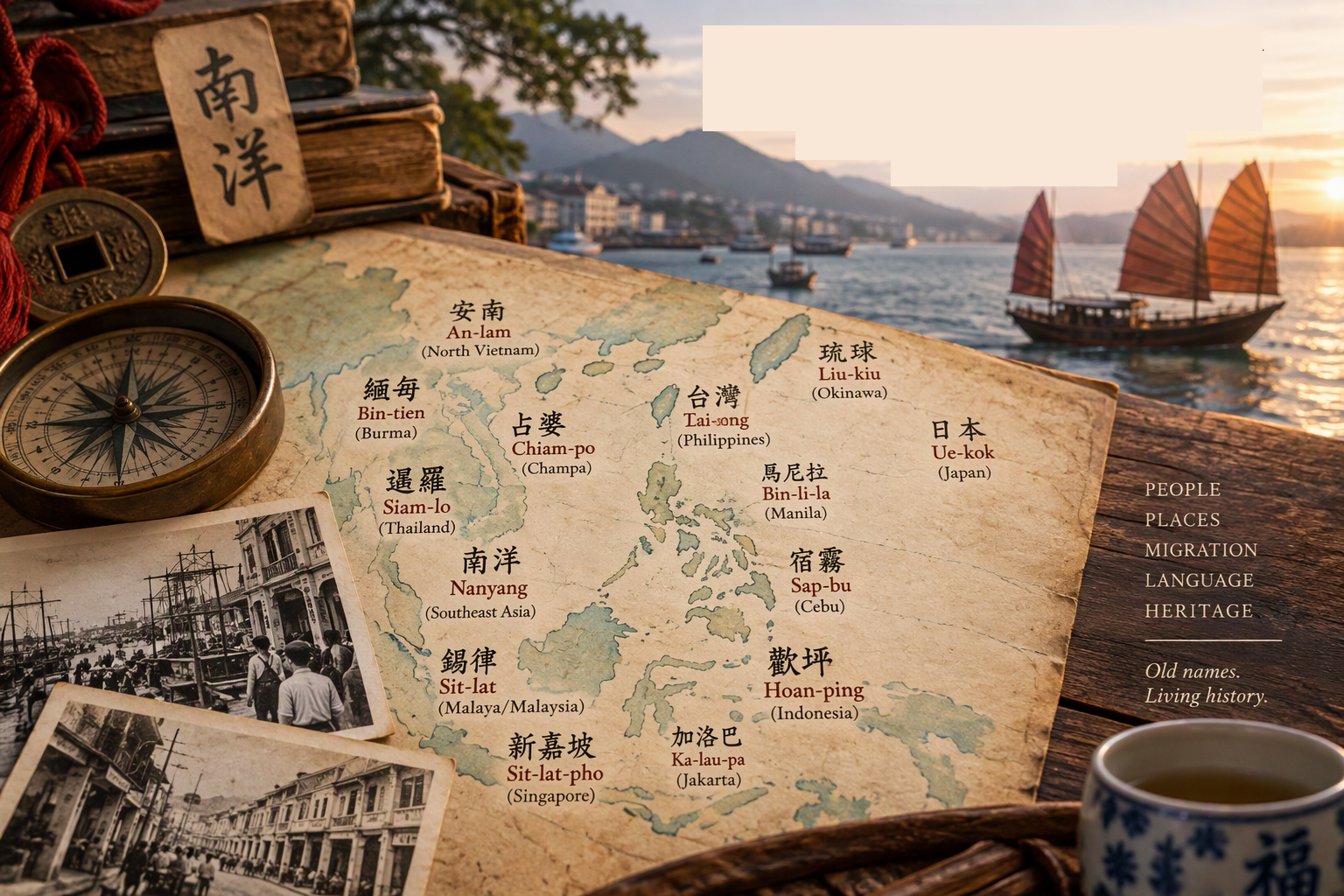
For centuries, Hokkien-speaking communities developed their own names for countries, cities, islands, and regions across East and Southeast Asia. Long before standardised Mandarin place names became dominant, merchants, sailors, migrants, and settlers used a rich geographical vocabulary that reflected their own history, trade routes, and cultural memory.
A fascinating discussion among Hokkien speakers in the early 2000s revealed dozens of these traditional names, many of which are now disappearing from everyday use. The conversation raises an important question: should these historical place names be preserved as part of Hokkien cultural heritage?
A Geographic Vocabulary Built by Travellers and Migrants
Unlike modern place names that are often borrowed directly from Mandarin or international usage, many traditional Hokkien geographical terms developed organically through maritime trade and migration.
Overseas Hokkiens travelling between Fujian, Taiwan, the Philippines, Malaya, Indonesia, Siam, and other parts of Asia created their own names for important destinations. These terms often survived for generations within families and trading communities.
Some examples include:
Traditional Hokkien
Modern Place
Lu-song
Philippines (originally Luzon)
Bin-li-la
Manila
Lap-bau
Davao
Sap-bu
Cebu
Sit-lat
Malaya / Malaysia
Sit-lat-pho
Singapore
Pin-ling-su
Penang
Hoan-ping
Indonesia
Ka-lau-pa
Jakarta
Siam-lo
Thailand
Ue-kok
Japan
Liu-kiu
Ryukyu / Okinawa
Many of these names originated long before modern nation-states existed in their present form.
The Memory of Nanyang
Several contributors recalled that older generations frequently referred to Southeast Asia simply as “Nanyang” (Southern Ocean).
For many Chinese migrants leaving Fujian during the nineteenth and early twentieth centuries, “Nanyang” did not necessarily refer to a specific country. Instead, it represented a broad region of opportunity that included present-day Malaysia, Singapore, Indonesia, Thailand, and beyond.
One participant observed that many early migrants had little knowledge of national borders. Their understanding of geography was shaped more by shipping routes, trading centres, and migrant networks than by political maps.
This helps explain why older Hokkien geographical terms often describe cultural or economic regions rather than modern states.
Geography Versus Politics
One of the most interesting debates in the discussion centred on whether traditional names should continue to be used today.
Supporters of preservation argued that geographic names and political administrative units are not the same thing. Languages around the world often preserve historical place names even when borders change.
Examples include:
“Germany” in English versus “Deutschland” in German.
“Holland” being used internationally although the country’s official name is the Netherlands.
Historical place names that remain embedded in local languages long after political boundaries have changed.
From this perspective, traditional Hokkien place names are cultural artefacts rather than political statements.
Critics argued that modern language users need terms that accurately reflect current countries and borders. Using older names for places such as Malaysia or Thailand can create confusion because these names originated under very different historical circumstances.
The debate reflects a broader tension between heritage and modernisation that many minority languages face today.
Oral Traditions and Migration Songs
The discussion also revealed how deeply these geographical names were embedded in Hokkien folklore.
Participants recalled hearing old migration songs and sayings from parents and grandparents. In these songs, destinations such as Taiwan, the Philippines, Indonesia, and Malaya were celebrated as places of work, wealth, opportunity, or adventure.
One contributor remembered verses describing:
Malaysia and Taiwan as destinations for labour.
Luzon (the Philippines) as a land associated with gold.
Indonesia as a land associated with silver.
Overseas migration as a major feature of Hokkien life.
These songs served as oral records of migration patterns long before most people had access to maps, newspapers, or formal education.
A Language Under Pressure
Perhaps the deepest theme running through the conversation was concern about language loss.
Several contributors observed that the vocabulary used by grandparents often differed dramatically from the modern speech of younger generations. Traditional Hokkien terms were increasingly being replaced by Mandarin-based expressions learned through schools, media, and official institutions.
Some participants argued that many younger speakers no longer speak the same Hokkien as their grandparents. While the language survives, much of its indigenous vocabulary is gradually disappearing.
The old geographical names became a symbol of this larger issue. To some speakers, preserving terms such as Lu-song, Hoan-ping, Sit-lat, and Ue-kok meant preserving a distinct Hokkien worldview.
Lessons from the Discussion
The debate does not yield a simple answer.
Modern communication may require standardised place names that align with contemporary countries and international usage. At the same time, historical names preserve memories of migration, trade, settlement, and cultural identity.
What becomes clear is that traditional Hokkien geographical terminology represents far more than a collection of place names. These words encode the experiences of generations of sailors, traders, labourers, and settlers who connected China with the wider world.
Whether or not these names return to everyday speech, they deserve to be documented as part of the cultural heritage of the Hokkien-speaking world.
The traditional geography of Hokkien offers a remarkable glimpse into how earlier generations understood the world. Their maps were not drawn through modern nation-states but through networks of kinship, commerce, migration, and memory.
Borno Geography, Economy, History, and Culture Borno is a notable state in northeastern Nigeria, known for its diverse landscape, significant agricultural activities, and strategic geographic positioning.…
Geography of Benin Republic Benin is located in West Africa in the tropical zone between the equator and the Tropic of Cancer (between the…
Geography of Oyo State Oyo State is located in the South West Region of Nigeria. Latitude 8 degree and Longitude 4 degree East bisect…
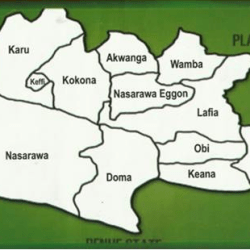
Geography of Nasarawa State The general topography of Nasarawa State is that of hills/ dissected terrain, undulating plains and lowlands. A look at the…
GEOGRAPHY OF ABUJA Abuja is located in the centre of Nigeria and has a land area of 8,000 square Kilometers. It is bounded…
Kebbi geography The geography of Kebbi State, Nigeria Kebbi State was created out of the old Sokoto State in 1991 and it…