From Temasek to Singapore: The Many Names of Singapore
Long before it became a modern financial hub, Singapore was known by sailors, merchants, diplomats, mapmakers, and migrants from across Asia and Europe. Each civilisation that encountered the island left behind a different name, reflecting how they understood its geography, political importance, or cultural identity.
The history of Singapore’s names is therefore more than a linguistic curiosity. It is a record of trade networks, competing empires, migration routes, and changing identities that span nearly two thousand years.
The Earliest Recorded Names
The earliest possible reference to Singapore may appear in the 2nd century AD in the geographical works of the Greek scholar Ptolemy. He identified a trading settlement called Sabana or Sabara near the southern tip of the Malay Peninsula.
Although historians continue to debate whether this location was actually Singapore, it demonstrates that the region was already known to distant trading networks linking the Mediterranean, India, and Southeast Asia.
Chinese records from later centuries may also contain references to the island under names such as Pu Luo Zhong, while Arab navigators described places in the region that some scholars believe could have referred to Singapore.
These early references reveal an important truth: Singapore was already part of international maritime commerce centuries before it appeared in modern history books.
Temasek: The Sea Town
Before Singapore became Singapore, it was known as Temasek.
The name appears in Javanese, Malay, Chinese, and possibly Vietnamese sources from the fourteenth century and earlier. It is generally believed to derive from the Malay word tasik, meaning “sea” or “lake”.
Temasek can therefore be interpreted as:
“Sea Town” or “Settlement by the Sea.”
The name perfectly reflected the island’s role as a maritime trading port located at one of the most strategic waterways in Asia.
Chinese traveller Wang Dayuan, who visited around 1330, recorded Temasek as Danmaxi and described settlements and commercial activity on the island. Chinese navigational charts from the Ming era continued using variations of Temasek even after the name Singapura had become established locally.
Today, the ancient name survives in modern Singapore through institutions such as Temasek Holdings, Temasek Polytechnic, and the Order of Temasek.
The Birth of Singapura
Sometime during the 14th century, the name Temasek was gradually replaced by Singapura.
According to the famous account in the Malay Annals, a Sumatran prince named Sang Nila Utama landed on the island and encountered a strange animal while hunting. He was told it was a lion and regarded the sighting as a good omen.
He subsequently founded a new city and named it:
Singapura
Singa = Lion
Pura = City
Thus emerged the name “Lion City.”
The story remains one of the most enduring legends in Southeast Asian history.
Did Sang Nila Utama Really See a Lion?
Modern historians remain sceptical.
Lions are not native to Singapore or Southeast Asia. Furthermore, the creature described in the Malay Annals possessed characteristics that do not clearly resemble a lion.
Several alternative explanations have been proposed:
The animal may have been a tiger.
It may have been another species of large cat.
It may have been a mythical creature referenced in regional folklore.
The story may have been symbolic rather than historical.
Many scholars believe the lion sighting legend was created to provide a prestigious origin story for the kingdom.
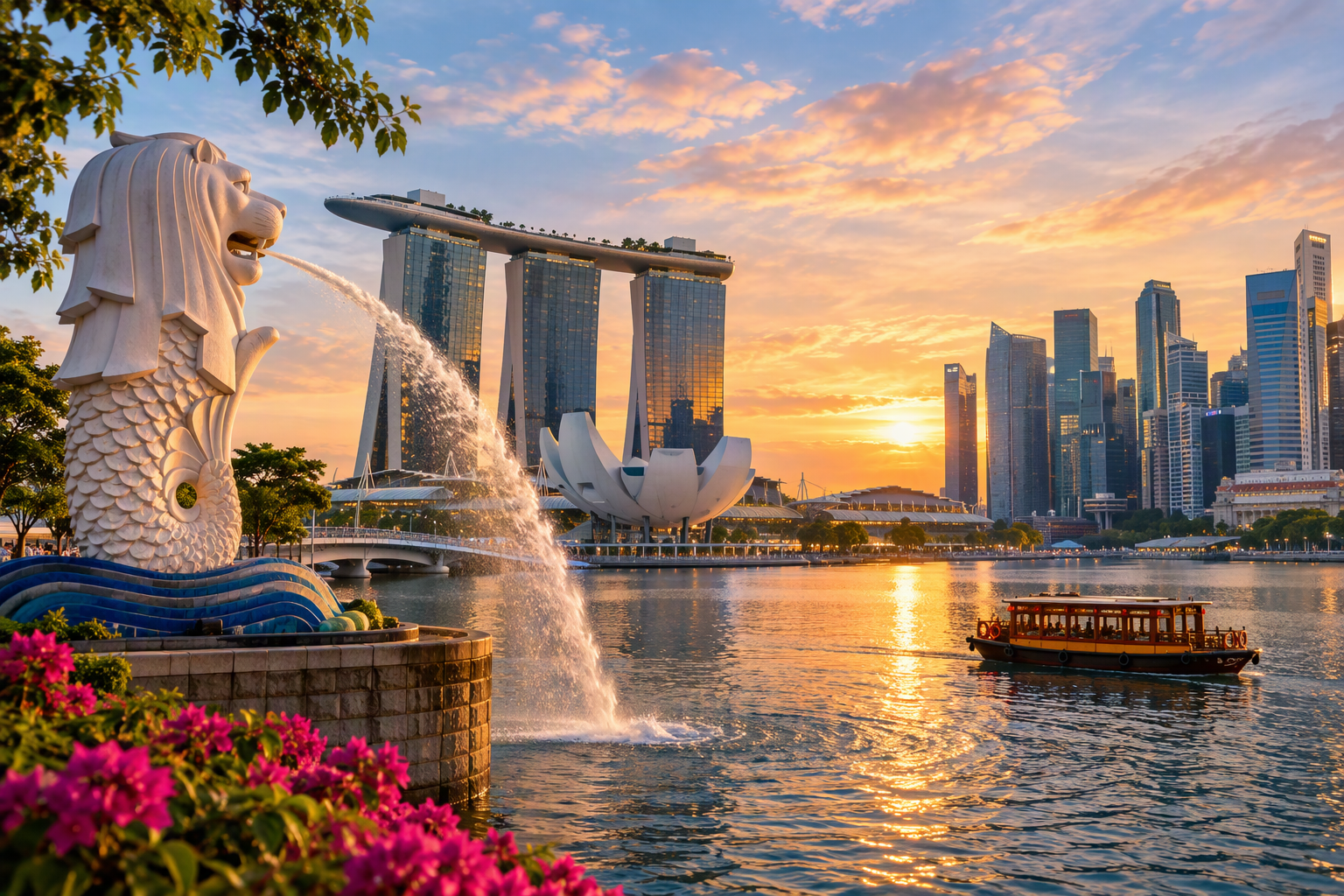
Regardless of its accuracy, the story permanently shaped Singapore’s identity. The lion remains the nation’s dominant symbol and inspired icons such as the Merlion.
Sanskrit and the Prestige of Power
The name Singapura reflects a much larger historical trend.
For centuries, Sanskrit functioned as the prestige language of royal courts and religious culture throughout Southeast Asia.
The word pura appears in numerous place names across the region:
Singapura (Singapore)
Jayapura (Indonesia)
Singburi (Thailand)
Angkor Borei (Cambodia)
The widespread use of Sanskrit names illustrates how deeply Indian cultural influences shaped pre-modern Southeast Asian civilisation.
In this context, Singapura was not an isolated invention but part of a broader tradition of royal and sacred city names.
European Maps and Many Spellings
When Portuguese, Dutch, Spanish, and British navigators entered Southeast Asian waters, they encountered the name Singapura but rendered it in dozens of different forms.
Historical maps contain spellings such as:
Sincapore
Sincapure
Singapoor
Singapure
Cingaporla
Cinghapola
Sinkapoor
Interestingly, many early European cartographers did not consistently use the name for the island itself. In some cases, “Singapore” referred to nearby waterways, especially the Singapore Strait.
For several centuries the name moved fluidly between an island, a harbour, a kingdom, and a maritime passage.
Hokkien Singapore: Sit-Lat and Sin-ka-pho
Among Chinese communities, Singapore acquired additional identities.
The modern Chinese name is:
新加坡 (Xīnjiāpō / Sin-ka-pho)
But earlier Hokkien-speaking migrants often used another name:
Sit-lat (石叻)
This name derived from the Malay word selat, meaning “strait.”
Over time several variants emerged:
Sit-lat
Sit-lat-po
Lat-po
For generations of Hokkien traders, sailors, labourers, and merchants, Sit-lat was the everyday name of Singapore.
As discussed in historical Hokkien sources, this term was tied closely to the maritime geography that made Singapore an important regional port.
The Japanese Occupation: Shōnan-tō
One of Singapore’s most dramatic name changes occurred during World War II.
Following the Japanese conquest in 1942, Singapore was renamed:
Shōnan-tō (昭南島)
The name is usually translated as:
“Light of the South” or “Southern Island of the Shōwa Era.”
The occupation lasted until 1945, after which British administration restored the name Singapore.
Although temporary, Shōnan remains one of the most significant historical names associated with the island.
Modern Singapore in Many Languages
Today Singapore’s name exists in dozens of linguistic forms:
Language
Name
English
Singapore
Malay
Singapura
Mandarin
Xīnjiāpō
Hokkien
Sin-ka-pho
Tamil
Ciṅkappūr
Japanese
Shingapōru
Korean
Singgaporeu
Khmer
Sernghakborey
Vietnamese
Xin-ga-po
Despite differences in pronunciation, most modern versions ultimately descend from the medieval name Singapura.
More Than One Name, More Than One Identity
The story of Singapore’s names reflects the story of Singapore itself.
Temasek tells us about an ancient maritime settlement.
Singapura speaks of royal ambition, Sanskrit influence, and legendary origins.
Sit-lat preserves the memory of Hokkien migration and trade.
Shōnan recalls wartime occupation.
Xīngzhōu, Seng-chiu, and Sin-ka-pho reveal the cultural creativity of overseas Chinese communities.
Each name captures a different moment in the island’s journey from regional trading port to global city-state.
Rather than replacing one another, these names form layers of history. Together they tell the story of a place that has always stood at the crossroads of languages, cultures, religions, and empires.
Singapore may officially have only one name today, but its past proves that it has always answered to many.
How many presidents has Nigeria had Nigeria has had 16 presidents as at 29 May, 2023. Bola Tinubu is the sixteenth president of the country. The…
How many states are in Burkina Faso There are 13 states (regions) in Burkina Faso, namely: Boucle du Mouhoun Cascades Centre Centre-Est Centre-Nord Centre-Ouest Centre-Sud Est Hauts-Bassins…
How many airports in Botswana There are 6 (six) airports in Botswana, namely: Sir Seretse Khama International Airport Maun International Airport Kasane International Airport PG…
How many international airports in Botswana There are 4 (four) international airports in Botswana, namely: Sir Seretse Khama International Airport Maun International Airport Kasane International Airport…
How many airports in Benin Republic Benin Republic have one international airport. It is called Cardinal Bernardin Gantin International Airport. Unofficially the airport is referred to…
How many international airport in Benin Republic Benin Republic have only one international airport. It is officially called Cardinal Bernardin Gantin International Airport. Unofficially the airport is…
How many states are there in Benin Republic There are 12 states in Benin Republic, namely: Alibori Atakora Atlantique Borgou Collines Kouffo Donga Littoral Mono Ouémé Plateau Zou…