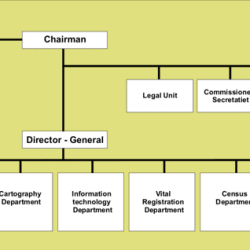
The departments of Nigeria’s National Population Commission (NPC) are:
General Services Department
Planning and Research Department
Procurement Department
Special Duties Department
Finance & Accounts Department
Legal Services Department
Human Resources Management Department
Population Studies Department
Information Communication Technology (ICT) Department
Geographic Resources Department
Census Department
Public Affairs Department
Civil Registration and Vital Statistics Department
Office of the Secretary to the Commission
Departments in NPC, their roles, structure, and importance in national development
A look at the departments in Nigeria’s National Population Commission provides a clear understanding of how the agency operates and fulfills its national duties. The National Population Commission (NPC) is a key government body responsible for collecting, analyzing, and managing population data in Nigeria. This data plays a vital role in national planning, economic development, and policy-making.
Established under Nigerian law, the NPC is tasked with conducting population censuses, maintaining vital statistics, and supporting demographic research. To effectively carry out these responsibilities, the Commission is structured into several specialized departments, each handling a unique aspect of its operations.
General Services Department
The General Services Department ensures the smooth day-to-day running of the Commission. It handles logistics, office maintenance, transportation, and overall administrative support.
This department acts as the backbone of the organization. Without it, many operational activities would face delays. From managing office facilities to coordinating internal services, General Services ensures that all departments function efficiently.
Planning and Research Department
The Planning and Research Department focuses on developing strategies and conducting research that guide population policies. It analyzes demographic data and provides insights that help the government make informed decisions.
This department also plays a critical role in forecasting population trends. By studying migration, fertility rates, and mortality rates, it helps Nigeria prepare for future challenges such as urbanization and resource allocation.
Procurement Department
The Procurement Department is responsible for acquiring goods and services needed by the Commission. It ensures that all purchases follow due process and comply with government regulations.
Transparency and accountability are central to its operations. The department carefully evaluates vendors, manages contracts, and ensures value for money in all transactions.
Special Duties Department
The Special Duties Department handles unique assignments and special projects assigned by the Commission’s leadership. These tasks often require quick decision-making and strategic planning.
Whether it’s coordinating special programs or handling emergency assignments, this department ensures that important initiatives are executed efficiently.
Finance & Accounts Department
The Finance & Accounts Department manages the financial resources of the Commission. It is responsible for budgeting, financial planning, and monitoring expenditures.
This department ensures that funds are used properly and in line with government regulations. It also prepares financial reports and supports audits, promoting transparency and accountability.
Legal Services Department
The Legal Services Department provides legal advice and ensures that the Commission operates within the law. It handles contracts, legal disputes, and policy interpretation.
This department also protects the Commission from legal risks by ensuring compliance with national laws and regulations.
Human Resources Management Department
The Human Resources Management Department oversees recruitment, staff welfare, and performance management. It ensures that the Commission has qualified personnel to carry out its duties.
Training and capacity building are also key responsibilities. By improving staff skills, this department enhances the overall efficiency of the organization.
Population Studies Department
The Population Studies Department conducts in-depth research on demographic issues. It examines population growth, fertility rates, and other key indicators.
The findings from this department are used to guide national development policies. It plays a major role in understanding Nigeria’s population dynamics.
Information Communication Technology (ICT) Department
The ICT Department manages the Commission’s digital infrastructure. It develops and maintains databases, software systems, and communication networks.
In today’s digital age, this department is essential for efficient data collection and processing. It supports modern census techniques and improves data accuracy.
Geographic Resources Department
The Geographic Resources Department handles mapping and spatial data. It uses Geographic Information Systems (GIS) to support census activities.
This department ensures accurate boundary mapping and helps in planning enumeration areas. Its work is crucial for conducting reliable population censuses.
Census Department
The Census Department is one of the most important units in the Commission. It is responsible for planning and conducting national population censuses.
This includes designing questionnaires, training enumerators, and supervising field operations. Accurate census data is essential for national development planning.
Public Affairs Department
The Public Affairs Department manages communication between the Commission and the public. It handles media relations, public awareness campaigns, and information dissemination.
This department ensures that citizens are informed about census activities and other programs. It helps build trust and encourages public participation.
Civil Registration and Vital Statistics Department
This department is responsible for recording vital events such as births and deaths. These records are essential for maintaining accurate population data.
The Civil Registration and Vital Statistics system supports government planning in areas like healthcare, education, and social services.
Office of the Secretary to the Commission
The Secretary to the Commission coordinates administrative activities and supports decision-making at the highest level. This office ensures effective communication between departments and leadership.
It plays a central role in policy implementation and organizational coordination.
Importance of the Departmental Structure
The departmental structure of the NPC allows for specialization and efficiency. Each department focuses on a specific function, ensuring that tasks are handled by experts.
This structure improves coordination, enhances productivity, and ensures that the Commission can fulfill its mandate effectively.
1. What is the main function of the National Population Commission?
The NPC is responsible for collecting and managing population data, conducting censuses, and maintaining vital statistics.
2. How many departments are in the NPC?
The NPC has multiple departments, each focusing on specific operational and administrative functions.
3. Why is the Census Department important?
It provides accurate population data, which is essential for planning and development.
4. What does the ICT Department do?
It manages digital systems, databases, and technology used for data collection and processing.
5. What is civil registration?
Civil registration involves recording births, deaths, and other vital events.
6. How does the NPC support national development?
By providing reliable population data that guides government policies and resource allocation.
Understanding the the departments in Nigeria’s National Population Commission helps highlight how the agency operates efficiently. Each department plays a unique and vital role in ensuring that population data is accurate, reliable, and useful for national development.
From data collection to public communication, the NPC’s structured approach allows it to meet its responsibilities effectively. As Nigeria continues to grow, the importance of these departments will only increase, making the Commission a cornerstone of national planning.
More
List of Philippine Government Departments and Agencies A directory of 441 government bodies including: Executive Departments (e.g., Department of Education, Department of Health) Constitutional Commissions (e.g., Civil…
List of Barbados Government Departments Barbados Government Departments are the backbone of the island’s public service system. They support citizens, protect national resources, manage critical…
List of Benin’s 12 Departments and 77 Communes Benin Republic is divided into 12 departments (French: départements), which together are subdivided into 77 communes, forming the primary units…
List of Burkina Faso Departments The provinces of Burkina Faso are divided into 351 departments. The well-defined administrative system helps manage its cities, towns, villages,…
NKST Departments and their leaders Secretariat – General Secretary – Rev EM Shir Treasury – Treasurer – Rev Dzwawua Aku RTS – Provost – Rev…
Benue State Law Courts Departments Following the enactment of the now repealed Decree Number 43 of 1998 which introduced the civil service reforms, the Benue…
Departments in Nigeria Police The Departments in Nigeria Police are: • Finance & Administration• Operations• Logistics & Supply• Crime Investigation• Training• Research & Planning•…
Departments of Ghana Police Service With a staff strength of over 30,000, the GPS is carefully structured in a way that facilitates efficient delivery across…
Ministries, Departments and Agencies (MDA) in Nigeria Nigeria Federal Ministries, Departments and Agencies (MDA) and their codes are: SNMDA CodeOrganization /MinistryMinisterial DepartmentAgency /Parastatal137001Federal Ministry of Industry, Trade…
Chad regions and departments The Republic of Chad has regions which are further divided into departments. The regions and their departments are: RegionDepartmentsBathaBatha Est, Batha…
Departments of National Population Commission, Nigeria Nigeria’s National Population Commission is divided into 8 Departments and 4 units. These are: Departments Planning and ResearchFinance and AccountsCartographyInformation…
Most Populated Departments of Bolivia The most populated departments of Bolivia, ranked from highest to lowest population Most Populated Departments of Bolivia are Santa Cruz…
NPC office addresses in 36 States and Abuja The offices addresses of NPC (National Population Commission) in 36 States and Abuja AbiaNational Population Commission, Uzafather Rd, Aba roundabout,…
NPC Makurdi office address The office address of NPC (National Population Commission) in Makurdi BenueNational Population Commission, No 3 New Otukpo Rd, GRA, Makurdi.…