Singapore is a small island nation, yet its currency sits among the ten most traded in the world. The Singapore dollar, nicknamed the “sing-dollar” or simply “sing”, is known for stability, strong management and a place at the center of Asian finance. This guide pulls together the key data on the currency, from banknotes and coins to its global ranking.
Singapore Dollar at a Glance
Detail
Information
Currency name
Singapore dollar
ISO 4217 code
SGD (numeric: 702)
Symbol
$ (often written S$ to avoid confusion with other dollars)
Nicknames
sing-dollar, sing
Subunit
Cent (1/100 of a dollar), symbol ¢
Plural forms (English)
dollars, cents
Introduced
12 June 1967
Replaced
Malaya and British Borneo dollar
Users
Singapore and Brunei
Central bank / issuer
Monetary Authority of Singapore (MAS)
Mint
Singapore Mint
Pegged by
Brunei dollar, at par (1:1)
Inflation
0.36% (2024, as listed in the source data)
Official website of issuer
mas.gov.sg
The Name in Singapore’s Official Languages
Singapore has four official languages, and the currency has a name in each:
Language
Name
English
Singapore dollar
Malay
Dolar Singapura (also Ringgit Singapura)
Chinese
新加坡元
Tamil
சிங்கப்பூர் வெள்ளி (Ciᵍkappūr Veḷḷi)
This is why Singapore banknotes carry text in several scripts, reflecting the country’s multicultural makeup.
Banknotes and Coins
Banknotes
Category
Denominations
Frequently used
$2, $5, $10, $50, $100
Rarely used
$1, $20, $25, $500
Discontinued but still legal tender
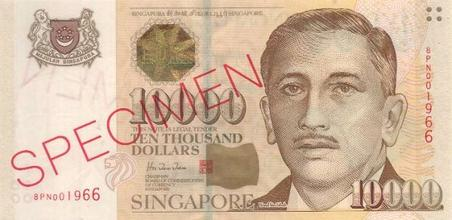
$1,000 and $10,000
Commemorative issues
$10, $20, $25, $50
The $10,000 note is one of the highest-value banknotes ever circulated by any country. Although it is discontinued, it remains legal tender.
Coins
Category
Denominations
Frequently used
5c, 10c, 20c, 50c, $1
Discontinued
1c (stopped in 2002, still legal tender, though some places may not accept it)
A Short History
Before 1967: Singapore used the Malaya and British Borneo dollar, shared across several territories.
12 June 1967: The Singapore dollar was introduced, replacing the older currency as Singapore built its own monetary identity after independence in 1965.
Today: The currency is 59 years old, managed by the Monetary Authority of Singapore, which acts as both central bank and financial regulator.
The Brunei Connection
Singapore and Brunei are the two users of the Singapore dollar in practice. The Brunei dollar is pegged to the Singapore dollar at par, meaning 1 Brunei dollar equals 1 Singapore dollar. Under a long-standing arrangement, the two are accepted interchangeably in both countries. Few currencies in the world enjoy such a close two-way relationship.
How Heavily Is the Singapore Dollar Traded?
Based on the BIS Triennial Central Bank Survey, the Singapore dollar is the 10th most traded currency in the world, ahead of the Indian rupee, South Korean won and Swedish krona.
Measure
April 2022
April 2025
Share of daily forex turnover
2.4%
2.4%
Rank
10th
10th
Change
Steady (0.0pp)
Shares are out of a 200% total, because every trade involves two currencies.
How SGD Compares to Nearby Currencies (April 2025)
Rank
Currency
Code
Share of daily turnover
8
Canadian dollar
CAD
5.8%
9
Hong Kong dollar
HKD
3.8%
10
Singapore dollar
SGD
2.4%
11
Indian rupee
INR
1.9%
12
South Korean won
KRW
1.8%
13
Swedish krona
SEK
1.6%
What stands out is that the Singapore dollar held its share exactly steady between 2022 and 2025, while several of its peers moved. The Hong Kong dollar rose 1.2 points, the Indian rupee gained 0.3 points, and the Swedish krona lost 0.6 points. For a currency of a country with a population of under 6 million, a 2.4% share is a remarkable result.
Why Is the Singapore Dollar So Widely Traded?
Singapore is a global financial hub. It is one of the world’s major foreign exchange trading centers, so large volumes of currency are handled there every day.
A strong, trusted central bank. The Monetary Authority of Singapore is respected for its disciplined approach. Unlike many central banks, MAS manages monetary policy mainly through the exchange rate rather than interest rates.
Open trade. Singapore’s economy depends heavily on international trade, which creates constant demand for currency exchange.
Stability and rule of law. Investors see Singapore as a safe, well-regulated place to hold money.
Regional gateway. Traders use the Singapore dollar as a convenient route into Southeast Asian markets.
Fun Facts
The Singapore $10,000 note was among the highest-denomination notes in regular circulation anywhere.
The 1-cent coin was discontinued in 2002, and prices are commonly rounded to the nearest 5 cents.
The currency is written in four languages in official use, and the Tamil name literally refers to “silver”, reflecting the old term for money.
Singapore and Brunei share what is among the world’s most closely linked currency pairs.
Key Details
The Singapore dollar (SGD) was introduced on 12 June 1967 and is issued by the Monetary Authority of Singapore.
It is the 10th most traded currency in the world, with a steady 2.4% share of daily forex turnover in both 2022 and 2025.
The Brunei dollar is pegged to it at par, and the two are used interchangeably.
Everyday cash is made up of $2, $5, $10, $50 and $100 notes plus coins from 5c to $1, while the $1,000 and $10,000 notes are discontinued but still legal tender.
The Singapore dollar proves that a currency does not need a huge economy behind it to matter globally. Backed by a trusted central bank, a thriving financial center and open trade, it holds a firm place among the world’s top ten traded currencies. If you travel to Singapore, do business with it, or follow Asian markets, the sing-dollar is a currency worth understanding.
Sources: Monetary Authority of Singapore; Bank for International Settlements (BIS) Triennial Central Bank Survey, April 2025
More
Anambra State: Facts & Figures Slogan: Light of the NationCreation: 27 August, 1991Population: 4,055,048 (Census 2006)Capital: AwkaMajor Commercial Cities: Onitsha, Nnewi and EkwulobiaLiteracy Rate: About…
Interesting Facts About Philippines 1. The Philippines is the world’s second-largest archipelago, consisting of over 7,600 islands, with only about 2,000 of them inhabited.…
15 Interesting Facts About Canada Here are 15 interesting facts about Canada: Canada is the second-largest country in the world by land area. Canada has…
20 INTERESTING FACTS ABOUT AMALA The following are some important facts about a popular Nigeria food called Amala 1. Amala is a local indigenous Nigerian…
Central Bank of Nigeria: Basic facts In 1991, the Bank s and Other Financial Institutions Act (BOFIA) formerly BOFI was promulgated to replace the CBN Act…
ONDO FACTS Country: Nigeria Capital: Akure Number of LGAs: 18 State Slogan: The Sunshine State Area: 15,500 km2 (5984.6 sq mi) Population: 3.44…