Top 10 Most Widely Spoken Languages at Home in the Philippines
The Philippines is one of the world’s most linguistically diverse countries, with numerous languages and dialects spoken across its islands and communities.
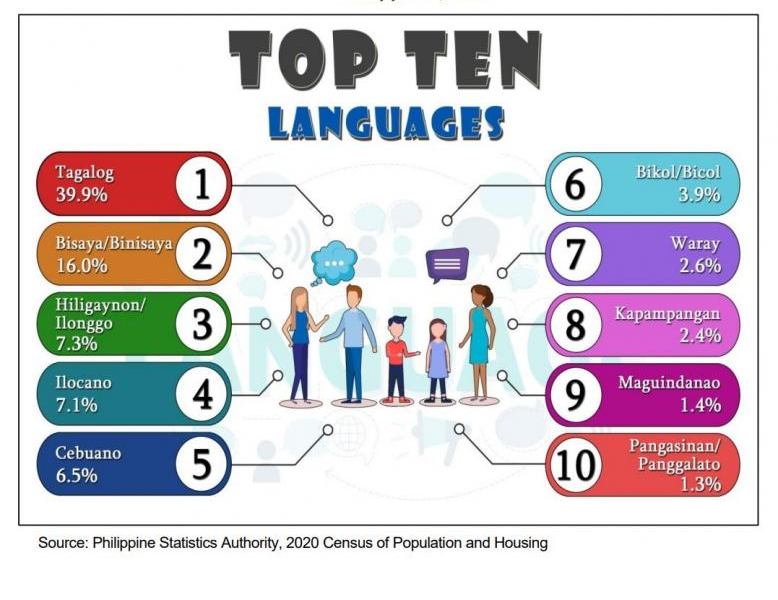
Tagalog is the language generally spoken at home in 10,522,507 households, equivalent to 39.9% of the country’s 26,388,654 households included in the census tabulation. Bisaya/Binisaya ranked second, followed by Hiligaynon/Ilonggo, Ilocano, Cebuano, and other major Philippine languages. (Philippine Statistics Authority)
These figures are important because they describe language use at the household level rather than simply counting people who can speak a particular language. They also demonstrate that, despite Tagalog’s leading position, the Philippines remains a highly multilingual society.
The leading languages and language groups:
Rank
Language/Dialect Generally Spoken at Home
Households
Share of Households
1
Tagalog
10,522,507
39.9%
2
Bisaya/Binisaya
4,210,000+
16.0%
3
Hiligaynon/Ilonggo
1,930,000+
7.3%
4
Ilocano
1,860,000+
7.1%
5
Cebuano
1,720,000+
6.5%
6
Bikol/Bicol
1,030,000+
3.9%
7
Waray
698,745
2.6%
8
Kapampangan
639,687
2.4%
9
Maguindanao
365,032
1.4%
10
Pangasinan/Panggalato
334,759
1.3%
—
Other languages/dialects
2,950,000+
11.2%
Figures are based on the PSA’s 2020 CPH release. Some household figures above are rounded where the PSA press release itself presents them in millions; exact figures are retained where explicitly stated in the source. (Philippine Statistics Authority)
Tagalog Leads Household Language Use
The most significant finding is the position of Tagalog.
The census recorded 10,522,507 households, or 39.9%, where Tagalog was generally spoken at home. In other words, approximately four out of every ten households included in this particular census language measure reported Tagalog as their household’s generally spoken language. (Philippine Statistics Authority)
This makes Tagalog the leading household language in the 2020 CPH.
However, the statistic should be interpreted carefully. The PSA’s measure is specifically about the language or dialect generally spoken at home by household members. It is not a ranking of every language a person can speak, understand, read, or write.
That distinction matters in a multilingual country such as the Philippines, where an individual may use one language with family members, another at school or work, and English or another Philippine language in different social situations.
Bisaya/Binisaya Ranks Second
The second-largest category in the PSA’s data was Bisaya/Binisaya, spoken generally at home in approximately 4.21 million households, representing 16.0% of the total.
The difference between Tagalog and Bisaya/Binisaya is substantial in household numbers. Tagalog was reported in more than 10.5 million households, while Bisaya/Binisaya accounted for roughly 4.21 million. (Philippine Statistics Authority)
The figures nevertheless show that languages other than Tagalog have a significant role in Filipino household life.
The presence of Bisaya/Binisaya near the top of the table is also consistent with the broader linguistic diversity associated with the Visayas and Mindanao and with communities elsewhere in the country.
Hiligaynon/Ilonggo and Ilocano Follow
The third-largest category was Hiligaynon/Ilonggo, reported in approximately 1.93 million households, or 7.3%.
It was followed closely by Ilocano, with approximately 1.86 million households, equivalent to 7.1%. (Philippine Statistics Authority)
The relatively close percentages of Hiligaynon/Ilonggo and Ilocano illustrate that the country’s language landscape cannot be reduced to a simple Tagalog-versus-other-languages division.
Several major Philippine languages have substantial household populations, and each represents communities with their own linguistic traditions, vocabulary, cultural expressions, and regional histories.
Cebuano Also Has a Major Household Presence
Cebuano was reported as the generally spoken household language in approximately 1.72 million households, or 6.5% of the national total. (Philippine Statistics Authority)
Cebuano’s position among the leading household languages further illustrates the geographic and cultural diversity of the Philippine linguistic environment.
The PSA’s classification is particularly useful because it captures what households actually identified as their generally spoken language or dialect, rather than attempting to determine language identity solely from geographic location.
Other Major Languages in the Census
The remaining languages in the PSA’s top ten included Bikol/Bicol, Waray, Kapampangan, Maguindanao, and Pangasinan/Panggalato.
Their recorded household shares were:
Bikol/Bicol: 3.9%
Waray: 2.6%
Kapampangan: 2.4%
Maguindanao: 1.4%
Pangasinan/Panggalato: 1.3%
Together, these categories demonstrate that significant populations across the Philippines continue to use regional languages and dialects as their primary household means of communication. (Philippine Statistics Authority)
The “Other Languages/Dialects” Category Is Also Significant
One of the most revealing aspects of the PSA data is the size of the group outside the ten leading categories.
The PSA reported that 2.95 million households, or 11.2%, generally spoke other languages or dialects at home. (Philippine Statistics Authority)
The agency specifically identified several languages and varieties within this broader group, including:
Boholano
Tausug/Bahasa Sug
Maranao
Karay-a/Kinaray-a
Bukidnon/Binukid
Akeanon/Aklanon
Masbateño/Masbatenon
Surigaonon
Zamboagueño-Chavacano
This category is important because it prevents the census results from being interpreted as though only the ten leading languages exist or matter in Philippine society.
In fact, more than one in ten households fell into the combined “other languages/dialects” category. (Philippine Statistics Authority)
What the Census Actually Measures
A common misunderstanding when reading language statistics is to assume that a census question about household language measures individual fluency.
It does not.
The PSA explicitly explains that the information was collected by asking a household respondent about the language/dialect generally spoken at home by household members. The answer therefore describes household language use. (Philippine Statistics Authority)
This means the figures should not automatically be interpreted as:
the total number of Filipino speakers of each language;
the number of people who speak each language as a second language;
literacy in each language;
the number of people who can understand each language;
the number of people who use each language outside the home.
Instead, the data answer a more specific question: Which language or dialect is generally spoken in the household?
Household Language Is Different From Language Ability
A person may be multilingual while living in a household classified under one language.
For example, a household could generally use Tagalog at home while individual members also speak English, Cebuano, Ilocano, Hiligaynon, or another language.
Consequently, the 39.9% figure for Tagalog should not be read as meaning that only 39.9% of Filipinos can speak Tagalog.
Likewise, the 16.0% figure for Bisaya/Binisaya does not mean that only 16.0% of the population has any ability to communicate in that language group.
The PSA statistic is specifically tied to household language use.
Why the Household Measure Matters
Household language data provide useful information about everyday linguistic practices.
Language used inside the home can be associated with:
Family communication The home is one of the primary environments where children acquire and maintain language.
Cultural transmission Languages carry expressions, traditions, stories, concepts, and forms of cultural knowledge between generations.
Regional identity Household language can provide an indication of the continued presence of regional linguistic communities.
Community communication Languages spoken at home can remain important in neighborhood, community, commercial, religious, and social settings.
Public-service planning Knowledge of language distribution can help institutions understand the linguistic environment in which public information is delivered.
A Comparison of the Leading Languages
The following table highlights the relative size of the leading categories:
Tagalog’s Lead Does Not Eliminate Linguistic Diversity
The dominance of Tagalog in the household-language statistics should not be confused with linguistic uniformity.
The census results show the opposite: alongside Tagalog are numerous large language communities.
When the ten leading categories and the “other languages/dialects” group are considered together, the distribution reveals a broad spectrum of languages used in Filipino homes. The second-largest category alone accounts for 16.0% of households, while several other languages individually account for between roughly 1% and 7% of households. (Philippine Statistics Authority)
The result is a linguistic landscape in which one language has a clear national lead in this particular measure, but many other languages continue to have substantial household use.
Tagalog and the Broader Philippine Language Landscape
Tagalog is often discussed in relation to Filipino, the national language of the Philippines. However, the PSA census release itself is reporting the language/dialect generally spoken at home, and the statistical category presented is “Tagalog.”
This distinction is useful when interpreting census data.
A statistical table should be read according to the exact variable collected. In this case, the question was not simply whether a household member could speak Filipino or Tagalog. Instead, the census sought to identify the language or dialect generally used among members of the household. (Philippine Statistics Authority)
The Importance of Regional Languages
The data also demonstrate why regional languages remain an important part of the Philippines’ cultural and demographic landscape.
Languages such as:
Hiligaynon/Ilonggo
Ilocano
Cebuano
Bikol/Bicol
Waray
Kapampangan
Maguindanao
Pangasinan
Tausug/Bahasa Sug
Maranao
Kinaray-a
represent linguistic communities that contribute to the country’s cultural diversity.
Some appear individually among the largest census categories, while others are represented within the PSA’s broader group of other languages and dialects. (Philippine Statistics Authority)
Important Points for Understanding the Statistics
Several details from the PSA should be kept in mind when citing or interpreting these numbers.
1. The data come from the 2020 Census
The figures describe the situation captured by the 2020 Census of Population and Housing. The PSA released this particular language finding on March 7, 2023. (Philippine Statistics Authority)
2. The unit is households
The principal figures are household counts, not individual speaker counts.
3. The question concerns the language generally spoken at home
This is the specific concept measured by the census question.
4. Homeless households are excluded from the stated household total
The PSA says that the total of 26,388,654 households used in the release excludes those enumerated as homeless. (Philippine Statistics Authority)
5. The information came from respondents
The PSA states that the statistics were based on information provided by the respondent or another responsible household member who could provide accurate information about the household. (Philippine Statistics Authority)
What the Numbers Tell Us About the Philippines
The 2020 CPH language results provide several broad observations:
Tagalog was the leading household language, reported in 39.9% of households.
Bisaya/Binisaya was the second-largest category, at 16.0%.
Hiligaynon/Ilonggo and Ilocano each accounted for more than 7% of households.
Cebuano accounted for 6.5%.
Bikol/Bicol, Waray, and Kapampangan each represented substantial household-language communities.
Maguindanao and Pangasinan/Panggalato also appeared among the ten leading categories.
Other languages and dialects collectively accounted for 11.2% of households.
The overall picture is therefore one of linguistic concentration alongside considerable diversity. (Philippine Statistics Authority)
Language, Culture, and Identity
Language statistics are more than numerical measurements. They provide a window into how communities communicate and maintain cultural connections.
A language spoken regularly within the home can be transmitted from parents and grandparents to children. It can also preserve local vocabulary, oral traditions, family expressions, and culturally specific ways of describing people, places, experiences, and events.
The PSA’s figures therefore provide a demographic snapshot of household language use while also illustrating the continued importance of linguistic diversity in Philippine society.
At the national level, Tagalog occupies the largest share of reported household language use. At the same time, the substantial shares associated with Bisaya/Binisaya, Hiligaynon/Ilonggo, Ilocano, Cebuano, Bikol/Bicol, Waray, Kapampangan, Maguindanao, Pangasinan, and numerous other languages show that the Philippines cannot be characterized by a single household language. (Philippine Statistics Authority)
Conclusion
The 2020 Census of Population and Housing confirms that Tagalog was the most widely reported language generally spoken at home in the Philippines, with 10,522,507 households, or 39.9% of the 26,388,654 households covered by the household-language statistic. Bisaya/Binisaya followed with 16.0%, while Hiligaynon/Ilonggo, Ilocano, Cebuano, and several other Philippine languages accounted for significant shares. (Philippine Statistics Authority)
The data also show why the Philippines is properly understood as a multilingual country. Tagalog’s leading position is clear in the census measure, but millions of households reported other Philippine languages and dialects as their usual language at home.
Ultimately, the PSA’s language statistics illustrate two facts at the same time: Tagalog has the largest household-language share, while linguistic diversity remains a defining characteristic of Philippine society.
Most widely spoken languages in Angola The Official Language is Portuguese, in addition to several national languages (dialects), the most widely spoken: Kikongo, Kimbundo, Tchokwe, Umbundo,…
Top 10 most powerful Idoma people The 10 most powerful Idoma, Igede people are: H.E. Dr. Sam Ode, Mni (Deputy Governor of Benue State) Comrade Senator…
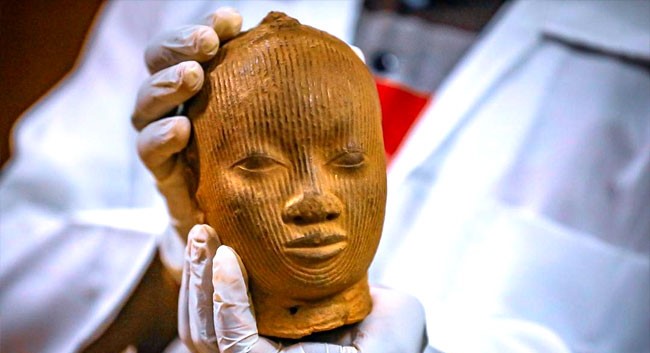
600 Year Old Ife Terracotta Returns Home The National Commission for Museums & Monuments has received a treasured repatriated Ife terracotta head from the Kingdom of Netherlands.…
LIST OF TOP 10 RELIGIONS With the exception of Christianity, the rest are self styled salvation that goes no where ChristianityPrincipal person: Jesus Christ United…
Top Russian Cities by Population While much of Russia’s territory is sparsely populated, its urban centers are dynamic hubs of culture, politics, and industry. The…
Top 10 Russian Cities by Population The top 10 Russian cities according to population (2021 Census) are: Moscow Saint Petersburg Novosibirsk Yekaterinburg Kazan Nizhny Novgorod Chelyabinsk…
Top microfinance institutions in Rwanda A detailed statistical comparison table of the top microfinance institutions in Rwanda based on recent available data. Top Microfinance Institutions…
Top 25+ Resilience Centers in Israel: A Guide Discover all resilience centers in Northern and Judea-Samaria Israel. Full list with contact numbers, locations, and opening hours. Find your…