Uzbekistan’s Regions and Their Capitals: A Guide to All 14 Divisions
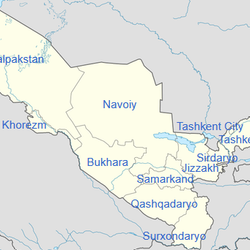
Uzbekistan is divided into twelve regions (viloyatlar), one autonomous republic (Karakalpakstan) and one independent city (Tashkent City). Most regions are named after their capital city or a river, and all are further divided into districts (tuman). Names below are in English with the Uzbek form beside them; transliterations vary widely.
All divisions at a glance
Division
Uzbek name
Capital
Area (km²)
Population (2026 census)
Andijan Region
Andijon viloyati
Andijan (Andijon)
4,303
3,531,777
Bukhara Region
Buxoro viloyati
Bukhara (Buxoro)
41,937
2,104,874
Fergana Region
Farg’ona viloyati
Fergana (Farg’ona)
7,005
4,238,911
Jizzakh Region
Jizzax viloyati
Jizzakh (Jizzax)
21,179
1,524,055
Republic of Karakalpakstan
Qoraqalpog’iston Respublikasi
Nukus (No’kis)
161,358
2,149,932
Kashkadarya Region
Qashqadaryo viloyati
Karshi (Qarshi)
28,568
3,692,323
Khorezm Region
Xorazm viloyati
Urgench (Urganch)
6,464
2,140,746
Namangan Region
Namangan viloyati
Namangan
7,181
3,149,161
Navoiy Region
Navoiy viloyati
Navoiy
109,375
1,184,591
Samarkand Region
Samarqand viloyati
Samarkand (Samarqand)
16,773
4,404,575
Surkhandarya Region
Surxondaryo viloyati
Termez (Termiz)
20,099
2,984,084
Syrdarya Region
Sirdaryo viloyati
Gulistan (Guliston)
4,276
954,361
Tashkent City
Toshkent shahri
Tashkent (Toshkent)
327
3,224,838
Tashkent Region
Toshkent viloyati
Nurafshon
15,258
3,763,093
Area figures here come from a different source than the State Committee of Statistics table used in the other Uzbekistan articles, so they differ slightly (Karakalpakstan is 161,358 km² here and 166,594 km² there; Tashkent City is 327 km² here and 449 km² there). Population figures are the 2026 preliminary census counts in both.
Western regions
Republic of Karakalpakstan (Qoraqalpog’iston), capital Nukus
Region: Uzbekistan’s only autonomous republic and its largest division, home to the Karakalpaks, a Turkic people with their own language. It holds the Uzbek part of the Aral Sea basin and had 2,149,932 people in 2026.
Capital: Nukus (No’kis), about 344,690 people (2025 estimate), on the east bank of the Amu Darya. Its Savitsky Museum, founded in 1966 by the artist Igor Savitsky, holds over 100,000 works and a noted Soviet avant-garde collection, and the city is the starting point for trips to the ship graveyard at Moynaq.
Khorezm Region (Xorazm), capital Urgench
Region: A small region by area (6,464 km²) with 2,140,746 people. It contains Khiva, whose walled inner town Itchan Kala became Uzbekistan’s first UNESCO World Heritage Site in 1990.
Capital: Urgench (Urganch), 155,690 people (2025 estimate). Khiva (100,066) is the better-known city but not the capital.
Bukhara Region (Buxoro), capital Bukhara
Region: A large desert region, the third largest division at 41,937 km², with 2,104,874 people.
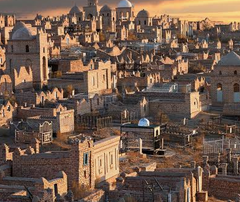
Capital: Bukhara, 274,800 people (2025 estimate). Its historic centre was listed by UNESCO in 1993 and, according to UNESCO, is the most complete example of a medieval city in Central Asia. The city’s roots go back over 2,000 years on the Silk Road.
Navoiy Region, capital Navoiy
Region: The second largest division (109,375 km²) and the least densely populated, with 1,184,591 people. It is the youngest region in Uzbekistan, named after the poet Alisher Navoi and formed in 1982. Its economy centres on gold and uranium mining in the Kyzylkum Desert, including the Muruntau mine.
Capital: Navoiy, 166,492 people (2025 estimate), founded in 1958 in an uninhabited desert alongside the Navoi Mining and Metallurgical Combine. The nearby city of Zarafshan (90,407) is known as Uzbekistan’s gold capital.
Central and southern regions
Samarkand Region (Samarqand), capital Samarkand
Region: The most populous region, with 4,404,575 people on 16,773 km².
Capital: Samarkand, 595,818 people (2025 estimate), the country’s third-largest city. Its historic centre has been a UNESCO World Heritage Site since 2001, listed as a crossroads of cultures. Highlights include Registan Square, framed by three madrasas, and Gur-i Amir, the tomb of Timur.
Kashkadarya Region (Qashqadaryo), capital Karshi
Region: The fourth most populous region, with 3,692,323 people on 28,568 km². It contains Shakhrisabz, the birthplace of Timur, whose historic centre was listed by UNESCO in 2000.
Capital: Karshi (Qarshi), 300,777 people (2025 estimate), the region’s largest city, well ahead of Shahrisabz (150,138).
Surkhandarya Region (Surxondaryo), capital Termez
Region: Uzbekistan’s southernmost region, bordering Turkmenistan, Tajikistan and Afghanistan, with 2,984,084 people on 20,099 km².
Capital: Termez (Termiz), 207,326 people (2025 estimate), on the Amu Darya. It has a history of about 2,500 years and ancient Buddhist sites such as Fayaz Tepe, dating to the 1st century AD. The Friendship Bridge to Afghanistan is nearby and carries the country’s only border crossing with Afghanistan. Soviet forces used the city as a base from 1979 to 1989.
Jizzakh Region (Jizzax), capital Jizzakh
Region: A mid-sized region of 21,179 km² with 1,524,055 people, lying between Tashkent and Samarkand.
Capital: Jizzakh (Jizzax), 199,942 people (2025 estimate), up from 161,400 in 2013.
Syrdarya Region (Sirdaryo), capital Guliston
Region: Named after the Syr Darya river. It is the smallest of the twelve regions by area (4,276 km²) and has the fewest people of any division (954,361).
Capital: Guliston (Gulistan), 79,800 people (2025 estimate), the second-smallest regional capital after Nurafshon.
The Fergana Valley
Fergana, Andijan and Namangan regions make up Uzbekistan’s share of the Fergana Valley, which it divides with Kyrgyzstan and Tajikistan. The three regions were assigned to Uzbekistan in the Soviet-era demarcation of 1924, and together they hold about 28% of the country’s people.
Fergana Region (Farg’ona), capital Fergana
Region: The second most populous region, with 4,238,911 people on 7,005 km². Its cities include Kokand (313,597), the capital of the Kokand Khanate in the 18th and 19th centuries, and Margilan (257,878), known for silk since the 10th century and home to the Yodgorlik Silk Factory.
Capital: Fergana (Farg’ona), 328,409 people (2025 estimate). It is a young city, built in 1876 as New Margilan after Russia annexed the Kokand Khanate.
Andijan Region (Andijon), capital Andijan
Region: The most densely populated region, with 3,531,777 people on just 4,303 km², about 821 people per km².
Capital: Andijan (Andijon), 492,425 people (2025 estimate), the fourth-largest city in the country and the birthplace of Babur, founder of the Mughal Empire. It lies only about 50 km from Osh in Kyrgyzstan.
Namangan Region, capital Namangan
Region: 3,149,161 people on 7,181 km².
Capital: Namangan, 713,385 people (2025 estimate), the second-largest city in Uzbekistan after Tashkent. It grew by about 52% from 468,000 in 2013 and is the home town of the poet Mashrab.
Tashkent City and Tashkent Region
Tashkent City (Toshkent shahri), capital Tashkent
Division: An independent city with region-level status, the smallest division by area (327 km² in this source) and home to 3,224,838 people. It is an enclave entirely surrounded by Tashkent Region.
Capital: Tashkent (Toshkent) is also the national capital. With 3,112,748 people (2025 estimate) it is more than four times the size of the second-largest city, and its international airport is the main air gateway to the country.
Tashkent Region (Toshkent viloyati), capital Nurafshon
Region: The third most populous region, with 3,763,093 people on 15,258 km². It borders Kyrgyzstan, Tajikistan, Syrdarya and Namangan and has 15 districts and seven district-level cities. It is described as the most economically developed region in the country, with energy, mining, metallurgy, chemicals and electronics, and it includes Chatkal National Park.
Capital: Nurafshon, 57,523 people (2025 estimate), about 25 km south of Tashkent and the smallest regional capital. It was called Toytepa until 2017, when the Senate approved the new name and the city was designated the region’s administrative centre. Before that, the governor’s office had been in Tashkent city.
Sources
2026 preliminary census populations and region areas (table data supplied); 2025 and 2013 city estimates from the State Committee of Statistics table used in the other Uzbekistan articles
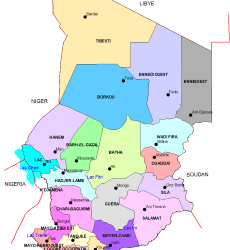
List of Chad regions and their capitals The 23 regions of Chad and their capitals are: Batha … Ati Chari-Baguirmi … Massenya Hadjer-Lamis … Massakory Wadi Fira…
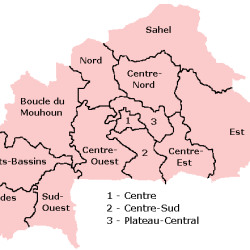
List of Burkina Faso regions and capitals Burkina Faso has 13 states (regions) namely: Boucle du Mouhoun Cascades Centre Centre-Est Centre-Nord Centre-Ouest Centre-Sud Est Hauts-Bassins Nord Plateau-Central…
List of Ethiopia regions and capitals The regions and their capitals in Ethiopia are as follows: Addis Ababa (City) …. Addis Ababa Afar Region … Semera Amhara…
Ethiopia regions and capitals The regions and their capitals in Ethiopia are as follows: Addis Ababa (City) …. Addis Ababa Afar Region … Semera Amhara…
Tanzania regions: Population, land area and capitals Regions of Tanzania by population, land area and capitals RegionPopulationArea (Km²)CapitalArusha1,694,31033,809ArushaDar es Salaam4,364,5411,393Dar es SalaamDodoma2,083,58841,311DodomaGeita1,739,530 GeitaIringa941,23856,864IringaKagera2,458,02328,388BukobaKatavi564,604 MpandaKigoma2,127,93037,037KigomaKilimanjaro1,640,08713,309MoshiLindi864,65267,000LindiManyara1,425,13146,359BabatiMara1,743,83019,566MusomaMbeya2,707,41060,350MbeyaMorogoro2,218,49270,799MorogoroMtwara1,270,85416,707MtwaraMwanza2,772,50919,592MwanzaNjombe702,097 NjombePemba North211,732574WetePemba South195,116332Chake ChakePwani1,098,66832,407Dar es SalaamRukwa1,004,53968,635SumbawangaRuvuma1,376,89163,498SongeaShinyanga1,534,80850,781ShinyangaSimiyu1,584,157 BariadiSingida1,370,63749,341SingidaTabora2,291,62376,151TaboraTanga2,045,20526,808TangaZanzibar…
List of Tanzania regions and capitals The regions of Tanzania and the capitals are: RegionCapitalArushaArushaDar es SalaamDar es SalaamDodomaDodomaGeitaGeitaIringaIringaKageraBukobaKataviMpandaKigomaKigomaKilimanjaroMoshiLindiLindiManyaraBabatiMaraMusomaMbeyaMbeyaMorogoroMorogoroMtwaraMtwaraMwanzaMwanzaNjombeNjombePemba NorthWetePemba SouthChake ChakePwaniDar es SalaamRukwaSumbawangaRuvumaSongeaShinyangaShinyangaSimiyuBariadiSingidaSingidaTaboraTaboraTangaTangaZanzibar NorthMkokotoniZanzibar South…
Botswana Districts and their Capitals Botswana’s Administrative District System Botswana is a unitary state whose territorial administration is structured to balance centralized governance with effective…