Internet access has become an important indicator of how households participate in modern economic, educational, social, and communication activities. this provides a detailed picture of household internet access, the types of connections being used, where people access the internet, and the availability of information and communication technology (ICT) devices in Filipino homes.
According to the Philippine Statistics Authority (PSA), 14,794,590 out of 26,374,653 households reported having access to the internet in 2020. This represented 56.1 percent of households nationwide, meaning that more than half of the households covered by the census reported internet access. (Philippine Statistics Authority)
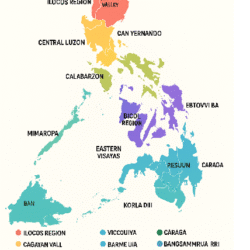
The data also reveal substantial differences between regions. While the National Capital Region recorded internet access among nearly three-fourths of its households, some regions had considerably lower levels of connectivity. The census therefore illustrates not only the growth of internet access but also the geographic differences that characterized digital connectivity in the Philippines in 2020.
Internet Access Reached More Than Half of Philippine Households
The central finding of the PSA report is that 56.1 percent of the 26,374,653 households covered by the census had internet access. In absolute terms, this amounted to 14,794,590 households. (Philippine Statistics Authority)
It is important to distinguish between households and individual internet users. The PSA figure refers to households reporting internet access, rather than a direct count of individual people using the internet.
Key internet-access figures from the 2020 Census
Indicator
2020 Census figure
Total households covered
26,374,653
Households with internet access
14,794,590
Share of households with internet access
56.1%
Households without reported internet access
Approximately 43.9%
Highest regional proportion
NCR – 74.6%
Lowest regional proportion
Zamboanga Peninsula – 28.5%
These figures show that internet connectivity had become a feature of everyday household life for a substantial portion of the country, but access was far from universal.
The remaining share is also significant. With 43.9 percent of households not reporting internet access, the census indicates that digital connectivity remained uneven across the country in 2020. (Philippine Statistics Authority)
Regional Differences in Internet Access
One of the most important aspects of the PSA data is the substantial difference in household internet access among the country’s regions.
The National Capital Region (NCR) had the highest proportion of households with internet access at 74.6 percent. Three other regions exceeded the national rate of 56.1 percent: CALABARZON at 70.2 percent, the Cordillera Administrative Region (CAR) at 62.8 percent, and Central Luzon at 62.3 percent. (Philippine Statistics Authority)
At the other end of the distribution, Zamboanga Peninsula recorded the lowest proportion, at 28.5 percent.
Selected regional internet-access rates
Region
Households with internet access
National Capital Region (NCR)
74.6%
CALABARZON (Region IV-A)
70.2%
Cordillera Administrative Region (CAR)
62.8%
Central Luzon (Region III)
62.3%
Philippines
56.1%
Zamboanga Peninsula (Region IX)
28.5%
The difference between NCR’s 74.6 percent and Zamboanga Peninsula’s 28.5 percent is 46.1 percentage points. This illustrates the extent of the geographic variation in household connectivity captured by the 2020 CPH.
The PSA figures should therefore not be interpreted as evidence that internet access was distributed evenly across the Philippine population. The national average conceals considerable differences among regions. (Philippine Statistics Authority)
CALABARZON Had the Largest Share of Internet-Connected Households
The PSA report also examined the distribution of internet-connected households by their share of the national total.
CALABARZON, or Region IV-A, accounted for the largest share at 19.3 percent of all households in the country that reported internet access. NCR followed with 17.6 percent, while Central Luzon ranked next with 12.8 percent. (Philippine Statistics Authority)
BARMM had the smallest share, accounting for 1.7 percent of households with internet access nationwide.
Share of the country’s internet-connected households
Region
Share of all internet-connected households
CALABARZON
19.3%
NCR
17.6%
Central Luzon
12.8%
BARMM
1.7%
This measure is different from the regional internet-access rate.
For example, a region can have a large share of the country’s connected households because it has a large household population, while its percentage of households with internet access may tell a different story. The PSA report uses both measures to provide a broader understanding of digital connectivity.
Mobile Broadband Was the Most Common Connection Type
Another major finding concerns how Filipino households connected to the internet.
The PSA reported that 42.1 percent of households had internet connections through a mobile broadband network. The agency defined this category as internet access through a handset, a card containing an integrated Subscriber Identity Module (SIM), or a USB modem. (Philippine Statistics Authority)
Other reported connection types included fixed wired broadband, fixed wireless broadband, and satellite broadband.
Main internet connection types reported by households
Internet connection type
Share of households
Mobile broadband network
42.1%
Fixed wired narrowband/broadband
15.0%
Fixed wireless broadband
4.0%
Satellite broadband
2.4%
The figures demonstrate the importance of mobile connectivity in the Philippine internet landscape.
Mobile broadband’s 42.1 percent share was considerably higher than the reported shares of the other specified connection categories. This points to the central role of mobile networks and mobile-enabled devices in household internet access during the period covered by the census.
Why Mobile Connectivity Matters
Mobile broadband can provide internet connectivity without requiring a traditional fixed-line connection into a home. For households located in areas where fixed broadband infrastructure is less accessible, mobile connectivity can serve as an important means of getting online.
The PSA data show that this was not simply a minor component of Philippine internet use. Mobile broadband was reported by a substantial portion of households as their main type of internet connection. (Philippine Statistics Authority)
The prominence of mobile broadband can be considered alongside another census finding: 81.7 percent of households had a mobile phone.
This combination of widespread mobile-phone availability and the prominence of mobile broadband illustrates the importance of mobile technology within the country’s digital ecosystem.
CALABARZON Led in Mobile Broadband
Among households nationwide reporting mobile broadband as their main internet connection, CALABARZON had the largest share, accounting for 17.9 percent of the country’s 11.1 million households in this category.
For fixed wired broadband, NCR had the largest share, at 26.4 percent of the total 3.97 million households in that category. CALABARZON followed with 23.4 percent, while Central Luzon accounted for 14.1 percent. (Philippine Statistics Authority)
Regional shares by connection type
Connection type
Leading region
Share
Mobile broadband
CALABARZON
17.9%
Mobile broadband
NCR
16.0%
Mobile broadband
Central Luzon
11.8%
Fixed wired broadband
NCR
26.4%
Fixed wired broadband
CALABARZON
23.4%
Fixed wired broadband
Central Luzon
14.1%
The same three regions also occupied the leading positions for reported fixed wireless and satellite broadband connections, according to the PSA. (Philippine Statistics Authority)
Home Was the Main Place for Internet Use
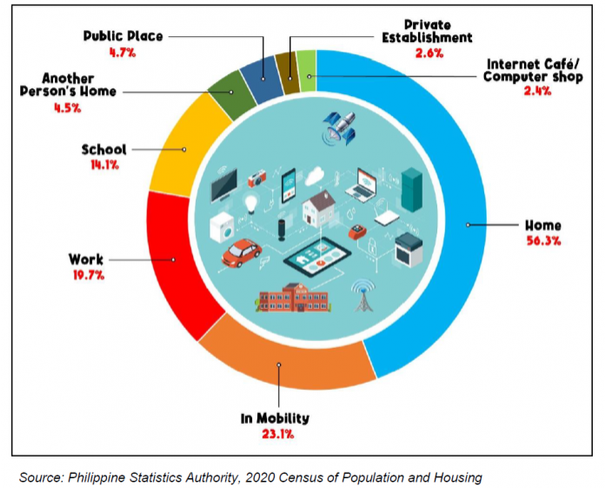
The census also looked beyond whether households had internet access and examined where household members used the internet during the three months preceding the enumeration.
The home was the most commonly reported location. 56.3 percent of households reported internet use at home. (Philippine Statistics Authority)
Other locations and circumstances included mobile use, workplaces, and schools.
Where households used the internet
Location or circumstance
Share
At home
56.3%
While mobile, using a cellular phone or other handheld device
23.1%
Workplace
19.7%
School
14.1%
These percentages describe reported internet-use locations and should not necessarily be added together as if they represented mutually exclusive categories. A household member could use the internet in more than one location.
The data nevertheless provide a useful picture of internet use in 2020. Home was the leading environment, while mobile access allowed people to connect while away from home. Workplace and school access also formed part of the internet-use landscape.
Mobile Phones Were the Most Common ICT Device
The census findings on internet access become even more significant when considered alongside household ownership of ICT-related devices.
The mobile phone was the most commonly reported household convenience/ICT device or vehicle, with 81.7 percent of households reporting one in working condition. (Philippine Statistics Authority)
Other frequently reported household items included electric fans and other cooling equipment, televisions, refrigerators or freezers, and washing machines.
Most commonly reported household devices
Household device
Households
Mobile phone
81.7%
Electric fan and other cooling equipment
77.9%
Television
75.7%
Refrigerator/freezer
46.2%
Washing machine
42.9%
The mobile phone’s 81.7 percent presence is particularly relevant to understanding the 42.1 percent share of households reporting mobile broadband as their main internet connection.
Together, the figures demonstrate the importance of mobile technology in household connectivity.
The Digital Divide Was Still Visible
The national figure of 56.1 percent can easily create the impression that internet access had become broadly universal by 2020. The regional data provide a more nuanced picture.
On one side, NCR had internet access in 74.6 percent of households. CALABARZON, CAR, and Central Luzon also exceeded the national rate.
On the other side, Zamboanga Peninsula had internet access in only 28.5 percent of households. (Philippine Statistics Authority)
This means that the country’s digital landscape contained substantial differences in household connectivity.
The data highlight several dimensions of the digital divide:
Geographic differences: Internet access varied substantially from one region to another.
Infrastructure differences: Households relied on different types of connections, including mobile, wired, wireless, and satellite networks.
Household access differences: More than half of households reported access, but a large minority did not.
Technology differences: Mobile phones were much more widespread in households than reported internet access.
Location of use: Internet use occurred at home, while mobile, at work, and at school.
The census therefore demonstrates that having a mobile phone and having household internet access were not equivalent conditions.
What the Numbers Say About Philippine Connectivity
Several broader observations can be drawn directly from the census statistics.
1. Internet access had become a mainstream household service
With 14.8 million households reporting internet access, connectivity was already an established part of household life in 2020. The 56.1 percent national rate means that internet access was reported by more than half of the households covered by the census. (Philippine Statistics Authority)
2. Mobile networks were central to connectivity
Mobile broadband accounted for 42.1 percent of households’ reported internet connection types. This was substantially higher than the reported shares for fixed wired, fixed wireless, and satellite broadband. (Philippine Statistics Authority)
3. Household connectivity differed considerably by region
The difference between the highest and lowest regional internet-access rates was substantial. NCR recorded 74.6 percent, compared with 28.5 percent in Zamboanga Peninsula. (Philippine Statistics Authority)
4. Internet access was closely associated with mobile technology
Mobile phones were present in 81.7 percent of households, making them the most common household ICT-related device reported in the census. (Philippine Statistics Authority)
5. Home was the dominant internet-use environment
The home was reported as the place of internet use by 56.3 percent of households, followed by mobile use, workplaces, and schools. (Philippine Statistics Authority)
A Statistical Snapshot of Internet Access
The following table brings the principal findings together:
The figures come from the 2020 Census of Population and Housing, but the PSA provides an important methodological qualification.
The household information discussed in this release was based on responses from a respondent or responsible household member who could provide accurate information about the household. The 26,374,653 households described in the release exclude households enumerated in relocation areas, homeless persons, and people living in other types of buildings such as buses, trailers, boats, and tents. (Philippine Statistics Authority)
For the specific data items concerning household conveniences, internet access, and internet use, enumerators collected information from a sample of 20 percent of households in the enumeration area or areas using the CPH sample household questionnaire or the self-administered questionnaire. (Philippine Statistics Authority)
The questions included:
Whether the household had specified conveniences, ICT devices, or vehicles in working condition.
What type or types of internet access were available at home.
This methodological information is important when interpreting the statistics. The figures are census-based household statistics, but particular ICT questions were collected through the specified sample-household component.
Internet Access and the Changing Philippine Household
The 2020 Census provides more than a simple measurement of how many Filipino households were online. It shows the structure of household connectivity.
The typical pattern reflected in the data includes several interconnected elements:
Mobile devices → mobile networks → internet access → use at home and while mobile
The high prevalence of mobile phones provides a technological foundation for mobile connectivity. At the same time, the continued presence of fixed wired, fixed wireless, and satellite connections demonstrates that Filipino households used multiple forms of internet infrastructure.
The data also show that internet access cannot be understood solely in national terms. The regional variation is a central feature of the statistics.
Why the 2020 Internet Statistics Matter
Internet connectivity affects the ability of households to participate in digital activities such as online communication, information retrieval, education, digital commerce, and other internet-based services. The PSA census does not attempt to measure all of these outcomes in this particular release, but its household connectivity figures provide an important baseline for understanding the country’s digital environment.
The statistics are particularly useful for examining:
Digital inclusion
Telecommunications infrastructure
Household ICT adoption
Regional connectivity
Mobile broadband dependence
Internet-use locations
Household technology ownership
The geographic dimensions of the digital divide
Because the data are broken down by region and connection type, they can also help researchers understand how internet access was distributed across the Philippines at the time of the 2020 Census.
Conclusion
The 2020 Census of Population and Housing presents a detailed picture of internet connectivity in the Philippines. Out of 26.37 million households covered by the relevant PSA release, 14.79 million, or 56.1 percent, reported internet access. (Philippine Statistics Authority)
The statistics show that connectivity was already widespread but uneven. NCR had the highest household internet-access rate at 74.6 percent, while Zamboanga Peninsula had the lowest at 28.5 percent. CALABARZON, CAR, and Central Luzon were the other regions that exceeded the national rate. (Philippine Statistics Authority)
Mobile connectivity was particularly important: 42.1 percent of households reported mobile broadband as their main internet connection, while mobile phones were present in 81.7 percent of households. The home was the most commonly reported place of internet use, although mobile, workplace, and school use also featured prominently. (Philippine Statistics Authority)
Taken together, these findings portray a Philippine digital environment in which internet access had become a major component of household life, while significant regional differences remained. The 2020 CPH therefore serves as an important statistical reference for understanding household internet access, mobile broadband adoption, ICT availability, and the distribution of digital connectivity across the country.
Source: Philippine Statistics Authority, More than 50 million have Access to the Internet (2020 Census of Population and Housing), Reference No. 2023-73, released July 4, 2023. Philippine Statistics Authority source article
Uganda: Illness Rates and Unequal Health Access Key findings from Uganda’s 2023/24 health survey, including illness trends, health-seeking behavior, and the rising cost of care. Health Status…
List of Ethnic Groups in Philippines Ethnic Groups in the Philippines: A Guide to Its Diverse Population Ethnic groups in the Philippines, from Tagalog and Visayan…
Interesting Facts About Philippines 1. The Philippines is the world’s second-largest archipelago, consisting of over 7,600 islands, with only about 2,000 of them inhabited.…
World Heritage Sites in Philippines UNESCO World Heritage Sites in Philippines are: Baroque Churches of the Philippines Tubbataha Reefs Natural Park Rice Terraces of the…