The Jurong Formation: Singapore’s Folded Sedimentary Bedrock
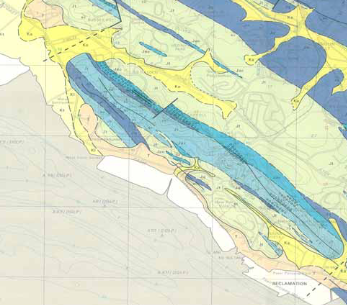
The Jurong Formation is a body of sedimentary rock that underlies the south-west of Singapore, and it is one of the island’s main geological units. It formed between the late Triassic and the early or middle Jurassic, roughly 200 million years ago, and its rocks have since been folded and broken by tectonic movement. Its mix of carbonate and clastic rocks, and the soils that weather out of them, matter to anyone building on the western side of the island.
Age and geological setting
The formation was laid down from the late Triassic into the early or middle Jurassic. Traditionally it covered much of the layered rock succession of Singapore’s south-west, and it gave the area around Jurong its distinct geology.
Later work places these rocks in a wider regional story. The strata accumulated in the southern part of the Semantan Basin, a depositional basin that also runs through the Central Belt of Peninsular Malaysia. Part of the sequence, the Upper Triassic red beds, is interpreted as molasse deposited in a half graben on the hanging wall of the Bukit Timah Fault after the main phase of the Indosinian Orogeny (Oliver and Prave, 2013).
What the formation is made of
The Jurong Formation is a mixed package of carbonate and clastic rocks:
Carbonates: dolomite and limestone
Fine-grained clastics: mudstone and shale
Coarser clastics: sandstone and conglomerate
The mix records changing conditions of deposition, from marine settings to river and floodplain environments. Reddish mudstone-sandstone cycles, for example, have been logged on Sentosa, where the rock coarsens and thickens upward in cycles of about ten metres.
Folding and faulting
The rocks of the formation are acutely folded and faulted, a result of tectonic plate movement. Geologists link the deformation to the collision of continental blocks in the latest Triassic to earliest Jurassic, which squeezed the Triassic strata into folds and thrusts and left them weakly metamorphosed (Leslie et al.). Some large folds were once visible at outcrops in the south-west, though development has since covered a number of them.
Weathering, soils and a revised name
In Singapore’s warm, wet climate, the formation weathers into residual soils, which are soils formed in place from the rock below. Their properties are a standard concern for foundations, excavations and slopes in the west of the island, and have been studied in detail by engineering researchers (Rahardjo et al., 2004).
The name itself has changed. A 2019 survey of Singapore’s sedimentary bedrock by the British Geological Survey and Singaporean partners treated the old Jurong Formation as too broad. It now divides the rocks into a Jurong Group, of Middle to Upper Triassic age, and a younger Sentosa Group, and the old single formation is regarded as obsolete (Dodd et al., 2019). Older maps and engineering reports still use the original term.
OPEC: Formation, Membership, and Evolution The Organization of the Petroleum Exporting Countries (OPEC) was founded in September 1960 in Baghdad, Iraq with the signing of…
Climate of Singapore Singapore climate normals, extremes.1948-present Singapore has a tropical rainforest climate. Temperatures barely change through the year, humidity is high, and…
Singapore Land Reclamation Land reclamation in Singapore has been a cornerstone of the city-state’s spatial, economic, and infrastructural strategy since the early nineteenth…
List of Islands of Singapore Singapore is widely known as a city-state, but it is also an archipelago made up of numerous offshore islands surrounding…
Singapore ministers and ministries list Singapore’s Cabinet ministers and their portfolios Lawrence Wong: Prime Minister and Minister for Finance Lee Hsien Loong: Senior Minister Gan…
World Heritage Site in Singapore UNESCO World Heritage Site in Singapore is: Singapore Botanic Gardens > View other UNESCO World Heritage Sites More on World…