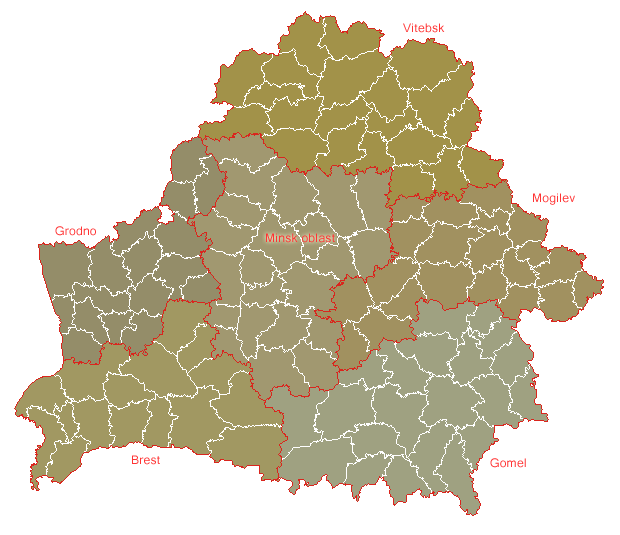
Belarus is divided into six regions (voblasts), each comprising numerous districts that serve as the fundamental administrative units of local governance. These districts vary widely in historical significance, economic activity, cultural heritage, and geographic landscape. The following article provides a structured, region-by-region overview based on the full list of districts you supplied, offering context and insights suitable for long-form reference or publication.
1. Brest Region
The Brest Region occupies the southwestern part of Belarus and is known for its fertile agricultural lands, historic fortifications, and strong cross-border connections with Poland and Ukraine. Its districts include important economic and transportation hubs as well as rural cultural centers.
Key Districts
Baranavichy District – Centered around Baranavichy, a major railway junction and industrial city.
Brest District – Surrounds the regional capital Brest, famed for the Brest Fortress and strategic border location.
Byaroza District – Known for its scenic lakes and monastic heritage.
Kamyenyets District – Home to the historic White Tower of Kamyenyets.
Kobryn District – Notable for waterways connected to the Dnieper–Bug Canal.
Luninyets and Lyakhavichy Districts – Regions with diversified farming and food-processing activities.
Malaryta District – Located near the Ukrainian border, rich in protected natural zones.
Pinsk District – Encompasses wetlands of Polesia, with Pinsk as a historical river port.
Pruzhany and Stolin Districts – Known for nature reserves, wooden architecture, and marshland culture.
Zhabinka District – Industrially significant due to sugar production and transport routes.
2. Gomel (Homiel) Region
The Gomel Region spans the southeastern territories of Belarus and features a mix of industrial zones, riverine trade centers, and large forestry areas. Several districts were affected by the Chernobyl disaster, shaping demographic and economic patterns.
Key Districts
Aktsyabrski and Brahin Districts – Rural regions influenced by post-Chernobyl rehabilitation programs.
Buda-Kashalyova and Chachersk Districts – Known for pottery traditions and historical fortifications.
Dobrush District – Hosts significant paper manufacturing industries.
Gomel District – Surrounds the region’s largest city and industrial powerhouse.
Yelsk, Kalinkavichy, Karma Districts – Characterized by mixed agriculture and small-scale manufacturing.
Khoiniki and Narowlya Districts – Includes areas of restricted use due to radioactive contamination.
Loyew District – A historically strategic settlement by the Dnieper River.
Mazyr District – Industrially prominent with oil refining and petrochemicals.
Pyetrykaw and Rahachow Districts – Agricultural districts with cultural landmarks.
Rechytsa District – Major center for petroleum extraction.
Svyetlahorsk District – Noted for its chemical-processing industries.
Vyetka and Zhlobin Districts – Known for folk art (Vyetka) and steel production (Zhlobin).
Zhytkavichy District – Features the Pripyat National Park and unique Polesian heritage.
3. Grodno (Hrodna) Region
Situated in the northwest, the Grodno Region blends medieval architectural treasures, diverse ethnic communities, and fertile farmlands. Its districts reflect both historical legacies and modern economic development.
Key Districts
Ashmyany and Astravyets Districts – Rich in cultural heritage, with Astravyets also hosting Belarus’s nuclear power plant.
Byerastavitsa and Dzyatlava Districts – Communities known for mixed Belarusian-Polish traditions.
Grodno District – Surrounds the regional capital, a major cultural and tourism hub.
Iwye and Karelichy Districts – Known for religious diversity and historical settlements.
Lida District – Features the famous Lida Castle and strong manufacturing base.
Masty, Novogrudok, Shchuchyn, Slonim Districts – Areas with preserved medieval towns and active agricultural sectors.
Smarhon District – Birthplace of the famous “bear school” tradition in the 18th century.
Svislach, Vawkavysk, Voranava, Zelva Districts – Rural towns with deep historical roots and tourism potential.
4. Minsk Region
Encircling the national capital (though administratively separate), the Minsk Region is the administrative and economic heartland of the country. It features advanced industry, robust transportation networks, and numerous cultural landmarks.
Key Districts
Barysaw District – A major logistics and industrial center.
Byerazino, Chervyen, Dzyarzhynsk Districts – Known for agriculture, woodworking, and historical estates.
Kapyl, Klyetsk, Krupki Districts – Traditional rural regions with developing processing industries.
Lahoysk District – Hosts ski resorts and archaeological sites.
Located in the east, the Mogilev Region blends agricultural landscapes with major industrial cities. Many districts contain significant historical monuments and Soviet-era industrial plants.
Key Districts
Asipovichy and Babruysk Districts – Industrial centers with machinery and rubber production.
Byalynichy, Bykhaw, Chavusy Districts – Known for traditional crafts and wartime history.
Cherykaw and Drybin Districts – Areas with distinct folk traditions, including the unique “Drybin comb-making” craft.
Hlusk, Horki Districts – Hosts the Belarusian Agricultural Academy in Horki.
Kastsyukovichy, Khotsimsk, Kirawsk Districts – Mixed farming regions with local cultural festivals.
Klichaw, Klimavichy, Krasnapollye Districts – Rural districts with forestry and agricultural significance.
Kruhlaye and Krychaw Districts – Known for mineral resources and historic battle sites.
Mogilev District – Surrounds the region’s administrative and industrial center.
Mstsislaw and Shklow Districts – Home to medieval fortresses and cultural landmarks.
Slawharad District – Noted for natural springs and ancient Slavic settlements.
6. Vitebsk (Vitsyebsk) Region
The northernmost region of Belarus, Vitebsk is known for its lakes, forests, and rich artistic traditions, including associations with the painter Marc Chagall. Many districts are popular destinations for eco-tourism.
Key Districts
Beshankovichy and Braslaw Districts – Features the Braslaw Lakes, one of Belarus’s prime natural attractions.
Haradok and Hlybokaye Districts – Centers of cultural festivals and lake tourism.
Lyepyel and Lyozna Districts – Forested districts with sanatoriums and recreational infrastructure.
Miory, Orsha, Pastavy Districts – Economically diverse, with Orsha being a major transport junction.
Polotsk District – Home to Polotsk, one of the oldest cities in Eastern Europe.
Rasony and Sharkawshchyna Districts – Known for national parks and pristine natural reserves.
Shumilina District – A landscape of rivers, forests, and traditional villages.
Belarus Districts and Regions
The administrative geography of Belarus reflects centuries of historical evolution, diverse cultural influences, and dynamic economic development. Each district contributes distinct attributes—from industrial capacity and trade infrastructure to natural beauty and deeply rooted traditions. Understanding these districts in a regional framework offers valuable insight into Belarus’s social fabric, economic landscape, and cultural identity.
List of Uganda Districts, Regions and Subregions Uganda’s administrative classification into regions, sub-regions, and districts reflects the country’s diversity: administratively, culturally and geographically. Classification of Uganda into…
Uganda Districts and Regions Uganda districts and regions. Learn their population, geographic divisions, history, and governance structure in this detailed guide. Uganda, often called…
Ghana districts. Population, size of land area and capitals of districts The districts of Ghana and their population, land area and capitals are as follows: DistrictPopulationArea (km.²)CapitalAbura-Asebu-Kwamankese90,093324Abura-DunkwaAccra1,659,136185AccraAdansi East129,3251,380New EdubiaseAdansi West235,680828ObuasiAfigya Sekyere117,653770AgonaAfram…
World Heritage Sites in Belarus UNESCO World Heritage Sites in Belarus are: Białowieża Forest Mir Castle Complex Architectural, Residential and Cultural Complex of the Radziwill…
Anthem of the Republic of Belarus Дзяржаўны гімн Рэспублікі Беларусь (Belarusian)Dziaržaŭny Himn Respubliki BiełaruśГосударственный гимн Республики Беларусь (Russian)Gosudarstvennyy gimn Respubliki Belarus The Belarus Anthem: History, Meaning…
Landscapes of the Yelnya swamp of Belarus Landscapes of the Yelnya swamp captivate travelers with ancient bogs, rare birds, mystical sights, and untouched beauty. Discover why this…
List of Tanzania regions and capitals The regions of Tanzania and the capitals are: RegionCapitalArushaArushaDar es SalaamDar es SalaamDodomaDodomaGeitaGeitaIringaIringaKageraBukobaKataviMpandaKigomaKigomaKilimanjaroMoshiLindiLindiManyaraBabatiMaraMusomaMbeyaMbeyaMorogoroMorogoroMtwaraMtwaraMwanzaMwanzaNjombeNjombePemba NorthWetePemba SouthChake ChakePwaniDar es SalaamRukwaSumbawangaRuvumaSongeaShinyangaShinyangaSimiyuBariadiSingidaSingidaTaboraTaboraTangaTangaZanzibar NorthMkokotoniZanzibar South…
List of Ethiopia regions and capitals The regions and their capitals in Ethiopia are as follows: Addis Ababa (City) …. Addis Ababa Afar Region … Semera Amhara…
List of Ethiopia Regions, Zones and Weredas (Towns) Ethiopia administrative areas: Regions, Zones and Weredas (Towns) Tigray Region Tigray map North Western Tigray Zone Tahtay AdiyaboLaelay AdiyaboMedebay ZanaTahtay…
List of Cameroon regions and their capital The 10 regions of Cameroon regions and their capital are: RegionCapitalAdamawaNgaoundéréCentreYaoundéEastBertouaFar NorthMarouaLittoralDoualaNorthGarouaNorthwestBamendaSouthEbolowaSouthwestBueaWestBafoussam 10 regions of Cameroon Cameroon comprises ten regions,…
List of Burkina Faso regions and capitals Burkina Faso has 13 states (regions) namely: Boucle du Mouhoun Cascades Centre Centre-Est Centre-Nord Centre-Ouest Centre-Sud Est Hauts-Bassins Nord Plateau-Central…
List of Chad regions and their capitals The 23 regions of Chad and their capitals are: Batha … Ati Chari-Baguirmi … Massenya Hadjer-Lamis … Massakory Wadi Fira…
List of Namibia Regions and Constituencies Namibia is a unitary state divided into 14 administrative regions, each with its own regional council. These regions are further…
List of Azerbaijan Regions, Rayons and Cities Azerbaijan, a country strategically located at the crossroads of Eastern Europe and Western Asia, has a well-structured system of governance…