G.I. Jones (Gwilym Iwan Jones) occupies a complex and enduring position in the historiography and anthropology of southeastern Nigeria. His work lies at the intersection of colonial administration, social anthropology, and early ethnographic documentation of the Ibibio-speaking peoples and their neighbors.
This case study critically examines Jones’s biography, the scope and substance of his Ibibio-focused research, the villages and regions he documented, and the long-term implications—both constructive and problematic—of his scholarship for contemporary Ibibio, Annang, Oron, and related identities.
While Jones wrote within a colonial framework, his detailed observations remain foundational for understanding pre-colonial and early colonial social organization in the Cross River–Bight of Biafra region. Accordingly, this study adopts a balanced approach: recognizing the empirical value of his records while subjecting his assumptions, categories, and silences to postcolonial scrutiny.
2. Biographical Background of G.I. Jones
G.I. Jones served as a British colonial officer in Nigeria from 1926 to 1946. His career unfolded largely in the Eastern Region, where he worked as an Assistant District Officer (A.D.O.) and later as District Officer (D.O.), especially in Bende Division and adjacent areas of Owerri Province. These postings placed him in prolonged contact with Ibibio-speaking, Igbo-speaking, and riverine trading communities connected to the Cross River and the Oil Rivers.
After retiring from colonial service, Jones transitioned into academic life as a lecturer in Social Anthropology at the University of Cambridge, where he remained until 1971. Notably, he returned to Nigeria in 1957 as a Commissioner appointed by the Eastern Regional Government to investigate the institution of chiefs and natural rulers. Further research visits followed in 1963–64 and 1964–65.
This dual identity—as colonial administrator and professional anthropologist—shaped both the depth and the limits of his scholarship. Administrative access enabled extensive data collection, but his interpretations were inevitably influenced by colonial governance priorities, particularly indirect rule and ethnic classification.
3. Scope of Jones’s Work on the Ibibio
Jones is best known for his sustained engagement with the Ibibio and closely related peoples of southeastern Nigeria. His major publications include:
The Ibo and Ibibio-Speaking Peoples of South-Eastern Nigeria
From Slaves to Palm Oil: Slave Trade and Palm Oil Trade in the Bight of Biafra
The Trading States of the Oil Rivers
The Art of South-Eastern Nigeria
Annual Reports of Bende Division, South Eastern Nigeria, 1905–1912 (edited and contextualized)
Across these works, Jones treated the Ibibio not as an isolated ethnic unit but as participants in a broad cultural and economic zone stretching from the Cross River basin into the interior hinterlands. His analysis addressed kinship systems, village organization, ritual and religious institutions—particularly Ekpe-related societies—land tenure, artistic traditions, and long-distance trade networks.
4. Ibibio Villages and Localities Documented by Jones
Jones’s administrative records and ethnographic writings covered a wide geographical spread of Ibibio-speaking territories. Although he never offered a single comprehensive list, his reports, maps, and references allow a reconstruction of the communities he encountered or described. Grouped by major sub-regional clusters, the following illustrates the breadth of his coverage.
4.1 Ikot Ekpene (Central Ibibio) Cluster
Frequently treated as a cultural and linguistic core, the Ikot Ekpene area featured prominently in Jones’s work.
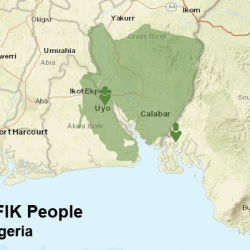
Jones classified the Oron (Òrò) as a coastal, riverine people belonging to the Lower Cross (Ibibioid) linguistic cluster. He emphasized shared linguistic structures, Ekpe traditions, and clan-based settlement patterns linking Oron, Ibibio, and Annang populations.
While Oron developed distinctive institutions through Atlantic trade, Jones understood Oron identity as a historically differentiated branch within a broader Ibibio civilizational sphere, rather than as an unrelated origin.
4.9 Calabar (Efik) and Ibibio Foundations
Jones consistently argued that the Efik of Calabar emerged from Ibibio-speaking hinterland populations migrating toward the Cross River estuary between the seventeenth and eighteenth centuries. He documented how Atlantic commerce transformed these groups into a centralized mercantile polity, without erasing their Ibibio linguistic and cultural roots.
4.10 Notes on Coverage and Limitations
Jones’s documentation followed administrative priorities rather than indigenous cartography. Many villages appear only indirectly through legal cases, trade references, or ritual descriptions. Nonetheless, the breadth of his work confirms extensive engagement with Ibibio territories across multiple ecological zones.
5. Methodology and Anthropological Approach
Jones practiced what may be described as administrative ethnography, drawing on court records, interviews with elders and ritual specialists, observation of festivals and markets, and mapping of trade routes and river systems. While his work predated later standards of participant observation, his long-term residence and repeated visits gave his studies unusual depth.
6. Contributions to Ibibio Historiography
Jones’s enduring contributions include:
Documentation of pre-colonial kinship, land tenure, and village autonomy
Analysis of economic transformation from slave trading to palm oil commerce
Insight into cultural continuity and institutional adaptation under colonial rule
7. Postcolonial Reassessment
Jones’s classifications sometimes froze fluid identities into rigid ethnic categories aligned with colonial governance. His depiction of Ibibio “statelessness” reflected a bias that equated political centralization with political maturity. Later misuses of his work—especially to deny Annang or Oron historical experiences—extend beyond his actual data.
From an Ikpaisong Ibibio perspective, Jones should be read as a recorder, not an ultimate authority.
8. Contemporary Relevance
Jones’s writings continue to influence academic research, land disputes, chieftaincy debates, and identity politics in Akwa Ibom and Cross River States. When read critically and dialogued with indigenous knowledge systems, his work remains a valuable historical resource.
References
Jones, G.I. The Ibo and Ibibio-Speaking Peoples of South-Eastern Nigeria. London: International African Institute. Jones, G.I. From Slaves to Palm Oil. Cambridge: African Studies Centre. Jones, G.I. The Trading States of the Oil Rivers. Oxford University Press. Jones, G.I. The Art of South-Eastern Nigeria. London. Afigbo, A.E. The Warrant Chiefs. London: Longman. Ekong, E.E. An Introduction to Rural Sociology. Uyo.
More
Ibibio, Efik names and meanings List of over 140 Ibibio, Efik names and meanings 1. Abasiakamauwemowo Means My Life Is In God’s Guard2. Abasiama Means…
List of Localities in Toro Local Government Area, Bauchi State, Nigeria BadikkoBakin KogiDogon KoliBarakin Yelwa RishiDababeDutsen HabeGanaGejiGurakaKalatuKwachchiyalKwamboLameMagamaMaraNafuta SutumiPakuruPalamaPeluPolchiRahamaRautaRauta GejiRibinaRibina EastRibina WestRinjim MukurRiriwan DalmaRishiRuhuSabon GariSangaTamaTauraTildeTilden FulaniToroTulaiTuluUnguwar GulawaWonu NorthWonu SouthZakshiZalauZarandaZomo Toro LGA Secretariat
List of Andorra Cities, Towns and Villages Andorra is divided into 7 parishes, each containing towns, villages, and hamlets. 1. Canillo Parish – Population: 4,633 Canillo (1,781)…
List of Botswana Villages and their Districts NGWAKETSE DISTRICT Kanye Ranaka Lotlhakane West Gasita Lorolwana Kgomokasitwa Pitseng Lekgolobotlo Seherelela Lotlhakane Sese Sesung Magotlhwane Segwagwa Manyana Dipotsana Diabo…