Internal Migration in Brazil: Causes, Impacts, and Transformations
Internal migration in Brazil has deeply shaped the country’s social, economic, and regional development. Have a look on its causes, history, impacts, and current trends.
Understanding Internal Migration in Brazil
Internal migration in Brazil refers to the movement of people within the national territory, whether between regions, states, or municipalities. Unlike international migration, this process does not change the country’s total population. However, it significantly reshapes the demographic, economic, and social structures of the areas involved. Over time, internal migration in Brazil has been driven mainly by economic opportunities and, to a lesser extent, ecological disasters and social inequalities.
From the colonial period to the present day, population movements have followed the country’s economic cycles. Wherever jobs, land, or better living conditions appeared, people followed. As a result, some regions experienced rapid growth, while others faced population loss, poverty, and social stagnation.
Main Causes of Internal Migration in Brazil
Economic Factors as the Primary Driver
Economic reasons are the most influential factor behind internal migration in Brazil. The capitalist production model tends to concentrate industries, investments, and infrastructure in specific regions, creating areas of opportunity alongside zones of exclusion. People often migrate in search of employment, higher wages, and improved living standards to meet their basic survival needs.
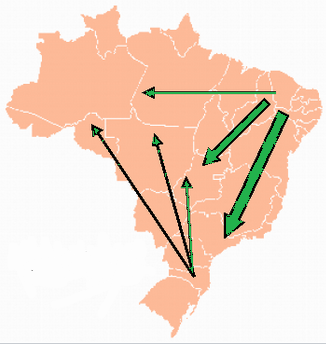
Historically, regions such as the Southeast became powerful magnets due to industrialization and job availability. São Paulo and Rio de Janeiro, for example, attracted millions of migrants throughout the 20th century, especially from poorer regions like the Northeast. These movements transformed Brazil’s urban landscape and labor market.
Ecological Disasters and Environmental Pressure
Environmental factors have also played a crucial role in internal migration in Brazil. Recurrent droughts in the Northeast, particularly in the semi-arid hinterland, forced thousands of families to abandon rural areas due to crop failure, water scarcity, and the absence of effective public policies. These ecological disasters made survival nearly impossible, turning migration into a necessity rather than a choice.
Floods, deforestation, and soil degradation in other regions have also contributed to population displacement, reinforcing the link between environmental vulnerability and migration.
Social Inequality and Access to Services
Another important cause is unequal access to public services. Education, healthcare, transportation, and commerce are far more available in urban centers than in rural or isolated areas. Many migrants move not only for jobs but also for better schools for their children, access to hospitals, and improved overall quality of life.
Historical Roots of Internal Migration in Brazil
Colonial Period and Early Economic Cycles
Migration across Brazilian territory has been associated with economic interests since European colonization. In the early colonial period, population movements were closely linked to agricultural production, particularly sugar cane in the Northeast. This region became Brazil’s first economic center, attracting labor and investments.
The Gold Cycle and Shifting Economic Centers
At the end of the 18th century, the decline of sugar production coincided with the discovery of gold in Minas Gerais and Goiás. This shift triggered a massive flow of people toward the interior, marking one of the earliest large-scale movements of internal migration in Brazil. Towns grew rapidly, trade expanded, and new urban centers emerged almost overnight.
The Rubber Cycle and Migration to the North
By the end of the 19th century, the rubber cycle transformed the Amazon region into a major destination for migrants, especially from the Northeast. Thousands of workers were drawn by the promise of wealth, although many faced harsh living and working conditions. This period left a lasting demographic and cultural legacy in the North of Brazil.
Internal Migration in Brazil During the 20th Century
Droughts and the Northeast Exodus
One of the most dramatic examples of internal migration in Brazil occurred in the 1960s, when severe droughts devastated the Northeast. The lack of agricultural alternatives, combined with limited social support, forced thousands of families to leave their homes in search of survival. Many migrated to urban centers in the Southeast, intensifying regional inequalities.
Industrialization and the Rise of the Southeast
From the mid-20th century onward, industrialization turned the Southeast into Brazil’s main economic hub. Cities like São Paulo became symbols of opportunity, attracting migrants from the Northeast, South, and even rural areas within the region itself. This wave of migration fueled rapid urban growth but also exposed structural problems such as housing shortages and unemployment.
Rural Exodus and Urban Challenges
The rural exodus intensified between the 1940s and 1990s. Mechanization of agriculture, land concentration, and poor rural infrastructure pushed millions toward cities. However, urban economies could not always absorb this growing labor force. As a result, informal employment expanded, and underemployment became common, especially in the service sector.
The lack of urban planning and investment led to the growth of slums and informal settlements, highlighting the social costs of unregulated internal migration in Brazil.
New Migration Patterns from the 1970s Onward
The March to the West and Brasília
From the 1970s, the North and Central-West regions gained prominence as migration destinations. This trend reflected earlier government policies such as the “March to the West,” initiated in the 1940s, and the construction of Brasília in 1960. The new capital attracted workers, civil servants, and businesses, accelerating regional development.
Agribusiness and Regional Development
The expansion of agribusiness in states like Mato Grosso and Goiás created new job opportunities, drawing migrants from various parts of the country. Improved infrastructure and incentives contributed to the growth of medium-sized cities, reducing pressure on traditional metropolitan areas.
Internal Migration Within Regions
Today, most internal migration in Brazil occurs within the same region rather than between distant regions. This shift reflects economic diversification, regional development, and improvements in local infrastructure. Interestingly, states that once experienced high emigration, such as Pernambuco, Bahia, Ceará, Paraíba, and Rio Grande do Norte, have become destinations for migrants.
Impacts of Internal Migration in Brazil
Economic Impacts
Internal migration in Brazil has been essential for economic growth, supplying labor to expanding industries and agricultural frontiers. However, it has also contributed to regional disparities, as wealth and infrastructure remain unevenly distributed.
Urban and Social Impacts
Rapid urbanization brought challenges such as housing shortages, transportation problems, and social inequality. At the same time, migration enriched Brazilian cities culturally, blending traditions, languages, and customs from different regions.
Demographic Changes
Migration reshaped population distribution, leading to aging populations in some rural areas and youthful, dynamic populations in urban centers. These changes influence public policy, labor markets, and social services.
1. What is internal migration in Brazil?
It is the movement of people within Brazilian territory, between regions, states, or cities, without crossing national borders.
2. What are the main causes of internal migration in Brazil?
The main causes are economic opportunities, environmental disasters such as droughts, and unequal access to services.
3. Does internal migration change Brazil’s total population?
No, it only redistributes the population across different regions.
4. Which region attracted the most migrants in the 20th century?
The Southeast, especially São Paulo, due to industrialization and job availability.
5. How did droughts influence migration?
Droughts in the Northeast forced rural populations to migrate due to lack of water, food, and employment.
6. What are current trends in internal migration in Brazil?
Today, migration is more regional, with growth in medium-sized cities and increased movement within the same region.
CAUSES OF THE COLLAPSE OF NATIONAL GRID The continued collapse of Nigeria’s national power grid is caused by a combination of technical, structural, and operational issues. Here…
List of ethnic and racial groups in Brazil 1. Official Racial Groups in Brazil Brazil officially recognizes five self-identified racial categories: Pardo (Mixed-race) – 45.3% People of mixed…
World Heritage Sites in Brazil UNESCO World Heritage Sites in Brazil are: Historic Town of Ouro Preto Historic Centre of the Town of Olinda Jesuit…
List of Brazil Languages List of the languages spoken in Brazil, grouped by status and usage Official / National Language Portuguese (Brazilian Portuguese) —…
Religion in Brazil by Region Religion in Brazil is a defining element of the country’s cultural identity and social structure. As the largest nation in…
Ethnicities by Region in Brazil Brazil is one of the most ethnically diverse countries in the world. This diversity did not happen by chance—it is…
List of Brazil’s most popular names Most popular names in Brazil, including meanings, cultural influence, and why these names have stood the test of time. Brazil…
List of Brazil’s Racial Groups A look at racial groups in Brazil based on the 2022 Census (IBGE), with percentages and population numbers Total population…
List of SNNP (Southern Nations, Nationalities and Peoples) Weredas and Zones Weredas and Zones of SNNP (Southern Nations, Nationalities and Peoples) Region, Ethiopia Gurage-Zone KebenaAbeshgeEzhaKokir GedabanoSodoMesekanMarekoEndegagnGumerChehaEnemorna EnerMuhor Na AklilGetaWelkiteButajira Hadiya-Zone MishaGibeLemoShashagoMisrak…