Italy’s 20 Regions by the Numbers: Population, Size and Density
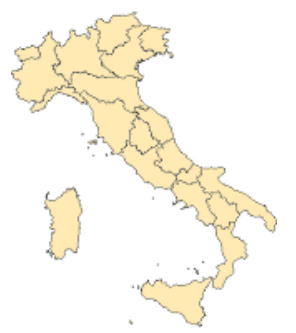
Italy’s 20 regions held 59,236,213 residents on 1 January 2021, spread over 302,068 km² and 7,904 municipalities, an average of 196 people per km². The averages hide a wide spread: Lombardy has about 418 people per km², Valle d’Aosta only 38. This article walks through the Istat figures by population, area, density and local government, and ends with the full cleaned table.
Population: nine regions hold 80% of Italians
Lombardy is the demographic heavyweight, with 9,981,554 residents, about 17% of the national total. Lazio (5,730,399) and Campania (5,624,260) follow, and the three together account for 36% of the population.
The next six regions, Veneto, Sicily, Emilia-Romagna, Piedmont, Puglia and Tuscany, each have between 3.7 and 4.9 million residents. Together with the top three, these nine regions hold about 80% of all residents. Below Tuscany (3,692,865) there is a sharp drop: the tenth region, Calabria, has 1,860,601.
At the other end, Valle d’Aosta has just 124,089 residents and Molise 294,294. Basilicata (545,130) and Umbria (865,452) are the only other regions below one million; Trentino-Alto Adige just clears it at 1,077,078.
Surface area: the biggest regions are not the most populous
Sicily is Italy’s largest region at 25,832.55 km², just ahead of Piedmont (25,386.70 km²), Sardinia (24,099.45 km²) and Lombardy (23,863.10 km²). Tuscany (22,987.44 km²) and Emilia-Romagna (22,444.54 km²) complete the top six.
Size and population rarely line up. Sardinia is the third largest region but has only 1,590,044 residents, barely more than Liguria (1,518,495), which is less than a quarter of its size at 5,416.15 km². The smallest regions are Valle d’Aosta (3,260.85 km²), Molise (4,460.44 km²) and Liguria.
Density: a crowded Lombardy and Campania, an empty Basilicata
The national average is 196 inhabitants per km², but only seven regions exceed it. Lombardy leads with 418, followed by Campania (411), Lazio (333), Liguria (280), Veneto (265), Puglia (201) and Emilia-Romagna (198).
Campania packs 5.6 million people into 13,670.60 km², a density only Lombardy beats. Liguria ranks fourth for density (280) with only 1.5 million residents, simply because its territory is so small.
The least dense regions are Valle d’Aosta (38 per km²), Basilicata (54), Molise and Sardinia (66 each) and Trentino-Alto Adige (79). Lombardy is roughly eleven times denser than Valle d’Aosta. Even Sicily, the largest region, sits below the national average at 187.
Municipalities and provinces: Lombardy and Piedmont are fragmented
Italy has 7,904 municipalities and 107 provinces. Lombardy has the most municipalities (1,506) and the most provinces (12), and Piedmont is second with 1,181 municipalities. The two regions together hold about a third of all Italian municipalities.
The contrast in size is striking. Piedmont’s 1,181 municipalities share about 4.3 million residents, an average of roughly 3,600 each. Lazio has 378 municipalities for 5.7 million residents, around 15,200 each. The national average is about 7,500 residents per municipality.
At the other end, Valle d’Aosta has 74 municipalities and a single province, Umbria has 92 municipalities and two provinces, and Basilicata, Molise and Trentino-Alto Adige also have just two provinces each. After Lombardy, the regions with the most provinces are Tuscany (10), Emilia-Romagna (9) and Sicily (9).
The full data
Regions are sorted by population, largest first. Population is the resident population on 1 January 2021.
Region
Residents
Surface (km²)
Density (inh./km²)
Municipalities
Provinces
Lombardy
9,981,554
23,863.10
418
1,506
12
Lazio
5,730,399
17,231.72
333
378
5
Campania
5,624,260
13,670.60
411
550
5
Veneto
4,869,830
18,345.37
265
563
7
Sicily
4,833,705
25,832.55
187
391
9
Emilia-Romagna
4,438,937
22,444.54
198
330
9
Piedmont
4,274,945
25,386.70
168
1,181
8
Puglia
3,933,777
19,540.52
201
257
6
Tuscany
3,692,865
22,987.44
161
273
10
Calabria
1,860,601
15,221.61
122
404
5
Sardinia
1,590,044
24,099.45
66
377
5
Liguria
1,518,495
5,416.15
280
234
4
Marche
1,498,236
9,401.18
159
225
5
Abruzzo
1,281,012
10,831.50
118
305
4
Friuli Venezia Giulia
1,201,510
7,932.48
151
215
4
Trentino-Alto Adige
1,077,078
13,604.72
79
282
2
Umbria
865,452
8,464.22
102
92
2
Basilicata
545,130
10,073.11
54
131
2
Molise
294,294
4,460.44
66
136
2
Valle d’Aosta
124,089
3,260.85
38
74
1
Italy
59,236,213
302,068.26
196
7,904
107
Source: Istat, resident population as of 1 January 2021.
List of Cameroon regions by population density Cameroon regions by population density, from most densely to the least populated are: RegionPopulation density (/km2)West97Northwest69Littoral67Far North54Southwest34Centre24North13Adamawa8South8East5 10 regions of…
List of Tanzania regions by population size. From most to least populated Tanzania regions by population size. From most to least populated RegionPopulationDar es Salaam4,364,541Mwanza2,772,509Mbeya2,707,410Kagera2,458,023Tabora2,291,623Morogoro2,218,492Kigoma2,127,930Dodoma2,083,588Tanga2,045,205Mara1,743,830Geita1,739,530Arusha1,694,310Kilimanjaro1,640,087Simiyu1,584,157Shinyanga1,534,808Manyara1,425,131Ruvuma1,376,891Singida1,370,637Mtwara1,270,854Pwani1,098,668Rukwa1,004,539Iringa941,238Lindi864,652Njombe702,097Zanzibar West593,678Katavi564,604Pemba North211,732Pemba South195,116Zanzibar North187,455Zanzibar South and Central115,588…
List of Cameroon regions by size of land Largest List of Cameroon regions by land area. From largest to smallest RegionArea (Km2)East109,002Centre68,953North66,090Adamawa63,701South47,191Far North34,263Southwest25,410Littoral20,248Northwest17,300West13,892 Smallest List of Cameroon regions…
Tigray Population Size by Zone and Wereda Population Size of Tigray by Zone and Wereda as of July 2023 Map of Tigray Region, Zone, WeredaPopulationTIGRAY Region5,838,000North Western…
Tanzania districts: Population, land size and capitals Districts of Tanzania by population, land size and capital DistrictPopulationArea (Km²)CapitalArumeru514,6512,896AkheriArusha281,60883ArushaBabati302,2534,969BabatiBagamoyo228,9679,842ChalinzeBariadi603,6049,777BariadiBiharamulo409,3898,938Biharamulo MjiniBukoba Rural394,0206,993BukobaBukoba Urban80,86880BukobaBukombe395,29810,842UshiromboBunda258,9302,782BundaChake82,998332Chake ChakeChunya205,91527,065MakongorosiDodoma Rural438,86614,004DodomaDodoma Urban322,8112,576DodomaGeita709,0785,880KalangalalaHai258,9352,369Hai MjiniHanang204,6402,918GananaHandeni248,6336,112ChanikaIgunga324,0946,788IgungaIlala634,924210IlalaIleje109,8471,935ItumbaIlemela264,873895IlemelaIramba367,0367,900SheluiIringa Rural245,03319,898IringaIringa Urban106,371160IringaKahama594,8919,461Kahama…
Ghana districts. Population, size of land area and capitals of districts The districts of Ghana and their population, land area and capitals are as follows: DistrictPopulationArea (km.²)CapitalAbura-Asebu-Kwamankese90,093324Abura-DunkwaAccra1,659,136185AccraAdansi East129,3251,380New EdubiaseAdansi West235,680828ObuasiAfigya Sekyere117,653770AgonaAfram…
Population Density of Balochistan Tehsils Balochistan’s tehsils in Pakistan, from most to least densely populated. Density is given in people per square kilometre (ppl/km²) and…
Burundi Population Density Population Density of Burundi ProvincePopulation (2008 census)Density (per km2)Eastern BurundiCankuzo228,873116.5Gitega725,223366.5Rutana333,510170.2Ruyigi400,530171.2Northern BurundiKaruzi436,443299.5Kayanza585,412474.7Kirundo628,256368.8Muyinga632,409344.4Ngozi660,717448.3Southern BurundiBururi313,102190.4Makamba430,899219.9Rumonge352,026326Western BurundiBubanza338,023310.4Bujumbura Mairie497,1665746.3Bujumbura Rural464,818438.6Cibitoke460,435281.5Muramvya292,589420.7Mwaro273,143325.3 Burundi Burundi is a country…
Algeria population density (sq mi) The density of Algeria population is 1 person per 36 sq mi. The density according to the provinces is as…
Algeria population density (km2) The density of Algeria population is 1 person per 14 km2. The density according to the provinces is as follows:…
10 states in Nigeria with the least population density States in Nigeria with the least population density are: TarabaYobeBornoNigerKwaraNasawaraAdamawaKebbiKogiBauchi List of states in Nigeria with the least population density…
Tanzania regions: Population, land area and capitals Regions of Tanzania by population, land area and capitals RegionPopulationArea (Km²)CapitalArusha1,694,31033,809ArushaDar es Salaam4,364,5411,393Dar es SalaamDodoma2,083,58841,311DodomaGeita1,739,530 GeitaIringa941,23856,864IringaKagera2,458,02328,388BukobaKatavi564,604 MpandaKigoma2,127,93037,037KigomaKilimanjaro1,640,08713,309MoshiLindi864,65267,000LindiManyara1,425,13146,359BabatiMara1,743,83019,566MusomaMbeya2,707,41060,350MbeyaMorogoro2,218,49270,799MorogoroMtwara1,270,85416,707MtwaraMwanza2,772,50919,592MwanzaNjombe702,097 NjombePemba North211,732574WetePemba South195,116332Chake ChakePwani1,098,66832,407Dar es SalaamRukwa1,004,53968,635SumbawangaRuvuma1,376,89163,498SongeaShinyanga1,534,80850,781ShinyangaSimiyu1,584,157 BariadiSingida1,370,63749,341SingidaTabora2,291,62376,151TaboraTanga2,045,20526,808TangaZanzibar…