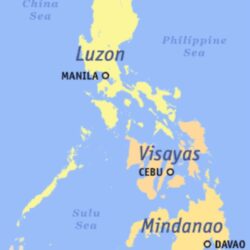
How local government in the Philippines is structured, from provinces and municipalities to barangays. Explore the 82 provinces and 17 administrative regions.
What are Local Government Units (LGUs)?
In the Philippines, government authority is divided into local government units (LGUs) to make administration more efficient. LGUs ensure that public services and governance are accessible at the provincial, city, municipal, and barangay levels.
The barangay is the smallest LGU in the country, while the province is the largest. As of 2022, the Philippines has 82 provinces.
Levels of Local Government in the Philippines
Provinces – The highest form of LGU. Each province is headed by a governor.
Cities and Municipalities – Found within provinces. Cities are generally more urbanized, while municipalities (towns) are less urban. Both are led by mayors.
Barangays – The smallest unit of government, often compared to villages or neighborhoods. Each barangay is headed by a barangay captain.
This structure ensures that governance reaches even the most rural areas of the country.
Administrative Regions in the Philippines
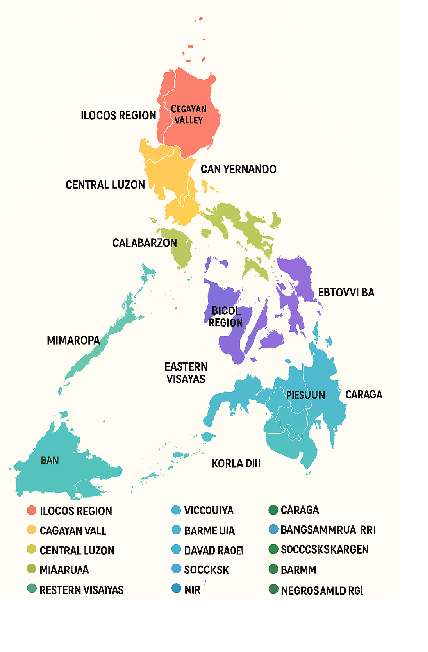
To organize government services, the Philippines is divided into 17 administrative regions. Most regions serve as groupings of provinces and do not have independent governments.
However, there are two exceptions:
Bangsamoro Autonomous Region in Muslim Mindanao (BARMM)
Cordillera Administrative Region (CAR)
These regions have their own autonomous governments with more power than standard regions.
List of Regions and Regional Centers
Here’s a full list of the 17 regions of the Philippines and their regional centers:
Region
Designation
Regional Center
Ilocos Region
Region I
San Fernando, La Union
Cagayan Valley
Region II
Tuguegarao, Cagayan
Central Luzon
Region III
San Fernando, Pampanga
CALABARZON
Region IV-A
Calamba City (de jure), Lucena City (de facto)
MIMAROPA
Region IV-B
Calapan, Oriental Mindoro
Bicol Region
Region V
Legazpi, Albay
Western Visayas
Region VI
Iloilo City
Central Visayas
Region VII
Cebu City
Eastern Visayas
Region VIII
Tacloban
Zamboanga Peninsula
Region IX
Pagadian, Zamboanga del Sur
Northern Mindanao
Region X
Cagayan de Oro
Davao Region
Region XI
Davao City
SOCCSKSARGEN
Region XII
Koronadal, South Cotabato
Caraga
Region XIII
Butuan
Bangsamoro Autonomous Region in Muslim Mindanao (BARMM)
–
Cotabato City
Cordillera Administrative Region (CAR)
–
Baguio
National Capital Region (NCR)
–
Manila
Negros Island Region (NIR)
–
Bacolod, Dumaguete
The Philippines has a four-tier LGU system: Provinces → Cities/Municipalities → Barangays.
There are 82 provinces (as of 2022) across the country.
The Philippines is divided into 17 administrative regions, but only BARMM and CAR have autonomous governments.
The barangay is the smallest LGU, while the province is the largest.
Philippines’ local government structure ensures that governance is both centralized through regions and localized through barangays, balancing national oversight with grassroots participation.
More
Top 25+ Resilience Centers in Israel: A Guide Discover all resilience centers in Northern and Judea-Samaria Israel. Full list with contact numbers, locations, and opening hours. Find your…
List of Philippine Government Departments and Agencies A directory of 441 government bodies including: Executive Departments (e.g., Department of Education, Department of Health) Constitutional Commissions (e.g., Civil…
Philippine Islands The major islands of Philippine are Luzon, Mindoro, Panay, Negros, Cebu, Samar, Leyte, Bohol, and Paragua (now Palawan). They appear…
Philippine Provinces per Region Provinces of Philippine grouped per region. Cordillera Administrative Region (CAR) Abra Benguet Ifugao Kalinga Mountain Province Apayao Region I –…
List of Belarus Districts and Regions Belarus is divided into six regions (voblasts), each comprising numerous districts that serve as the fundamental administrative units of local…
List of Azerbaijan Regions, Rayons and Cities Azerbaijan, a country strategically located at the crossroads of Eastern Europe and Western Asia, has a well-structured system of governance…
List of Namibia Regions and Constituencies Namibia is a unitary state divided into 14 administrative regions, each with its own regional council. These regions are further…
List of Uganda Districts, Regions and Subregions Uganda’s administrative classification into regions, sub-regions, and districts reflects the country’s diversity: administratively, culturally and geographically. Classification of Uganda into…
List of Chad regions and their capitals The 23 regions of Chad and their capitals are: Batha … Ati Chari-Baguirmi … Massenya Hadjer-Lamis … Massakory Wadi Fira…
List of Burkina Faso regions and capitals Burkina Faso has 13 states (regions) namely: Boucle du Mouhoun Cascades Centre Centre-Est Centre-Nord Centre-Ouest Centre-Sud Est Hauts-Bassins Nord Plateau-Central…
List of Cameroon regions and their capital The 10 regions of Cameroon regions and their capital are: RegionCapitalAdamawaNgaoundéréCentreYaoundéEastBertouaFar NorthMarouaLittoralDoualaNorthGarouaNorthwestBamendaSouthEbolowaSouthwestBueaWestBafoussam 10 regions of Cameroon Cameroon comprises ten regions,…
List of Ethiopia Regions, Zones and Weredas (Towns) Ethiopia administrative areas: Regions, Zones and Weredas (Towns) Tigray Region Tigray map North Western Tigray Zone Tahtay AdiyaboLaelay AdiyaboMedebay ZanaTahtay…
List of Ethiopia regions and capitals The regions and their capitals in Ethiopia are as follows: Addis Ababa (City) …. Addis Ababa Afar Region … Semera Amhara…