Official percentages to the estimated figures of revised salary table. The projections.
Non-Commissioned Ranks — +80% (Private to Staff Sergeant)
Rank
Current (est.)
Projected (Sept 2026)
Private
₦104,500
₦188,100
Lance Corporal
₦112,500
₦202,500
Corporal
₦115,500
₦207,900
Sergeant
₦125,500
₦225,900
Staff Sergeant
₦150,500
₦270,900
Warrant Officers to Colonel — +50%
Rank
Current (est.)
Projected (Sept 2026)
Warrant Officer
₦172,500
₦258,750
Master Warrant Officer
₦210,500
₦315,750
Army Warrant Officer
₦230,500
₦345,750
Second Lieutenant
₦195,000*
₦292,500
Lieutenant
₦280,000
₦420,000
Captain
₦325,000*
₦487,500
Major
₦380,500
₦570,750
Lieutenant Colonel
₦420,500
₦630,750
Colonel
₦580,500
₦870,750
Brigadier General to General — +30%
Rank
Current (est.)
Projected (Sept 2026)
Brigadier General
₦750,500
₦975,650
Major General
₦1,150,500
₦1,495,650
Lieutenant General
₦1,550,000*
₦2,015,000
General
₦2,150,000*
₦2,795,000
*Marked figures were midpoints of a range where sources conflicted.
A few caveats worth keeping in mind:
These “current” figures already vary by a lot between sources — the Defence Minister cited ₦49,000 rising to ₦100,000 as the baseline for the lowest rank, which doesn’t match the ₦104,500 figure some aggregators use, so the real starting point for Private is uncertain.
Officers’ pay in Nigeria typically includes housing, hazard, and other allowances on top of base salary, which aren’t reflected here.
The table is an estimate of scale, not a payslip.
A New Covenant: Inside Nigeria’s Landmark Military Pay Increase
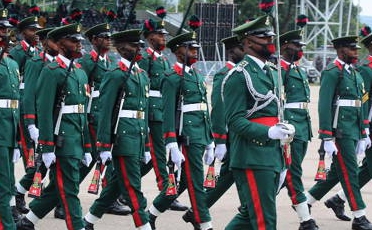
For soldiers who have spent years slogging through the Sambisa Forest, patrolling the highways of the North-West, and absorbing the daily grind of an insurgency that refuses to end, a government pay slip has rarely felt like recognition. That changed this week. President Bola Tinubu has approved a sweeping salary increase for Nigeria’s Armed Forces, one that pointedly rewards the men and women closest to the fighting the most.
The Numbers, Broken Down by Rank
The new structure, which takes effect from September 1, 2026, is deliberately graduated — the increase gets smaller the higher up the chain of command you go:
Private to Staff Sergeant — the junior combatants who bear the physical brunt of asymmetric warfare — receive an 80 per cent salary increase.
Warrant Officer to Colonel, spanning the mid-level backbone of the force, receive a 50 per cent increase.
Brigadier-General and above, up through the rank of General, receive a 30 per cent increase.
Defence Minister Christopher Musa had previously indicated that the baseline monthly salary for the lowest-ranked soldier has already climbed from ₦49,000 to ₦100,000 under this administration — a figure the new structure builds on further, though the full revised salary table has yet to be published.
Why the Inverted Curve Matters
This isn’t a flat, across-the-board raise. It’s a philosophy expressed in arithmetic. The soldiers taking the highest casualty risk — those manning checkpoints, clearing camps, and absorbing ambushes in the fight against terrorism, banditry, and kidnapping — get the steepest jump. Generals, who by rank already earn considerably more, get the smallest percentage bump.
Former Chief of Army Staff Tukur Yusuf Buratai called the structure a sign of strategic thinking, noting it prioritizes troops on the frontlines and directly recognizes those carrying the heaviest burden of Nigeria’s counter-insurgency operations. It’s an argument that pay reform, done right, can double as a morale strategy and a retention strategy at once — addressing the frontline fatigue that has long been a quiet crisis within the ranks.
The Fiscal Picture
The policy carries a real price tag. It lifts the Armed Forces’ annual wage bill from ₦660 billion to ₦924 billion — an additional ₦264 billion in yearly personnel spending, an overall increase of roughly 40 per cent to the total payroll. The government is framing this not as a cost but as an investment: a “vote of confidence,” in the words used to announce the policy, aimed at roughly 250,000 personnel across the Army, Navy, and Air Force.
Whether that framing survives contact with Nigeria’s tight fiscal environment — where the government is simultaneously managing debt servicing costs, subsidy reform fallout, and competing demands from other public sectors — will be a genuine test in the months ahead.
The Political Reception
The reaction from within the security and political establishment has been swift and largely favorable. The Northern Senators Forum and the Senate Committee on Defence both issued statements welcoming the move, describing it as a timely morale booster for troops confronting insecurity nationwide. Tinubu, in his own remarks, tied the decision to a broader security philosophy — that no nation can achieve development without first securing itself — and urged personnel to see the raise as a genuine gesture of national gratitude rather than a routine budget adjustment.
What Comes Next
The real test of this policy won’t be in the announcement — it will be in the September 1 rollout, and in whether the promised numbers translate into actual take-home pay for soldiers stationed far from Abuja’s press briefings. Nigeria has a documented history of gaps between promised welfare reforms and what filters down to frontline units. For a military stretched across multiple active theatres — the North-East insurgency, banditry in the North-West, and kidnapping crises nationwide — the credibility of this “covenant of care” will be measured less by the percentages announced this week and more by whether a private on patrol in Borno State sees the difference in his account come September.
Salary Structures in Nigeria Public Service The Nigerian public service salary system has a structured approach, organized into different consolidated salary structures tailored for specific sectors…
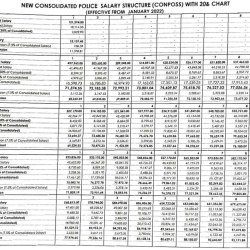
Nigeria Police salary Monthly salary of Nigeria Police according to Grade Level and Step based on the New Consolidated Police Salary Structure (CONPOSS)…
Nigeria president salary and allowances Nigeria president salary and allowances per month is N1,171,568.20 and N14,058,818.4 annually. President Bola Tinubu, like his predecessors, actually earn…
Who pays Nigeria president salary The president of Nigeria is paid monthly salary by the Accountant General of the Federation through IPPIS (Integrated Payroll and…
Nigeria president salary Nigeria president earns N1,171,568.20 monthly and N14,058,818.4 annually as salary and allowances. President Bola Tinubu, like his predecessors, actually earn…
Salary increase in Nigeria A Historical Perspective on Salary and Wage Reviews in Nigeria The history of Nigeria’s pay structure predates its political independence.…
DPO salary in Nigeria Police The salary of a DPO (Divisional Police Officer) in Nigeria police is ₦172,089.06 if the DPO’s rank is SP (Superintendent…
Nigeria Police salary chart Following the salary increase of 2010, the federal government extended the salary and allowance package to the military, para-military, police…
Nigeria police salary structure The Nigerian Police salary structure implemented in year 2023 describes the amount paid as salary to employees of the Nigerian…
What are the army ranks in Nigeria? Ranks and their badges (symbols of those ranks) in the Nigerian Army. Below is the list of Nigerian Army ranks…
Nigeria Army Corps of Military Police The history Nigerian Army Corps of Military Police (NACMP) dates back to the days of West African Frontier Force (WAFF).…
Nigeria Army Electrical and Mechanical Engineers Nigerian Army Electrical and Mechanical Engineers (NAEME) is responsible for the maintenance of electrical, mechanical, electronic, optical and electro-medical equipment…
Nigeria Army Intelligence Corps impact on Nigeria’s national interest or international obligation in support of world peace as provided for in the UN charter.…