Religion plays a central role in the history, identity, and social structure of Bosnia and Herzegovina. The country is widely known for its religious pluralism, where mosques, Catholic churches, and Orthodox churches often stand within close proximity—symbolizing centuries of shared space as well as periods of tension.
Major Religions and Beliefs
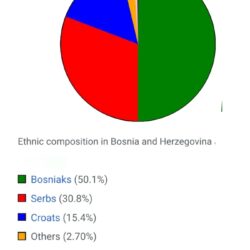
The most widely practiced religion in Bosnia and Herzegovina is Islam, followed by Christianity, which is primarily divided between Eastern Orthodoxy and Roman Catholicism. Religious affiliation is closely connected to ethnic identity:
Bosniaks are generally associated with Islam
Bosnian Croats are predominantly Roman Catholic
Bosnian Serbs are primarily members of the Serbian Orthodox Church
Almost all Muslims in the country follow Sunni Islam, mainly adhering to the Hanafi school of Islamic law and the Maturidi theological tradition.
Legal Framework and Religious Freedom
The Constitution of Bosnia and Herzegovina, as well as the constitutions of its two entities—the Federation of Bosnia and Herzegovina and Republika Srpska—guarantee freedom of religion. A state-level Law on Religious Freedom provides legal recognition and rights for religious communities.
In practice, the government generally respects religious freedom, particularly in ethnically mixed areas. However, in regions where one group dominates, members of minority religions have sometimes faced restrictions on worship or access to religious facilities.
Religious Composition (2013 Census)
According to the 2013 population census:
Islam – 51.3%
Eastern Orthodox Christianity – 30.7%
Roman Catholicism – 15.4%
No religion / Other beliefs – 2.6%
These figures broadly reflect the country’s ethnic distribution, though census data has been disputed by some political groups.
Religion in Daily Life
Religion remains important to many citizens. A Gallup poll found that 77% of people in Bosnia and Herzegovina consider religion an important part of their daily lives. However, levels of religious practice vary significantly:
A Pew Research survey reported weekly religious attendance among
31% of Muslims
10% of Orthodox Christians
54% of Catholics
For many people—especially Bosnian Muslims—religion often serves more as a cultural or ethnic marker than a daily practice, with observance focused on major life events such as births, marriages, and funerals.
Minority Religions and Communities
In addition to the three major religious traditions, Bosnia and Herzegovina is home to smaller communities, including:
Jews, numbering nearly 1,000 believers as of 2022
Protestants
Other Christian denominations
New religious movements, including a Slavic neopagan group established in 2011
The Jewish and Protestant communities are most concentrated in Sarajevo, reflecting the city’s long-standing multicultural character.
Impact of War and Migration
The 1992–1995 Bosnian War profoundly reshaped the country’s religious landscape. Ethnic cleansing and displacement led to large-scale population movements, resulting in greater ethno-religious separation:
Most Serbian Orthodox believers now live in Republika Srpska
Most Muslims and Catholics reside in the Federation
Although refugee returns peaked in the early 2000s, many communities remain demographically altered. Some towns have seen partial reversals through return migration, but overall patterns of segregation largely persist.
Regional Differences in Religious Practice
Religious observance tends to be stronger in rural areas than in major cities like Sarajevo or Banja Luka. Notably:
Catholic Croats in Herzegovina show higher levels of church attendance
Muslim communities in central Bosnia demonstrate stronger religious engagement
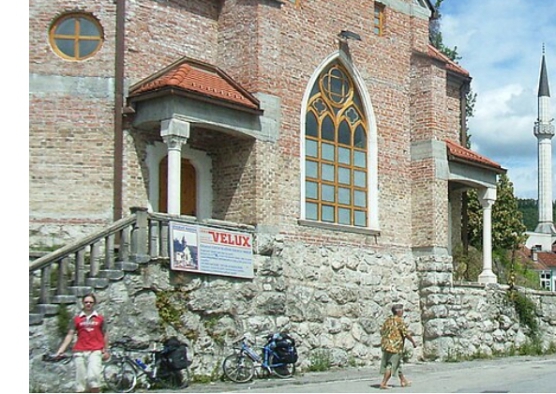
A Church in Bosnia and Herzegovina
Religious leaders from all three major traditions report increased interest among younger generations, especially those who grew up after the communist era and the war.
Education in Bosnia and Herzegovina Education in Bosnia and Herzegovina has a rich and layered history shaped by religious traditions, imperial rule, socialism, and modern…
Cuisine of Bosnia and Herzegovina The cuisine of Bosnia and Herzegovina is a rich reflection of the country’s history, geography, and cultural diversity. Shaped by…
Bosnia and Herzegovina Ethnic Composition Bosnia and Herzegovina is one of the most ethnically diverse countries in Southeast Europe. Its social fabric has been shaped…
Languages of Bosnia and Herzegovina Language in Bosnia and Herzegovina is closely tied to history, identity, and politics. While the country is linguistically unified in…
RELIGION IN ONDO STATE By religion, Ondo State people are mostly Christians (present day) while a sizable number of Muslims can be found in Ikare,…
Burundi religion Christians constitute 80–90% of Burundi population, going by estimates, with Roman Catholics representing the largest group at 60–65%. Protestant and…
What is the main religion in Burundi The main religion in Burundi is Christianity. Christians constitute 80–90% of Burundi population, going by estimates, with Roman Catholics representing…
Burundi population by religion In Burundi Christians constitute 80–90% of the population, going by estimates, with Roman Catholics representing the largest group at 60–65%.…
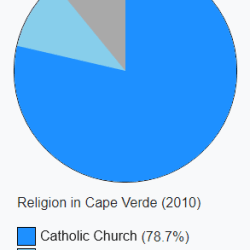
Cape Verde religion The vast majority of Cape Verdeans are Christians. This reflects centuries of Portuguese rule. Roman Catholics make up the single…
Cape Verde population by religion Majority of Cape Verdeans are Christians. Roman Catholics make up the single largest religious community, close to 80% as of…
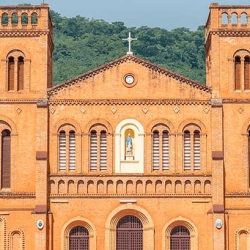
Religion in Central African Republic The main religion in Central African Republic is Christianity and majority of the Christians in the country are Roman Catholics.…
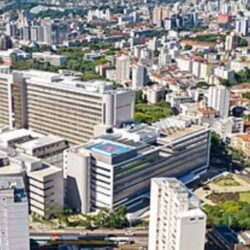
Religion in Brazil by Region Religion in Brazil is a defining element of the country’s cultural identity and social structure. As the largest nation in…
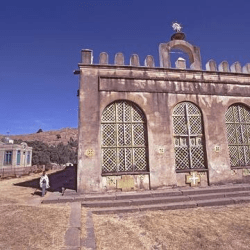
Aksum religion In the 4th century AD, under King Ezana, Christianity was declared the empire’s official religion. The introduction of Christianity resulted…
HOW TINUBU APPOINTS HEADS OF AGENCIES BY RELIGION President Tinubu’s approach to appointing heads of agencies in Nigeria has sparked conversations around religious and ethnic diversity. Tinubu has…