Which Languages Do Ukrainians Actually Speak? What the Latest Data Shows
Ukrainian is the only official language, but the real picture is more nuanced and changing fast. Here is what the census, recent surveys and language policy tell us as of late 2026.
Ukrainian is the sole official language of Ukraine. It is an East Slavic language in the Indo-European family. But “official” and “spoken at home” are different things, and in Ukraine the gap between them has been narrowing quickly since 2022. This post puts the old baseline numbers next to the newest survey data.
Start with the baseline: the 2001 census
The only census held since independence took place in 2001, so it remains the last full count. By ethnicity, Ukrainians made up 77.8% of the population and Russians 17.3%. The rest were small groups, including Romanians and Moldovans (0.8%), Belarusians (0.6%), Crimean Tatars (0.5%), Bulgarians (0.4%), and Hungarians and Poles (0.3% each).
Native language, which is not the same as the language spoken at home, tells a slightly different story:
Native language
Speakers
Share
Ukrainian
32,577,468
67.53%
Russian
14,273,670
29.59%
Romanian (incl. Moldovan)
327,703
0.67%
Crimean Tatar
231,382
0.48%
Hungarian
161,618
0.34%
Bulgarian
134,396
0.28%
Belarusian
56,249
0.12%
Armenian
51,847
0.11%
Other / not indicated
roughly 345,000
roughly 0.7%
Note the gap: 77.8% identified as ethnic Ukrainians, but only 67.5% named Ukrainian as their native language. Many ethnic Ukrainians, especially in the east and south, grew up Russian-speaking.
Other languages are spoken too: Rusyn, Romani, Yiddish, Crimean Tatar, Gagauz, Ukrainian Sign Language and others. Ethnologue lists around 40 minority languages and dialects in the country.
A century earlier: 1897
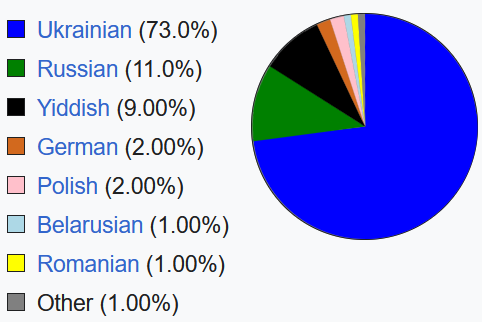
The Russian Imperial Census of 1897, covering the nine governorates in what is now Ukraine, recorded Ukrainian as the language of 73.0% of people, Russian 11.0% and Yiddish 9.0%. German and Polish had 2.0% each. It is a reminder that the linguistic map has shifted many times.
The 2009–2015 snapshot: a divided country
Polls in the years before the war showed a country split almost down the middle, with results depending heavily on how the question was asked:
October 2009 (FOM-Ukraine): 52% used Russian as their language of communication, 41% Ukrainian, 8% a mix.
August 2011 (Razumkov Centre): 53.3% used Ukrainian in everyday life and 44.5% Russian.
May 2012 (RATING): 50% called Ukrainian their native language, 29% Russian, 20% both.
December 2015 (Razumkov Centre): 60% named Ukrainian as native, 15% Russian, 22% both equally.
Methodology matters. A 2008 Gallup study offered the same questionnaire in Russian, Ukrainian and English without mentioning language. 83% of respondents chose to answer in Russian. That tells you about habit and comfort, not necessarily identity.
The shift since 2022
Every major survey since the full-scale invasion points the same way:
KIIS (February–March 2025): 63% speak Ukrainian at home, 13% Russian, 19% both, 5% something else. In 2020 the figures were 52% Ukrainian and 25% Russian.
Gradus Research (August 2025): 68% speak Ukrainian daily and 30% Russian. In 2022 the split was 53% to 46%.
Razumkov Center (April–May 2025): only 11% say they primarily speak Russian at home.
Rating Group (2024): 70% speak exclusively or mostly Ukrainian at home, up from 50% in 2015 and 46% in 2006.
The regional picture from KIIS is the most striking. The west was already at 85% Ukrainian-speaking in both 2020 and 2025. The centre rose from 62% to 68%. But the south jumped from 22% to 39%, and the east from 17% to 29%.
Surveys differ in wording and method (some count “mostly Ukrainian”, some separate out bilingual speakers), so the exact numbers vary by a few points. The direction does not.
What this means for the “Russian speakers” narrative
Russia has repeatedly cited the supposed oppression of Russian speakers as a justification for the invasion. The data does not support it. In a KIIS survey, 84% of Ukrainians said there is no systematic discrimination against Russian speakers, including 81% of Russian speakers themselves. In the Razumkov survey, 82% of those who speak mainly Russian at home had a negative view of Russia.
Language policy: from regional languages to the ombudsman
2012: a law let languages spoken by at least 10% of an oblast’s population become “regional languages” there.
2014: parliament voted to repeal it; the then acting president did not sign. The Constitutional Court ruled the 2012 law unconstitutional in February 2018.
2016: quotas for Ukrainian-language songs on radio and for 60% Ukrainian-language news and analysis on TV and radio.
2017: an education law requiring Ukrainian as the language of instruction, with exceptions for language classes taught in English or other EU languages. The Council of Europe has criticized parts of this approach as not adequately protecting minority language rights.
2019: the state language law, which created the Language Ombudsman.
June 2024: the Cabinet approved a list of endangered minority languages.
Enforcement is now visible in the numbers. The ombudsman’s office registered 2,227 complaints in the first three quarters of 2025, about 27% more than a year earlier, and 1,501 appeals in the first half of 2026. The ombudsman presented her 2025 annual report in May 2026, describing a shift toward systematic, state-led promotion of the language.
The debate is not one-sided. The ombudsman has said there is no legal basis to ban Russian-language versions of private websites, because the law allows other-language versions where Ukrainian is the main one. A 2025 Rating survey of young people found support for a total ban on Russian-language content falling from 49% to 40%, even as use of Ukrainian grew (as relayed in an analyst’s summary of that survey). Education policy also remains live: a bill registered in March 2025 would change language rules in schools, partly in connection with relations with Hungary.
English: the weak spot
A July 2023 Razumkov Center survey found almost 44% of Ukrainians knew no English at all, 26.9% knew some words, 19.2% could use it but not well, 7.5% could use it but not fluently, and just 1.1% were fluent. The EF English Proficiency Index tells a similar story of a middling result: in its 2025 edition Ukraine scored 524 and ranked 41st globally, a bit above the 485 global average. Younger Ukrainians do better, and IT workers score highest of any job group.
The old textbook line, that Ukraine is split between a Ukrainian-speaking west and a Russian-speaking east and south, is out of date. Ukrainian is now the main home language for roughly two-thirds of the country, Russian use is falling fastest in the regions that used Russian most, and a sizeable bilingual group persists. The open question is policy: how much to rely on mandates and bans, and how much on incentives and culture.
MARKETERS SPEAK ON REDUCING FUEL PRICE In Nigeria, petroleum marketers and government stakeholders have been in talks to reduce fuel prices, aiming to ease the economic…
Top 10 Largest Languages in Indonesia Indonesia is home to more than 700 living languages. Here is how the biggest ones rank, based on national data.…
List of Indonesian Languages Indonesia has over 700 languages. This linguistic variety constitutes approximately 10% of the world’s total languages. Languages of Indonesia Indonesian…
List of 527 Languages in Nigeria An alphabetical reference to 527 language names reported for Nigeria, with notes on linguistic classification and links to Ethnologue, SIL…