The Etymology and Historical Evolution of the Name “Uzbekistan”
The name Uzbekistan (meaning “Land of the Uzbeks,” combining the ethnonym Uzbek with the Persian locative suffix -stan, “place of”) carries centuries of Central Asian linguistic, political, and imperial history. While the modern nation-state emerged in the 20th century, the roots of its name trace back to medieval steppe confederations, Renaissance-era chronicles, and the shifting orthographies of Soviet and post-Soviet rule.
Early Attestations: From Steppe Confederations to Tarikh-i Rashidi
One of the earliest surviving literary appearances of the geographic term Uzbegistán dates to the 16th century in the Tarikh-i Rashidi (History of Rashid). Written in Persian between 1541 and 1546 by Mirza Muhammad Haidar Dughlat—a Chagatai-Mongol nobleman, military commander, and cousin to the Mughal emperor Babur—the chronicle documents the histories of the Khanates of Moghulistan and Central Asia.
At the time Mirza Haidar wrote, the term “Uzbek” was transitioning from a fluid political label for nomadic Kipchak-Turkic tribes of the Dasht-i Qipchaq (the Kipchak Steppe) into a territorial identity. Following the 1500–1501 campaigns of Muhammad Shaybani Khan, these nomadic confederations swept south into Transoxiana (Mawarannahr), conquering Timurid centers like Samarkand and Bukhara and laying the geopolitical foundations for the region’s eventual name.
The Four Etymological Theories of “Uzbek”
Despite its prominent place in Central Asian history, the precise linguistic origin of the root word Uzbek (historically rendered as Uzbeg, Özbeg, or Oʻzbek) remains a subject of scholarly debate. Historians and Turcologists generally organize the origins into four primary hypotheses:
The “Self-Master” Theory (Öz + Beg): This linguistic interpretation breaks the word into two Old Turkic elements: öz (or uz), meaning “self” or “one’s own,” and beg (or bek), a noble title meaning “lord,” “master,” or “chief.” Under this reading, Uzbek translates roughly to “independent lord” or “one’s own master,” reflecting the autonomous ethos of steppe warriors and tribal leaders.
The Eponymous Hero Theory (Oghuz Khagan): According to legendary genealogies of the Turkic peoples, the term derives from Oghuz Khagan (also referred to as Oghuz Beg), the mythical progenitor and cultural hero of the Oghuz Turks. Over centuries of oral transmission, Oghuz Beg is posited to have contracted phonetically into Uzbek.
The Tribal Leader Contraction (Oğuz + Bek): Closely related to the legendary theory, this strictly morphological explanation suggests a contraction of uğuz (from earlier oğuz, meaning “tribe” or “clan confederation”) combined with bek (“leader”), yielding the compound meaning “tribal leader” or “chief of the Oghuz.”
The Golden Horde Dynastic Theory (Özbeg Khan): The most widely cited historical explanation links the ethnonym to Sultan Ghiyas ad-Din Muhammad Özbeg (reigned 1313–1341), the longest-reigning and most powerful khan of the Golden Horde. Özbeg Khan institutionalized Islam as the state religion of the Ulus of Jochi and consolidated vast territories across the Eurasian steppe. His loyal subjects and military followers became known collectively as Özbegs (“people of Özbeg”), a political designation that persisted long after his death and migrated south with the Shaybanids in the 16th century.
The Unifying Linguistic Thread: Beg
A notable feature across all four competing theories is their shared second syllable. Whether derived from a personal name, a mythic ancestor, or a descriptive compound, the middle phoneme in Uz-bek / Uz-beg is universally cognate with the ancient Turkic aristocratic title beg (variants: bek, bey, bi). Historically used across Central Asia and the Ottoman Empire to denote a chieftain, governor, or nobleman, its presence anchors the ethnonym firmly within Turkic social and political hierarchy. (In historical texts, Uzbeg was the standard rendering; the modern spelling Uzbek emerged largely through phonetic devoicing of the final consonant, reinforced by Slavic and Western transliterations).
Script and Orthography: From Soviet Rule to Modernity
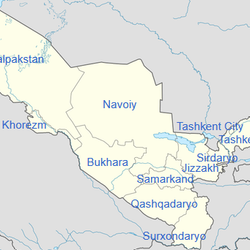
Before 1924, the territory of modern Uzbekistan was divided among the Emirate of Bukhara, the Khanate of Khiva, and the Khanate of Kokand (later Russian Turkestan), rather than existing as a single unified nation-state. When the Soviet Union delimited national republics in Central Asia in 1924, it formally established the Uzbek Soviet Socialist Republic (Uzbek SSR), cementing the name as a permanent political boundary.
During the Soviet era, the spelling and script of the country’s name reflected Moscow’s shifting language policies:
Era / Language
Script
Spelling
Notes
Pre-1928
Chagatai (Perso-Arabic)
اوزبیکستان
Traditional literary script used in Central Asia prior to Soviet reforms.
1928–1940
Yañalif (Soviet Latin)
Ozbekistan / Özbekistan
Introduced during the Soviet Latinization campaign to boost literacy.
1940–1991 (Uzbek)
Uzbek Cyrillic
Ўзбекистон (Oʻzbekiston)
Mandated in 1940; uses the distinct Cyrillic letter Ў (short U) to represent the rounded front-mid vowel [o].
1940–1991 (Russian)
Russian Cyrillic
Узбекистан (Uzbekistan)
The official union-wide administrative spelling, which served as the basis for the English spelling Uzbekistan.
1991–Present
Modern Uzbek Latin
Oʻzbekiston
Adopted following independence in 1991 (reformed in 1993/1995) to restore Turkic orthographic heritage.
Today, while the international community continues to use the English exonym Uzbekistan—inherited via the 16th-century Persian Uzbegistán and the 20th-century Russian Узбекистан—the nation officially identifies itself in its native tongue as Oʻzbekiston Respublikasi (The Republic of Uzbekistan).
Etymology and History Behind the Name Bangladesh The fascinating etymology and deep-rooted history behind the name Bangladesh — uncovering its linguistic origins, cultural symbolism, and evolution from…
OPEC: Formation, Membership, and Evolution The Organization of the Petroleum Exporting Countries (OPEC) was founded in September 1960 in Baghdad, Iraq with the signing of…
Taraba Historical and Attractive Sites Taraba State ranks as one of the pace-setters in the field of Tourism. Below are some very historical and attractive…
Evolution of Strategic Food Reserves in Nigeria The concept of strategic food reserves in Nigeria has evolved significantly, shaped by the country’s socio-economic needs, agricultural policies, and…
Uzbekistan Members of Parliament Uzbekistan’s parliamentary deputies, including their photographs, constituency information, political party affiliations and committee memberships. Akramova Zulayho AbdurazovnaParty affiliation: People’s Democratic…