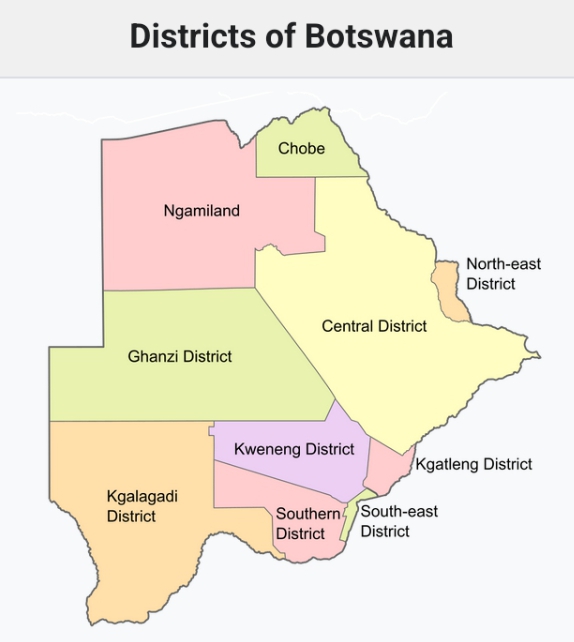
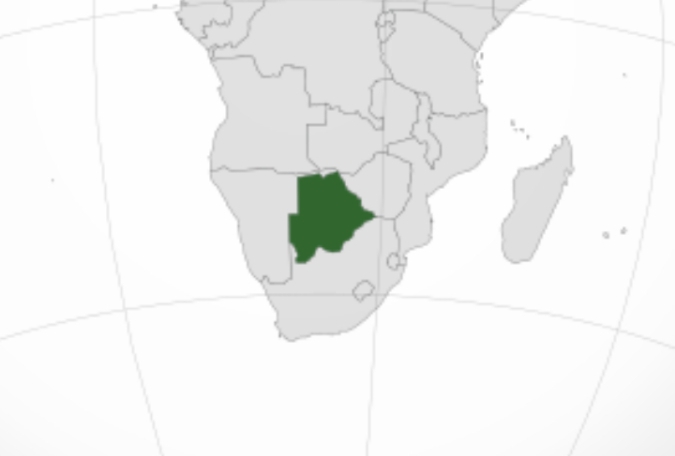
Botswana is a unitary state whose territorial administration is structured to balance centralized governance with effective local administration. The country is divided into administrative districts and urban districts, which together form the foundation of local government. These districts are administered through local authorities, including district councils, city councils, and town councils, which are responsible for service delivery, local development planning, and community administration.
At the core of this system are Botswana’s ten main administrative districts, each with a designated capital that serves as the administrative and political center of the district. These districts vary significantly in population density, geographic size, and economic activity, reflecting Botswana’s diverse physical and demographic landscape.
Administrative Districts of Botswana
Botswana has ten administrative (rural) districts, which collectively cover the majority of the country’s land area. These districts are primarily rural, although many contain large villages and growing semi-urban settlements.
Below is a detailed overview of each district, including its capital, population, land area, and population density based on recent census estimates.
Districts of Botswana: Capitals, Population, and Area
Administrative District
Capital
Population (2022)
Area (km²)
Population Density (/km²)
Southern District
Kanye
221,928
28,470
7.80
South-East District
Ramotswa
111,440
1,780
62.61
Kweneng District
Molepolole
387,983
31,100
12.48
Kgatleng District
Mochudi
121,882
7,960
15.31
Central District
Serowe
652,085
147,730
4.41
North-East District
Masunga
69,352
5,120
13.55
Chobe District
Kasane
28,743
20,800
1.38
North-West District
Maun
198,436
109,130
1.82
Ghanzi District
Ghanzi
56,555
117,910
0.48
Kgalagadi District
Tsabong
58,857
105,200
0.56
Key Characteristics of the Administrative Districts
Central District
The Central District is both the largest by area and the most populous district in Botswana. Its capital, Serowe, is one of the country’s most historically significant settlements and a major administrative hub. Despite its large population, the district has a relatively low population density due to its vast land area.
South-East District
The South-East District is the smallest by land area but one of the most densely populated districts. Its proximity to the capital city region contributes to its high population density, with Ramotswa serving as the administrative center.
Kweneng and Southern Districts
These districts contain some of Botswana’s largest traditional villages, including Molepolole and Kanye, which function as important cultural, political, and economic centers within their respective districts.
North-West and Chobe Districts
These districts are notable for their ecological significance and tourism-driven economies. Maun, the capital of the North-West District, is widely regarded as the gateway to the Okavango Delta, while Kasane, the capital of Chobe District, supports tourism linked to Chobe National Park.
Ghanzi and Kgalagadi Districts
These districts are among the least densely populated in the country. They are characterized by arid and semi-arid environments, pastoral livelihoods, and dispersed settlements, with Ghanzi and Tsabong acting as essential administrative and service centers.
Urban Districts in Botswana
In addition to the ten administrative districts, Botswana has seven urban districts, which are not classified as rural administrative districts but are instead governed by city or town councils. These urban districts include:
Cities
Gaborone
Francistown
Towns
Lobatse
Jwaneng
Selibe Phikwe
Orapa
Sowa Town
These urban districts are administratively separate from the rural districts and are designed to address the governance needs of densely populated urban and industrial areas.
Sub-Districts
To improve administrative efficiency, Botswana further subdivides some large districts into sub-districts. Sub-districts facilitate decentralized service delivery, especially in geographically extensive districts such as Central, Kweneng, and Southern. While they do not function as independent districts, they play a critical role in day-to-day governance and public administration.
More
Ghana districts. Population, size of land area and capitals of districts The districts of Ghana and their population, land area and capitals are as follows: DistrictPopulationArea (km.²)CapitalAbura-Asebu-Kwamankese90,093324Abura-DunkwaAccra1,659,136185AccraAdansi East129,3251,380New EdubiaseAdansi West235,680828ObuasiAfigya Sekyere117,653770AgonaAfram…
List of Botswana Villages and their Districts NGWAKETSE DISTRICT Kanye Ranaka Lotlhakane West Gasita Lorolwana Kgomokasitwa Pitseng Lekgolobotlo Seherelela Lotlhakane Sese Sesung Magotlhwane Segwagwa Manyana Dipotsana Diabo…
List of Ghana districts and capitals Ghana districts and capitals are: DistrictCapitalAbura-Asebu-KwamankeseAbura-DunkwaAccraAccraAdansi EastNew EdubiaseAdansi WestObuasiAfigya SekyereAgonaAfram PlainsDonkorkromAgonaSwedruAhafo Ano NorthTepaAhafo Ano SouthMankransoAhanta WestAgona NkwantaAjumako/Enyan/EsiamAjumakoAkatsiAkatsiAkwapim NorthAkropongAkwapim SouthNsawamAmansie EastBekwaiAmansie…
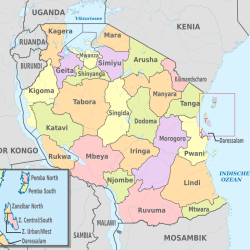
List of Tanzania districts and capitals The districts of Tanzania and their capitals are: DistrictCapitalArumeruAkheriArushaArushaBabatiBabatiBagamoyoChalinzeBariadiBariadiBiharamuloBiharamulo MjiniBukoba RuralBukobaBukoba UrbanBukobaBukombeUshiromboBundaBundaChakeChake ChakeChunyaMakongorosiDodoma RuralDodomaDodoma UrbanDodomaGeitaKalangalalaHaiHai MjiniHanangGananaHandeniChanikaIgungaIgungaIlalaIlalaIlejeItumbaIlemelaIlemelaIrambaSheluiIringa RuralIringaIringa UrbanIringaKahamaKahama MjiniKaragweKayangaKaratuKaratuKaskazini ‘A’MkokotoniKaskazini…
Tanzania districts: Population, land size and capitals Districts of Tanzania by population, land size and capital DistrictPopulationArea (Km²)CapitalArumeru514,6512,896AkheriArusha281,60883ArushaBabati302,2534,969BabatiBagamoyo228,9679,842ChalinzeBariadi603,6049,777BariadiBiharamulo409,3898,938Biharamulo MjiniBukoba Rural394,0206,993BukobaBukoba Urban80,86880BukobaBukombe395,29810,842UshiromboBunda258,9302,782BundaChake82,998332Chake ChakeChunya205,91527,065MakongorosiDodoma Rural438,86614,004DodomaDodoma Urban322,8112,576DodomaGeita709,0785,880KalangalalaHai258,9352,369Hai MjiniHanang204,6402,918GananaHandeni248,6336,112ChanikaIgunga324,0946,788IgungaIlala634,924210IlalaIleje109,8471,935ItumbaIlemela264,873895IlemelaIramba367,0367,900SheluiIringa Rural245,03319,898IringaIringa Urban106,371160IringaKahama594,8919,461Kahama…
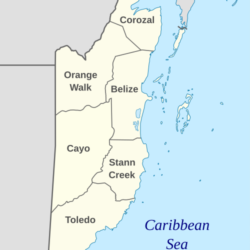
List of Belize Districts and Capitals Administrative Subdivisions in Belize Belize is divided into six main administrative districts. These districts serve as the highest-level subdivisions for…
List of Chad regions and their capitals The 23 regions of Chad and their capitals are: Batha … Ati Chari-Baguirmi … Massenya Hadjer-Lamis … Massakory Wadi Fira…
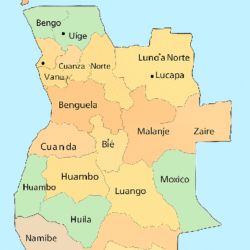
Provinces of Angola and Their Capitals Angola is administratively divided into 18 provinces, each with its own capital city. These provinces represent the country’s diverse geography,…
List of largest cities, towns and districts in Botswana The largest cities, towns and districts in Botswana according to population size are: RankNameCity, Town or DistrictPopulation 20221GaboroneGaborone246,3252FrancistownFrancistown103,4173MogoditshaneKweneng District88,0044MaunNorth-West District85,3505MolepololeKweneng…