How Nigeria’s New Tax ID Affects MDAs, Government Workers
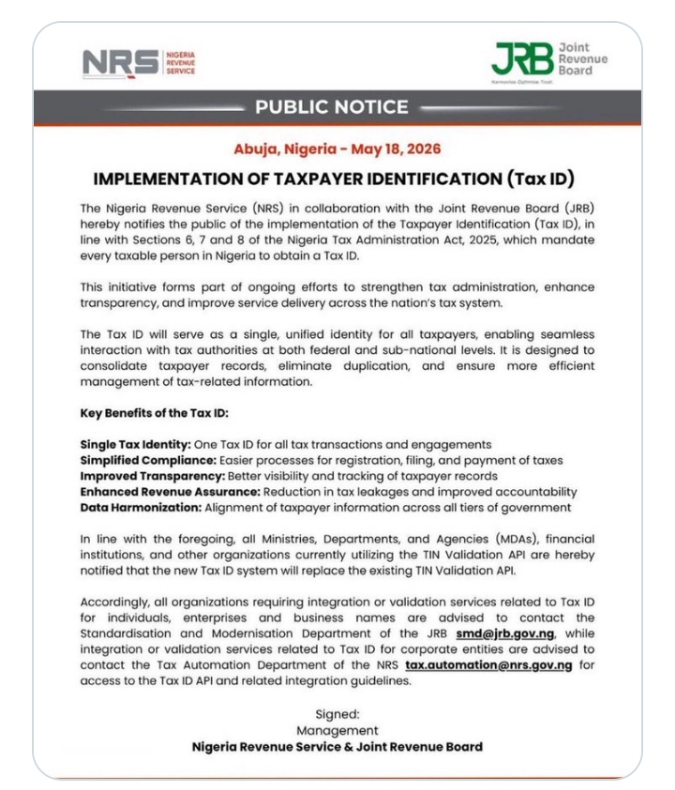
The newly introduced Taxpayer Identification (Tax ID) system by the Nigeria Revenue Service (NRS) and the Joint Revenue Board (JRB) is expected to have direct implications for government workers across ministries, departments, and agencies (MDAs).
Although the public notice focuses broadly on all taxable persons in Nigeria, federal civil servants are among the key groups likely to experience immediate operational and administrative changes under the new framework.
Mandatory Tax Identification for All Workers
Under the Nigeria Tax Administration Act, 2025, every taxable person is required to obtain a Tax ID. For federal government employees, this means that workers across MDAs will likely need to ensure their tax records are properly linked to the new unified system.
For many workers already registered under the previous Tax Identification Number (TIN) structure, the process may involve migration, validation, or synchronization of existing records into the new Tax ID database.
This could become a standard requirement for:
Salary administration
PAYE (Pay As You Earn) tax deductions
Pension processing
Promotion documentation
Government payroll verification
Access to certain public financial services
Integration With Government Payroll Systems
Federal government payroll platforms may eventually integrate directly with the new Tax ID infrastructure.
Because the Tax ID is intended to become a single identity for all tax interactions, payroll systems operated by MDAs could automatically validate employee tax information before salary processing or tax remittance.
This may help government agencies:
Reduce duplicate employee records
Detect inconsistencies in tax data
Improve PAYE remittance accuracy
Strengthen audit and compliance processes
Workers with incomplete or inconsistent tax records may be required to update their information to avoid administrative delays.
Easier Access to Tax Records
One likely benefit for federal workers is simplified access to tax-related information.
With a unified Tax ID, employees may eventually be able to:
Track tax payments more easily
Access consolidated tax histories
Verify tax clearance information faster
Reduce repeated registration processes across agencies
This could become especially useful for workers applying for:
Loans
Mortgages
Visa applications
Contract opportunities
Tax clearance certificates
Increased Transparency and Compliance Monitoring
The centralized structure of the Tax ID system could increase monitoring of taxpayer compliance across government employment structures.
Since employee records, tax deductions, and remittances may become more interconnected, discrepancies between salaries and declared tax obligations could become easier for authorities to identify.
For federal workers, this may lead to:
More accurate tax assessments
Faster identification of unpaid liabilities
Improved verification during audits
Reduced opportunities for duplicate or conflicting tax records
Possible Requirement During Employment Processes
Over time, the Tax ID could become a mandatory requirement during several employment-related processes within the federal civil service.
Potential areas where the Tax ID may be requested include:
New employee onboarding
Staff verification exercises
Promotion and conversion processes
Pension administration
Retirement documentation
Vendor and contractor registrations involving public institutions
While the government has not yet released detailed implementation guidelines specifically for workers, such integration is consistent with how centralized taxpayer systems operate globally.
Impact on Financial Institutions and Loan Processing
Because financial institutions are also affected by the transition from the old TIN Validation API to the new Tax ID system, federal workers may notice changes in banking and loan-related procedures.
Banks and lenders may eventually use the Tax ID to:
Verify income consistency
Confirm tax compliance status
Authenticate taxpayer identity
Process salary-backed loans
This could simplify verification processes but may also increase scrutiny of tax compliance records.
Digital Transformation of Public Administration
The introduction of the Tax ID is part of Nigeria’s broader push toward digital governance and centralized public administration systems.
For federal workers, the long-term impact may include more automated interactions between payroll systems, pension databases, tax authorities, and financial institutions.
If implemented effectively, the system could reduce bureaucracy, improve record accuracy, and streamline many administrative procedures tied to employment and taxation.
However, the actual experience for workers will depend heavily on how smoothly agencies implement the transition and how well taxpayer data is harmonized across government systems.
More
IPPIS beginnings, pilot MDAs Integrated Payroll and Personnel Information System (IPPIS) was conceptualized in October 2006 by the Federal Government as one of its reform…
How toxic air affects people Few things are as vital to sustaining human life as air. The average adult breathes more than 10,000 liters of…
IPPIS: Tax state I work in Kogi State, where will my tax be paid to and would the IPPIS apply the tax rate…
Benefits of Tax Payment Individuals, groups, organizations and corporate citizens may derive valuable benefits from imbibing a culture of tax compliance. The benefits derivable…
WACS (Workers Aggregated Credit Scheme) WACS (Workers Aggregated Credit Scheme) is a service from IPPIS (Integrated Payroll and Personnel Information System) that manages loan deductions…
Benue’s new Local Government Chairmen Benue State Governor, Hyacinth Alia, on Monday 7 October 2024, inaugurated 23 newly elected Local Government Council Chairmen of the…