The ethnic Composition of Benin Republic covering major ethnolinguistic groups, language families, regional distribution, and some historical context.
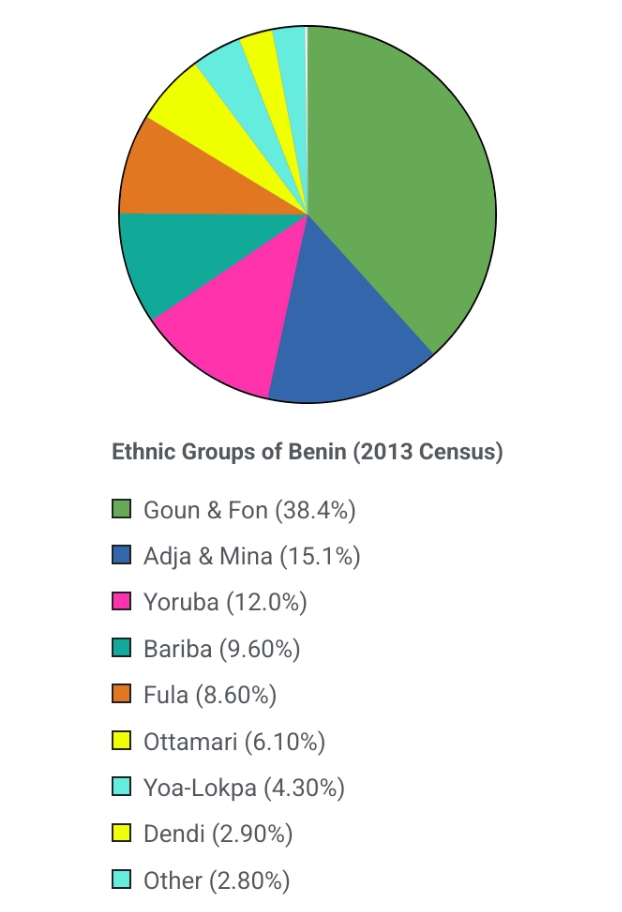
According to the most recent widely used data (as summarized in the CIA World Factbook), the ethnic breakdown of Benin’s population is approximately as follows (2013-estimate for ethnic shares):
Fon (and related groups): 38.4%
Adja (and related groups): 15.1%
Yoruba (and related groups): 12%
Bariba (and related groups): 9.6%
Fulani / Peul (and related groups): 8.6%
Ottamari (and related groups): 6.1%
Yoa-Lokpa (and related groups): 4.3%
Dendi (and related groups): 2.9%
Others / smaller groups / foreigners: remainder (together less than 5% in most aggregations)
In total, there are more than 50 distinct ethnic groups in Benin.
Given a 2023 estimated total population of roughly 14.2 million, these percentages continue to shape the demographic and cultural mosaic of the country.
Ethnolinguistic Families & Distribution
The ethnic groups of Benin belong primarily to major African language families, reflecting deep historical migrations, cultural evolution, and state formations. The main linguistic families represented include:
Niger–Congo (majority)
The largest share of Benin’s population belongs to Niger–Congo–speaking peoples.
Within Niger–Congo there are several sub-branches represented:
Kwa (Gbe languages): This includes the Fon, Adja, Gun, Aizo (Ayizo), and related groups. The Gbe-speaking (Kwa) peoples are concentrated in the southern and central parts of the country.
Benue–Congo subgroup: Represented by some Yoruba communities who settled in western/southwestern Benin, historically migrating from the core Yoruba regions (now Nigeria) centuries ago.
Gur (Voltaic) languages: Found mainly in the northern regions — groups such as the Bariba, Ottamari, Yoa-Lokpa and others.
Mande languages (to some extent): There are small Mande-derived groups (e.g. Busa/Boko), though many have been absorbed over time.
Nilo-Saharan (Songhai branch)
The Dendi people speak a Songhai-derived language. Historically, they descend from the territories of the Songhai Empire.
The Dendi are primarily located in the northern reaches along riverine zones and are also an important trading and cultural group there.
Afro-Asiatic (via migration / merchants — minor presence)
While not among the largest ethnic groups, there has historically been the presence of groups speaking Afro-Asiatic languages (e.g. traders), but these are far less significant compared to the Niger–Congo and Songhai linguistic communities.
This linguistic diversity illustrates how Benin sits at a crossroads of West African cultural and linguistic zones, blending southern forest and coastal traditions with northern savanna and Sahel influences.
Regional Distribution & Historical Context
Southern Benin (coast, south-central regions):
The south is dominated by Gbe-speaking peoples: notably the Fon (historically heirs of the old kingdom of Kingdom of Dahomey), Adja, Gun, Aizo, and some Yoruba communities. The capital of Dahomey, Abomey, lies in south-central Benin and remains a cultural heartland for the Fon.
The southern coastal cities also tend to be more densely populated; overall, over two-thirds of Benin’s population live in the south, while the northern savanna zone — though large in land area — remains more sparsely populated.
Northern and Central Benin (savanna, northern provinces):
Groups such as Bariba, Ottamari, Yoa-Lokpa, and Dendi are concentrated in various northern departments (e.g. Borgou, Alibori, Atakora, northern Donga).
The Bariba people (also called Baatonu) are among the largest northern groups; they historically built powerful regional polities (the old Borgu kingdom) and remain centered in northeastern Benin — around towns such as Nikki.
The northerners’ traditional livelihoods tend to lean toward pastoralism, agro-pastoralism, and trade — in contrast to the south’s agrarian and coastal trade orientation. For instance, Fulani (Peul) communities in northern and central Benin remain (or historically were) nomadic herders.
Formation of Ethnic Identities & Historical Migration:
The Fon people themselves emerged historically through the intermixing of the Adja (original immigrants from the Mono-Togo region) with local populations — over centuries forming the core of the Kingdom of Dahomey.
The Aja migrated into southern Benin around the 12th–13th centuries from the Mono River region (in present-day Togo).
Northern groups such as the Bariba and Dendi trace lineages to earlier migrations from areas of the Sahel and Sahelian savanna, with historical ties to larger polities and empires (e.g. the Songhai Empire for the Dendi) before colonial demarcations.
Cultural & Social Significance of Ethnic Diversity
The presence of more than 50 ethnic groups — with very different languages, traditions, historical backgrounds and livelihoods — makes Benin one of the most culturally diverse countries in West Africa.
This diversity reflects in languages: there are ~55 recognized languages spoken in Benin. The official language is French (a legacy of colonial rule), but indigenous languages such as Fon language (Gbe-family), Yoruba, Gur languages (e.g. Bariba), Dendi (Songhai), Fulfulde (Fulani) remain widely spoken, especially in rural and regional communities.
The variation in ethnicity also maps roughly onto differences in geography and ecology — coastal forest/savannah in the south, savanna and Sahel-adjacent zones in the north — which historically shaped different economic modes: agriculture, coastal trade, pastoralism, long-distance trade.
Historically, ethnic identity has influenced the formation of pre-colonial states and kingdoms (e.g. Kingdom of Dahomey), patterns of migration and resettlement (especially during and after the trans-Atlantic slave trade), and contemporary regional demographics.
Notes on Minority Groups and Complexity
While percentages above show the largest ethnic groups, many smaller communities and subgroups — some only a few thousand strong — contribute to the national tapestry, especially in northern and central Benin.
There are also ethnic/linguistic overlaps and blending: migrations, intermarriages, internal resettlements, trade, and colonial/post-colonial realignments have blurred lines between “pure” ethnic identities. This means that while statistics give a broad sense, lived identity is often more fluid.
Religious and cultural syncretism is another dimension: many groups combine traditional beliefs (e.g. indigenous religions, ancestor worship, forms of spiritual practices) with Islam or Christianity, depending on region, historical influences, and urban vs rural setting.
Benin remains a deeply diverse nation — ethnically, linguistically, culturally, and geographically. Its majority populations belong to the Niger–Congo language family (notably Gbe-speaking groups such as Fon and Adja, plus Yoruba and Gur-branch groups), but there are important minorities with origins in Nilo-Saharan (Songhai-derived Dendi) and other migratory or trade-linked backgrounds.
This diversity has shaped Benin’s history and continues to influence its social fabric, regional cultures, languages, and communal life.
List of ethnic groups in Kaduna Kaduna State comprises over 63 ethnic groups namely: Abinu (also known as Binawa) Ada (also known as Kuturmi) Adara (also known…
List of ethnic groups in Equatorial Guinea The ethnic groups in Equatorial Guinea are: 85.7% Fang6.5% Bubi3.6% Ndowe1.6% Annobon1.1% Bujeba1.1% other Languages in Equatorial Guinea Spanish and…
List of ethnic groups in ADDIS ABABA, Ethiopia The ethnic groups in ADDIS ABABA, Ethiopia are: SurmaSheTigrieTimebaroTsemayUpoWelaitaWerjiYemZeyeseZelmam Ethiopia ethnicity Ethiopia is a multi-ethnic country with over 80 different…
List of ethnic groups in GULELE, Ethiopia The ethnic groups in GULELE, Ethiopia are: Affar Agew—Awi Agew Hamyra Alaba Amhara Anyiwak Argoba Ari Arborie Bacha Basketo Bench…
List of ethnic groups in LIDETA, Ethiopia The ethnic groups in LIDETA, Ethiopia are: Affar Agew—Awi Agew Hamyra Alaba Amhara Anyiwak Argoba Ari Arborie Bacha Basketo Bench…
List of ethnic groups in KIRKOS, Ethiopia The ethnic groups in KIRKOS, Ethiopia are: Affar Agew—Awi Agew Hamyra Amhara Anyiwak Argoba Ari Arborie Bacha Basketo Bench Berta…
List of ethnic groups in ARADA, Ethiopia The ethnic groups in ARADA, Ethiopia are: Affar Agew—Awi Agew Hamyra Alaba Amhara Anyiwak Argoba Ari Arborie Bacha Basketo Bench…
List of ethnic groups in YEKA, Ethiopia The ethnic groups in YEKA, Ethiopia are: Affar Agew—Awi Agew Hamyra Alaba Amhara Anyiwak Argoba Ari Arborie Bacha Basketo Bench…
List of ethnic groups in BOLE, Ethiopia The ethnic groups in BOLE, Ethiopia are: Affar Agew—Awi Agew Hamyra Alaba Amhara Anyiwak Argoba Ari Arborie Bacha Basketo Bench…
List of Angola tribes, ethnic groups The ethnic groups, tribes in Angola are: Ambundu Bakongo Ovimbundu Ohvanyaneka Ovimbundo Tucokwe Ovanganguela Ovambu Cokwe Ovanga Oluyaneka List of…